How to Use AI-Assisted Research Without Making Fake Strategy
A research or brand strategy lead does not need to decide whether AI belongs in the process. It already is in the process. The decision that matters is narrower: which stage of the pipeline is an AI-generated read allowed to inform, and which stage requires a controlled experiment or real respondent data before it reaches a strategy deck.
Get that boundary wrong and a team presents a fluent AI-generated narrative as if it were customer evidence. The recommendation is wrong, and the business commits budget on an unvalidated hypothesis.
Why is the pressure showing up now?
AI is no longer a side experiment; it sits inside the everyday research workflow, where teams lean on it to analyze, report, prep data, and pull self-service insight. That shift does not eliminate research demand: the U.S. Bureau of Labor Statistics market research analyst outlook forecasts headcount growth for market research analysts and marketing specialists over the 2024-2034 span.
The real risk is narrower than "AI replaces researchers." It is that confident, fluent AI output gets treated as if it were evidence, and strategy gets built on top of it. As AI-assisted tools absorb more of the mechanical steps in a research job, whoever holds that job needs to sit nearer the actual call being made. That translates to sharper questions, more deliberate evidence choices, clearer caveats, and a more explicit call on what to trust.
What changes for the person doing the work?
Expertise used to live partly in access: knowing how to field a study, clean responses, and package a finding. AI-assisted tools weaken that access advantage. More people can now draft a survey, summarize a transcript, or generate an audience read on short notice.
Expertise is not going away, but it is now checkable in a way it wasn't before. When anyone can produce a plausible-sounding answer, the person worth paying is the one who can judge which answer to trust, and who can spot a narrative that is generic, poorly grounded, or beside the point for the decision at hand. Concretely: frame the question before handing it to AI, and take responsibility for the caveat once AI has produced something.
Build an evidence system, not an AI habit
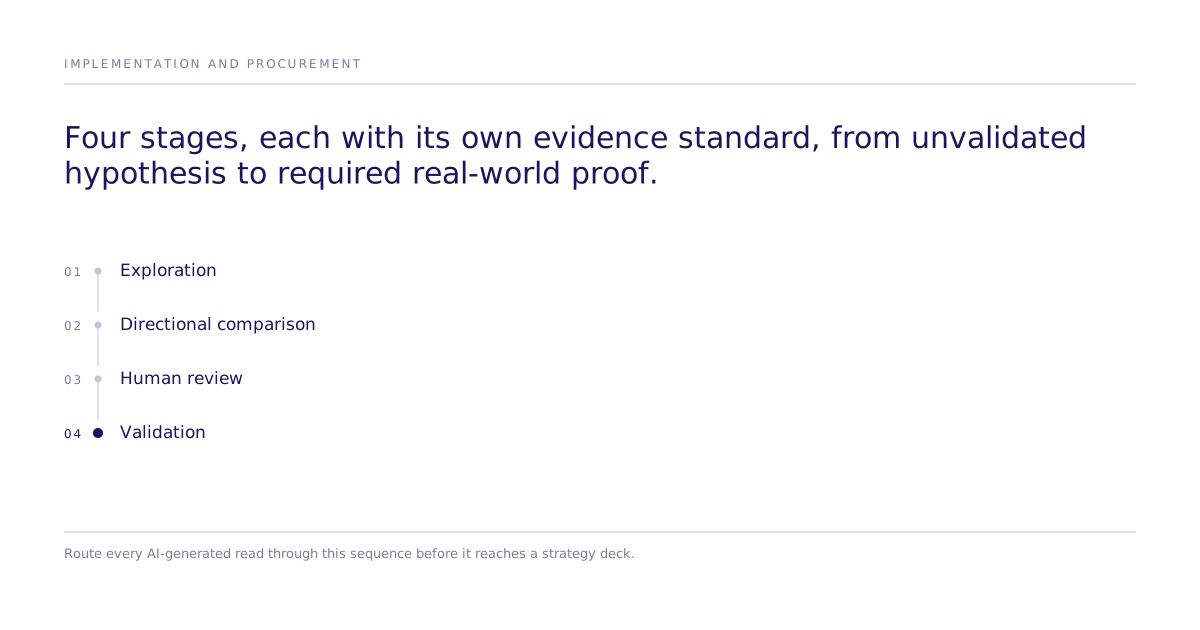
An evidence system spells out the scope AI-assisted work is permitted, flags what needs a human's eyes, and sets which claims need real validation before reaching a decision-maker.
| Stage | What it's for | Evidence standard |
|---|---|---|
| Exploration | Generate hypotheses, objections, and alternative framings | None required; treat output as a starting list, not a finding |
| Directional comparison | Compare options quickly with an AI-assisted or simulated read | Directional only; label as unvalidated before it informs a decision |
| Human review | Check audience definition, prompt neutrality, source grounding, business context | A person, not a model, signs off |
| Validation | Confirm the finding with real respondent data, behavioral data, or a controlled experiment | Required before an expensive or public decision moves forward |
The AI-assisted output is not the value on its own. The value is a disciplined path from a question to a safer decision, with a defined point where the read either passes to a real test or gets set aside.
Where a controlled experiment fits
Once an AI-assisted exploratory pass has produced hypotheses or objections, those hypotheses still need to be checked against something more than a fluent model output. Subconscious tests the specific action a team is considering as a controlled experiment against a defined audience, using causal experimentation and discrete-choice-style testing to compare actions. That gives the directional read a causal comparison and a confidence interval before it informs a decision.
Framed against the table above: an AI-assisted exploratory pass earns a place in "Exploration." A controlled experiment is what "Validation" looks like when the decision is expensive or the claim will be made publicly. Directional comparison and human review still sit between the two.
What mistake makes this dangerous?
Danger shows up when a team builds an audience read out of stereotypes or one fluent model output, then hands it over as if it were research. Deadline pressure is usually the trigger: the model returns something confident-sounding, a closing slide is still needed, and nobody stops to ask where the confidence came from. Credibility here rests on one distinction: can the team tell its own output apart from actual evidence? A model is capable of drafting something useful. Judging whether that draft holds up for the decision at hand is not something it can do.
Limits belong inside the deliverable itself. Name what the AI-assisted work supported, name what it left unproven, and name the validation step that comes next. Spelling this out doesn't undercut confidence; it signals discipline, because the reader can see exactly where the confidence stops and starts.
What to do this week
- Pick a real project with a live decision attached to it.
- Write the business decision in one sentence.
- Define the audience and the risk level of getting it wrong.
- Use an AI-assisted read only for the exploratory stage.
- Go through the output by hand and flag what holds up, what's shaky, and what's unsafe to use.
- Present the answer with an explicit caveat and a named next validation step.
Repeat that weekly for a month. The payoff is not a longer tool list; it's a research system that visibly moves fast, exercises judgment, and holds a quality bar, with a clear record of which stage each finding passed through.
Limitations
This is a process discipline, not a shortcut. Subconscious does not replace the human review step; checking audience definition, prompt neutrality, and source grounding remains a person's job. Subconscious also does not generate the initial exploratory hypotheses or objections a team starts from; that work happens before a controlled experiment is worth running. A team still has to decide, stage by stage, what evidence a given claim needs.
Next step
Before a directional read reaches a strategy deck, name the stage it came from and the stage it still needs to pass through. Where that path leads to a controlled experiment, Subconscious's research approach explains how the causal comparison works, how we work covers the process end to end, and a live demo walks through a specific decision. Read more about Subconscious for the broader context.