PyMC in the Browser: Why Deployment Architecture Isn't a Causal Validity Signal
A vendor demo opens a browser tab and runs a Bayesian model with no server and no install. The demo is real. A modeling stack like PyMC can now run entirely client-side. The question a technical evaluator scoping a causal-experimentation or Bayesian-modeling purchase should ask is different: does removing the server change whether the experiment underneath produces a valid causal estimate? It does not.
What changed to make browser-native modeling possible?
Running a full Python data-science stack in a browser tab, rather than a stripped-down subset, depends on a Python distribution compiled to WebAssembly and run inside the page (Pyodide). That runtime lets a modeling library like PyMC substitute a pure-Python execution mode for its usual C or JAX compilation path, at a cost in raw sampling speed. It does not change what the model is doing: the same priors, likelihood, and sampler run, just on the visitor's own machine instead of a shared server.
The three-step pattern behind the demo
The deployment mechanics are simple, worth naming because that simplicity is what makes them easy to over-credit:
- Declare packages. A page-level configuration block lists the libraries to install into the browser session, the modeling library, its tensor backend, and a plotting library, pulled the same way as from the Python Package Index.
- Embed the model. Python code defining priors, a likelihood, and a sampling call sits directly in the page markup. A beta-binomial coin-flip model, an uninformative Beta(1,1) prior on the probability of heads, a Binomial likelihood connecting n observed flips (for example, n=10) to k observed heads (for example, k=5) through that probability, and No-U-Turn sampling to draw from the posterior, is a common first example. The same structure applies to conversion-rate and other binary-outcome estimation problems.
- Open the page. No server deployment step exists. The runtime installs packages on load and the model is ready to sample.
Three steps, no infrastructure ticket. That is a real reduction in setup friction for a demo, a workshop, or a teaching notebook. It says nothing about whether the beta-binomial model, or whatever model replaces it in a real evaluation, was the right experimental design for the decision being made.
Where is this pattern genuinely useful?
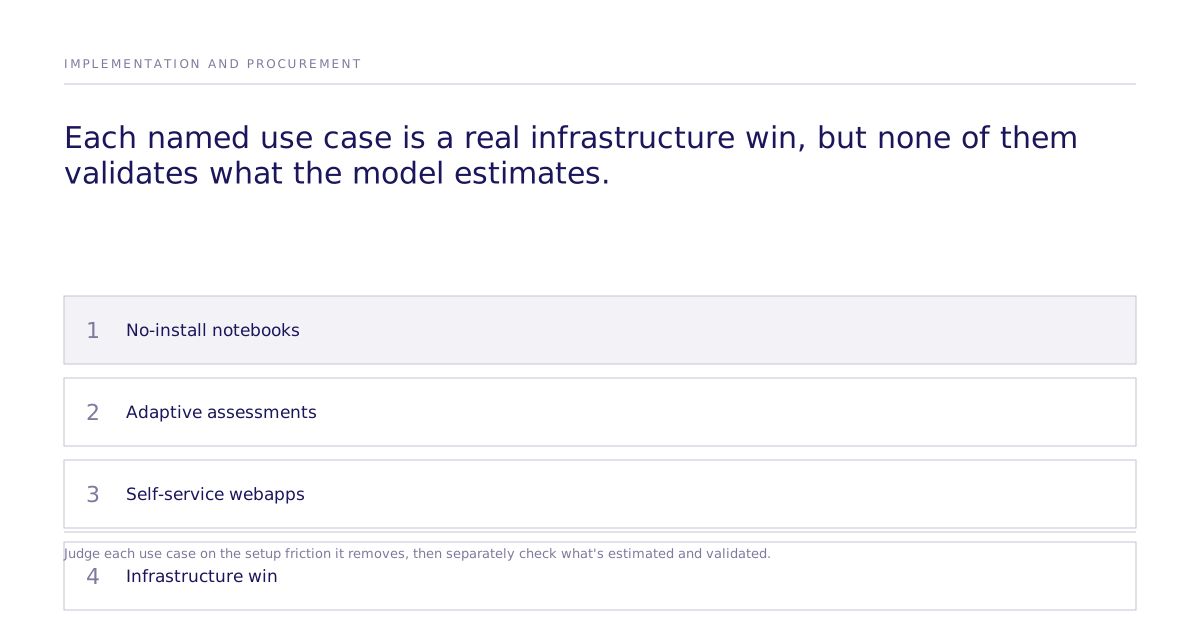
Browser-native execution has concrete uses beyond the demo: interactive notebooks that run without a local Python install, adaptive assessments that select the next question from a live posterior instead of maintaining two parallel implementations (one for batch fitting, one for real-time serving), and self-service webapps where a hierarchical model is fit against data a visitor uploads directly, without backend infrastructure. Each is an infrastructure win: fewer moving parts, faster iteration.
None of them is a substitute for asking what the model is estimating and how that estimate was validated. A workshop notebook that lowers the bar to trying Bayesian modeling is not the same claim as a procurement-ready causal estimate.
The evaluation checklist this replaces
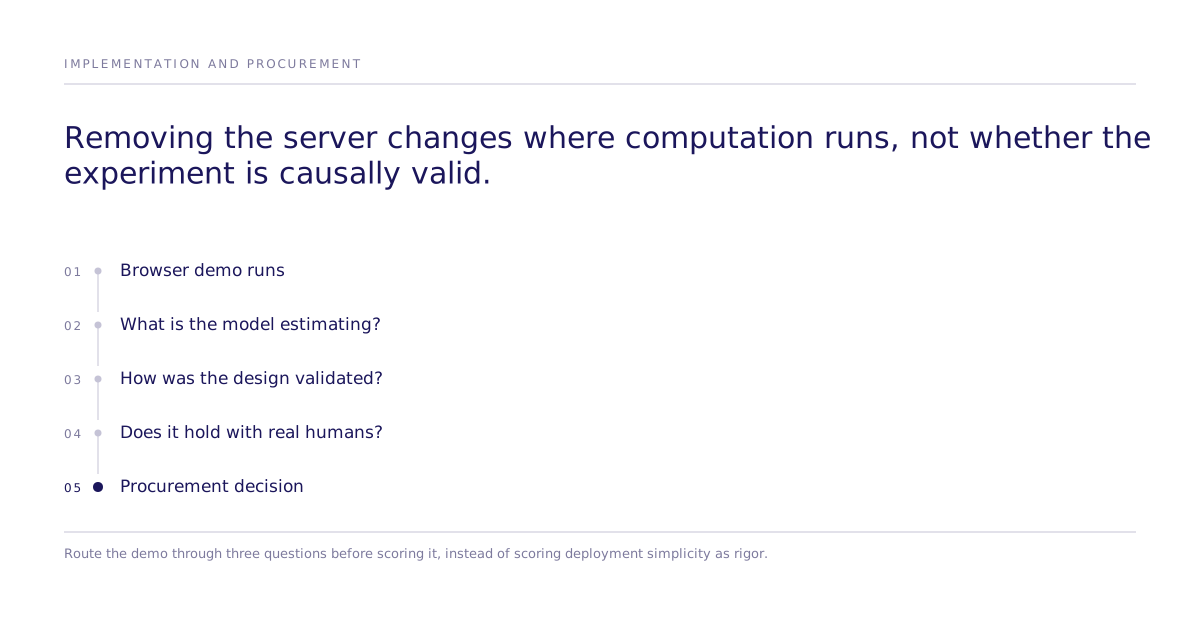
When a deployment-architecture claim shows up in a vendor evaluation, three questions separate it from an evaluation of the underlying method:
- What is the model estimating, and is that a causal effect or a correlational fit?
- How was the experimental design validated, independent of where it runs?
- Can the same causal question move from a simulated setting to real-human testing without changing what's being measured?
Subconscious is built around that third distinction. /research and /how-we-work document how that experimental design and validation process work, separate from any question of client-side versus server-side execution.
Limitations
A scope claim only counts if it says what it excludes. Subconscious does not ship a client-side or browser-embedded modeling runtime, and this is not a comparison of Subconscious's architecture to any browser-based Python runtime. No accuracy, speed, or cost claim about either approach should be read into this article.
What to check before you sign off
If a deployment-architecture claim is part of what's being evaluated, ask the vendor to show the experimental design and validation evidence on its own terms, separate from the demo. If that evidence exists only as "it runs in the browser," the procurement decision is being made on infrastructure, not on causal validity.