From Report Builder to Research Strategist: Restructuring the Research Workflow
A research operations lead restructuring the team's workflow around AI has one decision to make: which business questions fast, directional AI-assisted exploration can answer, and which need a controlled experiment that produces a measurable causal effect with a confidence interval before anyone acts. Get that boundary wrong, and budget, pricing, or positioning decisions move on a hypothesis that was never tested against real behavior.
What has AI actually changed in this job?
AI has moved from novelty into daily research work. Drafting, summarizing, first-pass analysis, and quick directional reads are now routine. None of that removes the underlying demand for research judgment; it changes what gets rewarded. Market research analyst employment is projected to grow between 2024 and 2034 (U.S. Bureau of Labor Statistics). The mechanical parts of the job (formatting, first-draft summarizing, slide production) are getting faster and cheaper, which means the people doing that work have to move closer to the decision itself: sharper questions, better evidence choices, clearer caveats.
The failure mode this restructuring prevents
The costly mistake is not AI-assisted exploration, but mistaking it for proof. A fast, unvalidated read can surface hypotheses, objections, and comparisons. It cannot, on its own, tell a team whether the answer is safe to act on for an expensive or public decision. That judgment belongs to a human, and it must happen before the read reaches a stakeholder deck or an external claim.
Two evidence tiers, not one blended step
Two tiers, each with its own claim to make, keep fast methods safe:
| Evidence tier | What it produces | When it's appropriate | Risk if misapplied |
|---|---|---|---|
| Directional exploration | Hypotheses, objections, comparisons, a fast read on which options look worth pursuing | Early framing, narrowing options, stress-testing a strategic assumption | The read gets presented as a proven answer instead of a starting point |
| Controlled validation | A measured causal effect with a confidence interval, or confirmation from recruited real-human participants | The decision is expensive, public, or will be defended to stakeholders outside the research team | The team ships a hypothesis as if it had already been tested |
Naming a failure mode in advance is what lets a team catch it before it happens. The tiers are sequential. Skipping the second one to save time on a decision that warrants it is the failure this structure exists to prevent.
Where does a controlled experiment fit?
Subconscious operates at the validation tier. It runs a controlled discrete choice experiment against a modeled population and returns a causal effect for the tested action, with a confidence interval rather than a single fluent-sounding number. That distinction matters for a research operations lead because it changes what the team can defend in a room: not "this seemed compelling" but "this action moved the outcome by a measured amount, within this range of uncertainty."
The same causal question can move from a simulated comparison to real-human validation when the decision is big enough to warrant recruited participants, without being rebuilt from scratch: the audience brief, the tested action, and the outcome measure carry over.
A working process for the transition
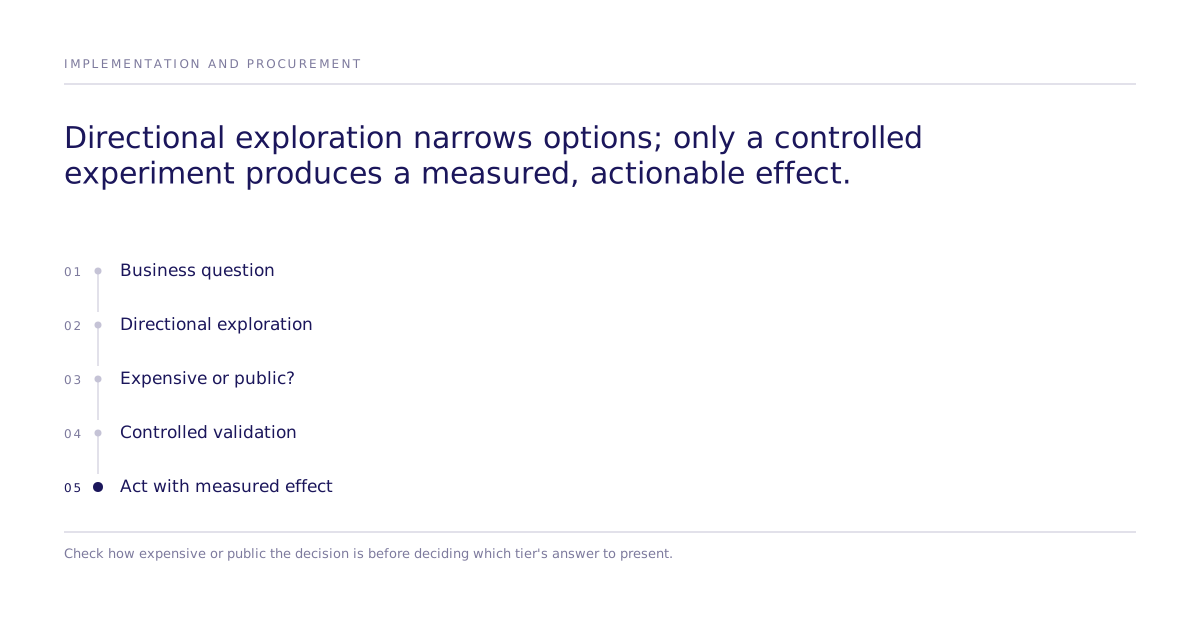
- Write the business decision in one sentence: what changes depending on which way the evidence points.
- Define the audience and name the risk level: how expensive or how public is being wrong.
- Use directional exploration to narrow the options worth testing.
- Have a person review the audience definition, question framing, and business context before treating a directional read as an answer.
- Route decisions that are expensive or will be stated externally to a controlled experiment, and to recruited real-human validation when the decision demands it.
- Present every result with its evidence tier attached: what was tested, what was not, and what needs a higher tier of proof.
What does this restructuring not do for you?
A method's limits belong on the record next to what it does well. A controlled experiment does not decide the business question, does not write the audience brief, and does not decide when a decision is expensive or public enough to require full validation. Those calls stay with the research operations lead. The platform gives the team a measured effect to act on, not the judgment behind it.
The first move this week
Do not restructure the whole function at once. Take one live decision with a real deadline, write its one-sentence business question, and run it through both tiers: a fast directional pass to narrow the options, then a controlled comparison with a measured effect for the option closest to committing budget. Bring that decision into a working session once it's framed this way, and see how the two tiers connect end to end before scaling the process across the rest of the team's roadmap.