Where to Put the Human-Review Gate When AI Drafts Market Research
An insights leader who lets an AI draft move straight into a pricing deck or a launch brief has made a quiet decision: that draft is now evidence, not a hypothesis. The decision that matters is where the human-review and validation gates sit in the workflow, and which evidence tier each AI-assisted output is allowed to support before it reaches a business decision.
The Failure Mode Is Not the AI Draft Itself
The risk in an AI-assisted research workflow is rarely a bad answer; it is an ungated output treated as a finished finding. A generic or ungrounded read ships into a pricing, launch, or positioning decision, the budget commits on its authority, and the mistake surfaces after the spend is gone. A researcher who forwards every AI draft without a review step loses the credibility that made the research function decision-relevant.
Before adding an AI step to a research pipeline, ESOMAR's buyer guidance recommends pressing any AI-based service on how its outputs are grounded, validated, and disclosed to the people who will act on them (ESOMAR, 20 Questions to Help Buyers of AI-Based Services for Market Research and Insights). The same questions work internally: which layer is this output allowed to support, who reviewed it, and what would it take to move it up a tier.
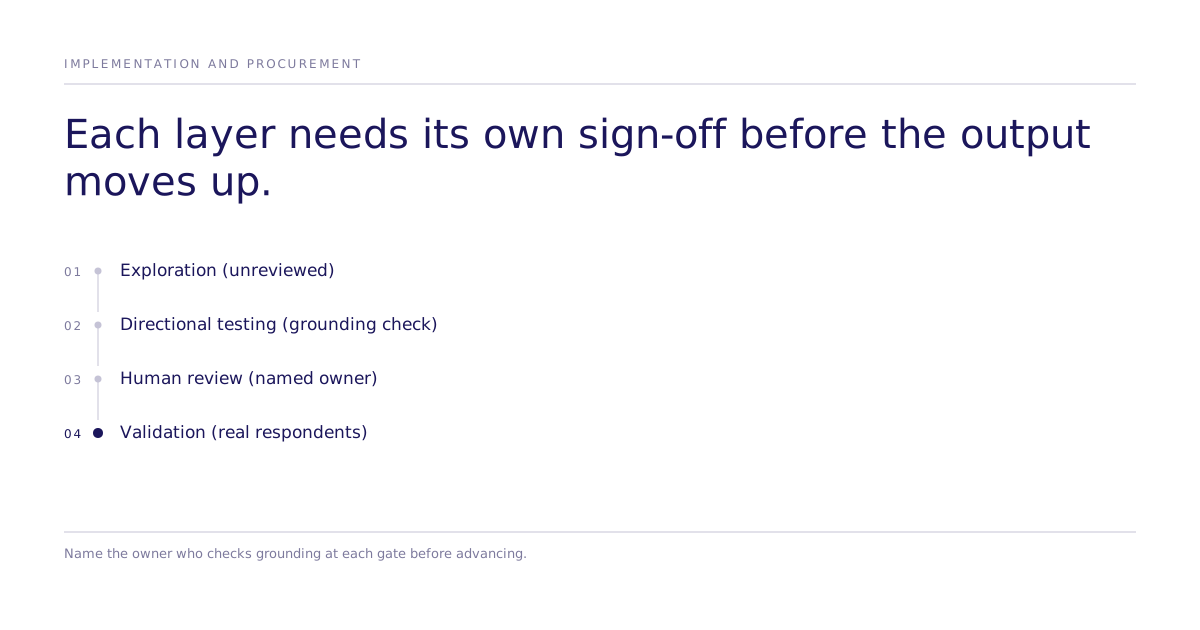
What Are the Four Layers of the Evidence System?
A workable version separates AI involvement into four layers, each with a different evidence tier and a different owner:
| Layer | What happens | Who signs off | What it proves |
|---|---|---|---|
| Exploration | Generate hypotheses, objections, alternative framings | Researcher, unreviewed | Nothing on its own, only raw material |
| Directional testing | Run a focused comparison across options in a controlled simulated setting | Researcher checks grounding and neutrality | A directional read, before committing budget |
| Human review | Confirm the audience is defined correctly, the prompt is not leading, sources hold up, and the finding fits the business question | Named research owner | Whether the directional read is safe to act on |
| Validation | Field the question with real respondents or behavioral data | Research owner, sometimes an external panel partner | Whether the finding holds outside the simulation |
The value in this chain is not the AI output by itself. It is the recorded, repeatable path from a question to a decision the business can defend later.
Where Does a Simulated Experiment Belong in the Chain?
This is the layer where Subconscious fits: turning an AI-generated hypothesis into a controlled, directional read by running randomized experiments against a simulation of the market, compared against alternatives, before anyone commits budget. That is a distinct evidence tier from an AI-drafted summary or an unstructured chat answer.
The distinction matters because a simulated read and a validated read answer different questions. A simulation compares how options perform against each other under controlled conditions; validation confirms the answer holds when real people respond.
The Validation Gate: When to Move to Real Humans
Not every decision needs the same evidence tier. A concept test that only informs an internal brainstorm can stop at directional testing. A pricing change, a launch claim, or anything stated publicly needs the next gate: real-human validation on the same causal question, not a different one improvised for the fielding stage. Subconscious can test or validate studies with real human participants, which lets a team move from a simulated experiment to fielded validation without rewriting the question the business is trying to answer.
That handoff has a boundary. A simulated experiment run this way is a pre-commitment read, not a replacement for fieldwork, and it is not a recruitable respondent pool. Any AI-assisted step in the chain, whether it runs on Subconscious or a general-purpose model, needs a named human owner who checks grounding, neutrality, and fit to the decision before the output leaves the research team.
What to Change This Week
- Pick one live project with a real decision behind it.
- Write the business decision the research needs to answer in one sentence.
- Assign each AI-assisted step to one of the four layers above, in writing.
- Name the human owner who checks grounding and neutrality before any output moves up a tier.
- Decide in advance which findings require real-human validation before they can be stated externally.
Repeat the exercise on the next study. The output is not a shorter report. It is a documented evidence chain a stakeholder can question and a researcher can defend.
Where Does This Fit in a Broader Research Program?
Directional simulated testing is one stage in a larger research program, not a standalone shortcut. Teams evaluating where it fits can review worked examples in case studies or map their own evidence layers onto a live decision in a working session. A walkthrough of the process end to end shows how the four layers connect in practice.