How CPG Teams Should Gate Packaging Redesigns Before Production
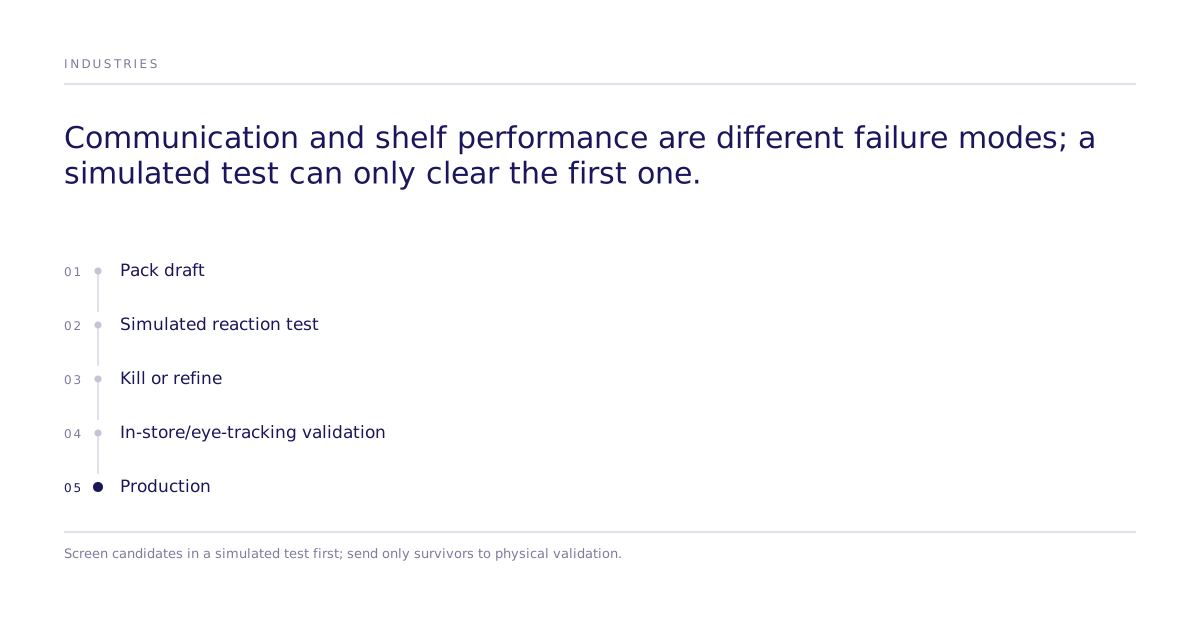
A CPG brand or innovation team should advance a packaging redesign only after it passes two different tests. The first asks whether buyers understand the brand, variant, benefit, and difference. The second asks whether the pack earns attention and holds up under physical retail conditions. Publishing what a test cannot do is what lets a buyer trust what it can do. A controlled experiment on a simulated population can answer the first question. It cannot establish the second.
The retailer window makes a weak choice costly
Most package redesigns do not increase sales, and some reduce them, according to Designalytics research on package redesign failure. An analysis of the U.S. CPG industry likewise found that innovative package changes can move sales in either direction rather than produce a certain lift (The Sales Effect of Innovative Package Changes: Evidence from the U.S. CPG Industry).
The downside is not limited to production expense. A losing design can consume trade spend and a retailer listing window that another concept might have used. The useful decision is therefore not which design looks strongest in a review. It is which option deserves capital, a trade presentation, and physical validation.
What's the difference between package communication and shelf performance?
A pack has to communicate brand, variant, benefit, and difference in approximately two seconds of shelf attention. It can pass that test in isolation and still disappear beside competing products. It can also draw attention while leaving buyers unclear about the product, variant, or benefit. These are different failure modes and need different evidence.
| Decision gate | Question it answers | Evidence still needed |
|---|---|---|
| Simulated communication and reaction test | Which alternative changes buyer understanding and reaction under a controlled comparison? | Actual shelf attention, sensory response, and physical retail behavior |
| In-store, sensory, or purchase-data validation | What happens when the surviving pack meets real retail conditions? | Evidence tied to the final channel, placement, promotion, and launch plan |
The first gate should remove alternatives that fail their basic communication job. The second should determine whether the survivors work on shelf. Neither gate should be described as evidence supplied by the other.
How do you use a causal test to decide what packaging advances?
Subconscious runs controlled experiments on a simulated population to compare packaging or product-concept alternatives on communication and reaction. The study should hold the buyer question steady across the alternatives: which change affects understanding or response, for whom, and in what direction?
A buyer checking a study needs to know exactly who answered it. The simulated audience is constructed for simulation, not recruited from real-human respondents.
For CPG decision teams, a practical test begins with these choices:
- Define the production or retailer decision before evaluating creative work.
- Compare the current pack and each candidate against the same communication and reaction measures.
- Reject alternatives that obscure the brand, variant, benefit, or intended difference.
- Send only the surviving alternatives to in-store observation, sensory work, or purchase-data validation.
When the decision needs another proof point, Subconscious can test or validate the same causal question with real human participants. That step checks the simulated result without turning it into automatic proof of shelf performance or market sales.
Read the result within its boundary
The misses belong next to the hits, on the same page as the result. A simulated comparison does not reproduce actual shelf attention or eye-tracking behavior, replace sensory testing, in-store observation, or purchase-data validation, or establish that a launch will increase sales.
A number without its limits functions as marketing rather than as a result. Confidence intervals, differences between buyer groups, and automated recommendation outputs depend on the study design; they are not standard outputs of every packaging comparison. The result is evidence for which alternative should receive further validation, not a substitute for it.
Structure the next packaging decision
Start with the pack or concept choice, the behavior that would distinguish a winner, and the physical evidence still required before launch. Review the research approach, then book a walkthrough to frame a controlled comparison around a specific packaging decision.