How Government Communications Teams Can Pre-Test Public Messaging Before Launch
A government communications team can compare draft messages before launch using appropriately designed human research or an optional modeled screen. Specify eligible citizens, excluded or poorly covered groups, languages, accessibility needs, and the measured endpoint. Generated responses do not establish public opinion or entitlement uptake.
Why Does This Decision Carry More Risk in the Public Sector?
Weak public messaging can obscure eligibility, prevent access to services, or undermine trust. The risk depends on the policy, audience, and action asked of citizens. Do not assume the public sector always has thinner evidence than private brands; inspect the campaign's actual sources and constraints.
What Causes Public Messaging to Ship Untested
Three planning questions to answer before choosing a method:
Procurement and timing. Confirm the applicable purchasing route, approvals, recruitment feasibility, and deadline. GAO-15-8, published in 2014, examines supplier-capability research and procurement documentation at selected U.S. agencies. It does not establish delays in citizen-message research or show that campaigns launch before research contracts clear.
Citizen access. Define consent, privacy, accessible participation, and language needs with the relevant research and legal owners. Sensitive questions can require additional care; that does not make citizen research unavailable.
Policy and topic facts. Agree on the approved entitlement, eligibility, exceptions, and required disclosures before drafting or testing. Research preferences cannot authorize a policy statement or repair incorrect policy facts.
Where Does Subconscious Fit In?
A scoped Subconscious comparison may test generated responses to defined alternatives. Random assignment supports the tested contrast under design assumptions. Label whether the endpoint is generated comprehension, trust, or stated intent; each differs from actual application or uptake.
Confirm two things for the proposed study:
- Which population, languages, and relevant traits are supported and what independent evidence establishes their coverage. A generated profile does not prove citizen representation.
- Which human recruitment, accessibility, instrument adaptation, and fielding services are included. Document changes between a modeled screen and citizen research rather than assume a fixed audience and question.
A modeled comparison can inform revisions when coverage fits. Direct citizen work and appropriately sampled polling can also begin first. The required evidence follows comprehension, coverage, stakes, and the action, rather than whether the campaign will cite a public number.
What a Faster Testing Cycle Looks Like
Costs and timelines depend on jurisdiction, procurement, recruitment, language, accessibility, and design. Scope those dependencies against the launch date before selecting a testing sequence.
| Human research | Optional modeled screen | |
|---|---|---|
| Timing | Can run as discovery, iterative comparisons, or final checks where feasible | Depends on preparation, model access, design, review, and revisions |
| Response source | Actual participants, with sampling and measurement limits | Generated responses conditional on model and design |
| Useful role | Comprehension, experience, population estimates where sampling supports them, or identified contrasts | Comparing specified alternatives and generating questions for independent testing |
| Requires | Appropriate population access, consent, instrument, assignment where needed, and analysis | Documented coverage, permitted inputs, design, and matched validation plan |
An Illustrative Six-Week Workflow
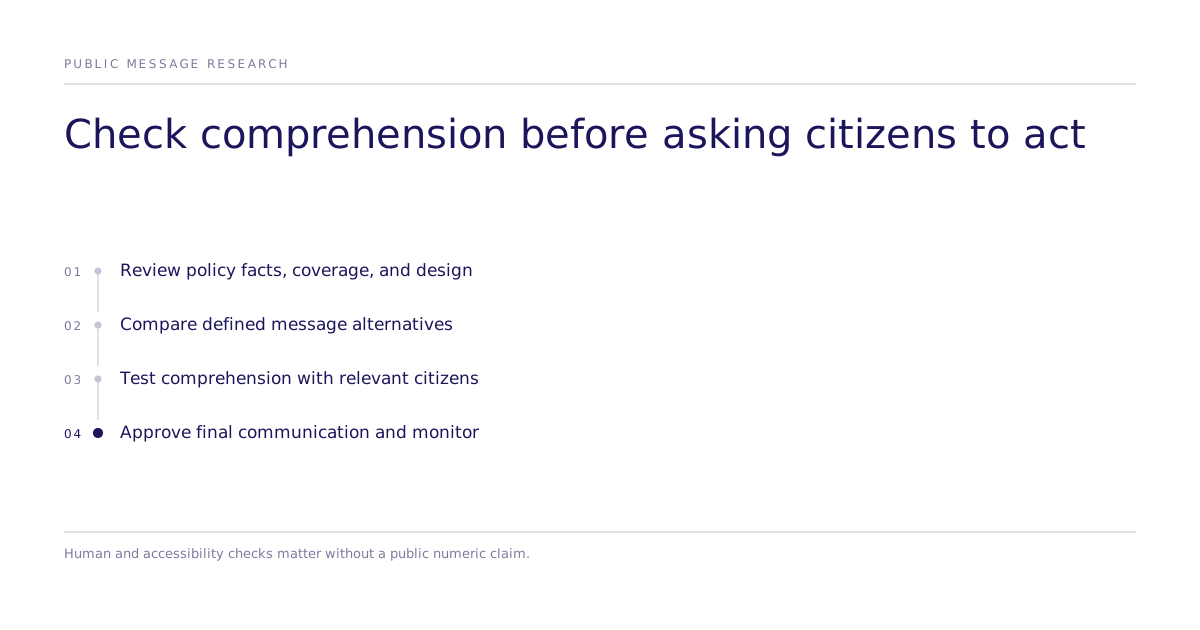
This hypothetical six-week calendar is a planning assumption, not a delivery promise or completed engagement. A ministry is explaining a proposed expanded parental-leave entitlement. The policy facts and eligible population must be verified before messages ask citizens to act.
- Week 1: review facts, coverage, and design. Confirm approved eligibility and benefit information; use existing evidence or direct discovery to identify comprehension risks, languages, and accessibility needs.
- Week 2: compare concepts. Pilot practical-entitlement, family-time, and shared-responsibility framings. Predeclare comparator, assignment, comprehension and stated-intent endpoints, and subgroup analysis. A modeled screen is optional if coverage fits.
- Week 3: revise copy. Use the measured responses to refine headlines and calls to action. Keep baseline, borderline, and poorly covered alternatives for direct checks.
- Week 4: check with citizens. Test comprehension and application-task usability with appropriate eligible participants and relevant subgroups. Evaluate actual formats, languages, accessibility, and permitted channel adaptations.
- Week 5: review decision evidence. Check policy accuracy, source fidelity, results, unresolved subgroup issues, and the final communication with accountable policy, legal, accessibility, and research owners.
- Week 6: approve and monitor. Resolve material issues before launch. Plan monitoring of real applications or service use; a stated-intent difference does not establish uptake.
Where a Causal Experiment Is Not the Right Tool
| A comparison may support | Evidence or review still needed |
|---|---|
| Generated preference between defined messages | Independent citizen response and appropriate sampling for public-opinion claims |
| Suggested confusion or objection hypotheses | Actual comprehension and accessible task checks with relevant citizens |
| Defined message-response contrast | Policy accuracy and applicable legal or regulatory review |
| Preparation before launch | Live operational evidence and proportionate crisis monitoring |
Limitations and Failure Conditions
- A generated comparison describes the specified model's responses. It does not establish the public's distribution of opinions or actual benefit uptake.
- Applicable research, privacy, and protected-group duties depend on jurisdiction, data, population, and purpose. Have the appropriate legal and research owners determine the requirements for the actual study.
- For a live crisis, use current verified operational facts and appropriate listening, polling, or direct research rather than assume a pre-launch model covers the changed context.
- The method depends on the team being able to name the population, the specific alternatives, and the outcome in advance. An open-ended question ("what do citizens think of us") is a poor fit.
How Should a Team Get Started?
Bring one campaign decision with verified policy facts, population, languages, alternatives, comparator, and endpoint to a scope discussion. Review the aggregate research evidence as context, then agree on direct citizen checks and claim-review responsibilities for the project.