Real Estate and Financial Services: Test Messaging Before It Ships
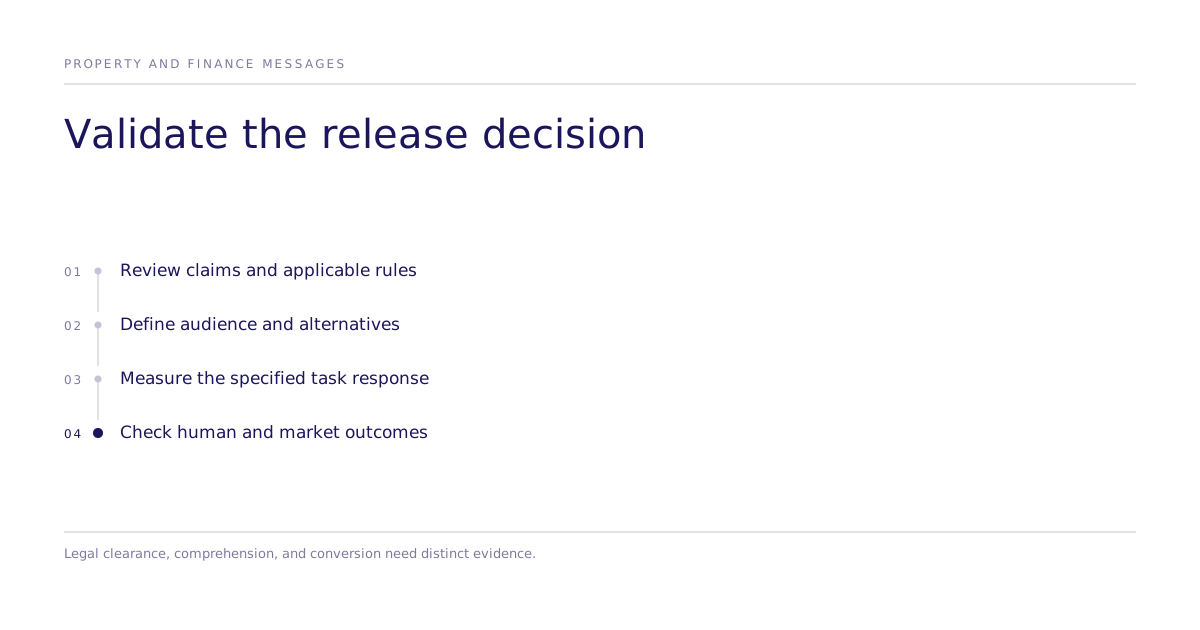
Real estate and financial services involve long buyer journeys and consequential decisions. A concept comparison can help test a defined message or offer, while the research endpoint and applicable rules determine what the result supports. A simulated task measures generated responses; human comprehension and actual market outcomes need appropriate evidence.
Which decisions in these categories are suitable for a controlled experiment?
The strongest candidates hold the buyer context stable and vary one commercial action: positioning, price, message, or script. This is concept testing: comparing alternatives against a defined audience, not asking which one the team likes (Qualtrics, "Concept Testing: Definition, Methodology & Examples").
| Decision | Alternatives to compare | Response to examine | Evidence still needed |
|---|---|---|---|
| New-development positioning | Launch narrative, amenity order, open-house framing | Appealing versus generic to the target segment | Sales-office feedback and in-market hand-raiser rate |
| Listing price and description | Defined price points, headline variants, comparable framing | Stated price perception and message comprehension | Local comparables, housing review, and actual market response |
| Wealth or private-banking communication | New positioning concepts, brand story drafts, advisor talking points | Differentiated versus generic private-wealth language | Compliance and legal review, advisor feedback |
| Retail or neobank feature launch | Feature name, pricing structure explanation, onboarding copy | Clearest framing to the target segment | In-app A/B result after launch |
| Insurance product framing | Value-proposition language, claims-process explanation | Comprehension of the explanation | Applicable legal review and actual customer understanding |
| Mortgage or lending message | Messaging variants matched to life stage (purchase, refinance, equity release) | Best fit to the buyer's current moment | Lender underwriting and market response |
Real estate: buyer segments and listing-level use cases
Define the intended audience and ensure lawful recruitment and use of research findings. For illustration, a team might examine these distinct housing needs; the age and income ranges below are hypothetical research assumptions, not advertising eligibility rules or a customer result:
- First-time buyers, ages 30–38, household income €120K–€200K, currently renting, considering ownership in 12–24 months.
- Move-up buyers, ages 40–55, household income €250K–€500K, moving from a starter home to a suburb or peri-urban residence.
- Investment buyers, age 45+, accredited-investor profile, seeking cash-flow assets with light personal involvement.
- Downsizer buyers, age 60+, equity-rich, considering a smaller residence with amenities.
In this hypothetical planning exercise, a study could investigate whether "luxury living" feels generic, whether workspace flexibility deserves a different position in the amenity list, and whether open-house language creates pressure. Those are questions, not observed panel findings. A human task can assess comprehension or stated preference; actual inquiries and sales require separate measurement.
Beyond launch positioning, individual listings raise their own comparisons:
| Use case | What gets compared |
|---|---|
| Headline and description testing | Three headline options read against the target buyer for that property |
| Pricing perception | A defined set of price points (for example, €1.2M vs €1.25M vs €1.18M) against the listing description and local comparables |
| Imagery and tour framing | Which photography and tour sequence reads as genuine rather than staged |
| Buyer story matching | Which buyer narrative a listing speaks to most strongly, for outreach to qualified buyers |
Financial services use cases
Both categories have applicable rules. For example, US housing advertising is subject to prohibitions on discriminatory statements and notices under 24 CFR 100.75. Financial services has its own product- and jurisdiction-specific requirements. Obtain the relevant review before testing claims or deciding how the findings will be used.
Wealth management and private banking
For private banking, assess the actual recruitable client and prospect population, privacy arrangements, and feasibility of a human study. If using a simulated population, document the profile assumptions and obtain independent evidence of agreement with relevant human tasks. A demographic prompt alone does not establish coverage of HNW or UHNW preferences.
Retail banking and neobanks
A neobank may use feature flags or live experiments where permissions and design allow them. Review regulated disclosure and pricing claims before exposure. Human comprehension testing can examine naming, pricing explanations, and onboarding; a modeled task needs independent checks before the result supports release.
Insurance
Compare feasible explanations of an insurance feature, such as a cyber-insurance rider, after checking that the language accurately describes the policy. Use human comprehension evidence for customer understanding and keep legal clearance and actual claims experience as distinct checks.
Investment products
Compare investment-product explanations that preserve the same verified information and required disclosures. Assess comprehension with the intended readers; emotional resonance or generated preference is not evidence of suitability, legal compliance, or an investment outcome.
Mortgage and lending
A first-time purchase, refinance, and equity-release decision may create different information needs. Compare feasible messages for each context and measure understanding, while checking the lender's applicable rules and actual market response.
A worked planning example: wealth-advisor communication refresh
The following is an illustrative planning scenario, not a Subconscious customer result.
In this hypothetical example, a wealth-advisory firm with 60 clients and assets in the mid-hundreds of millions considers a communication refresh. The team assesses whether clients can participate with suitable privacy and consent, and whether prospect recruitment is feasible. A modeled population might explore draft alternatives, but coverage of entrepreneurs, founders, or recently liquid prospects must be checked against relevant human evidence. The following sequence is one planning option:
| Phase | What is tested |
|---|---|
| 1. Perception study | Current relationship with wealth management, what builds trust, what causes dismissal |
| 2. Positioning concept testing | Three positioning concepts compared for differentiation |
| 3. Brand story and communication testing | Draft brand story, website hero, and advisor pitch deck |
| 4. Advisor enablement | A recommended introductory-conversation flow, pressure-tested for moves that build or erode trust |
| 5. Review and launch | Check human comprehension and unresolved findings, obtain applicable legal and compliance clearance, then release and measure response |
Limits and complements
Choose evidence for the endpoint: concept response, comprehension, inquiry, purchase, or retention. Legal review assesses applicable requirements; it does not prove that a message improves conversion. Advisor or broker judgment supplies context, while a randomized task identifies only the contrast and endpoint supported by its design.
If a modeled comparison is used, plan the human or live check separately and confirm recruitment, responsibilities, scope, and deliverables with the provider. Keep the intervention comparable and document any endpoint change between generated choice, human stated response, and observed behavior. The aggregate leaderboard provides benchmark context, rather than a service or handoff guarantee.
Where does this fit in the research stack?
| Research layer | Best use | Main limit |
|---|---|---|
| Brand or market tracker | Category and brand movement over time | Does not isolate a specific messaging or pricing action |
| Deep segmentation study | Audience structure and subgroup questions | Precision and practical relevance depend on the sample and update cycle |
| Regulatory and compliance review | Legal and regulatory clearance | Does not test whether the message lands with the buyer |
| Controlled simulated experiment | Generated responses to defined messages or offers | Requires matched evidence before claims about human understanding or actual market outcomes |
Getting started
Choose the research method for one upcoming decision and its business endpoint. Bring the alternatives, audience assumptions, applicable review requirements, and current evidence to scope a study. Read the case studies for their documented methods and limits.