How to Develop Effective Likert Scale Questions?
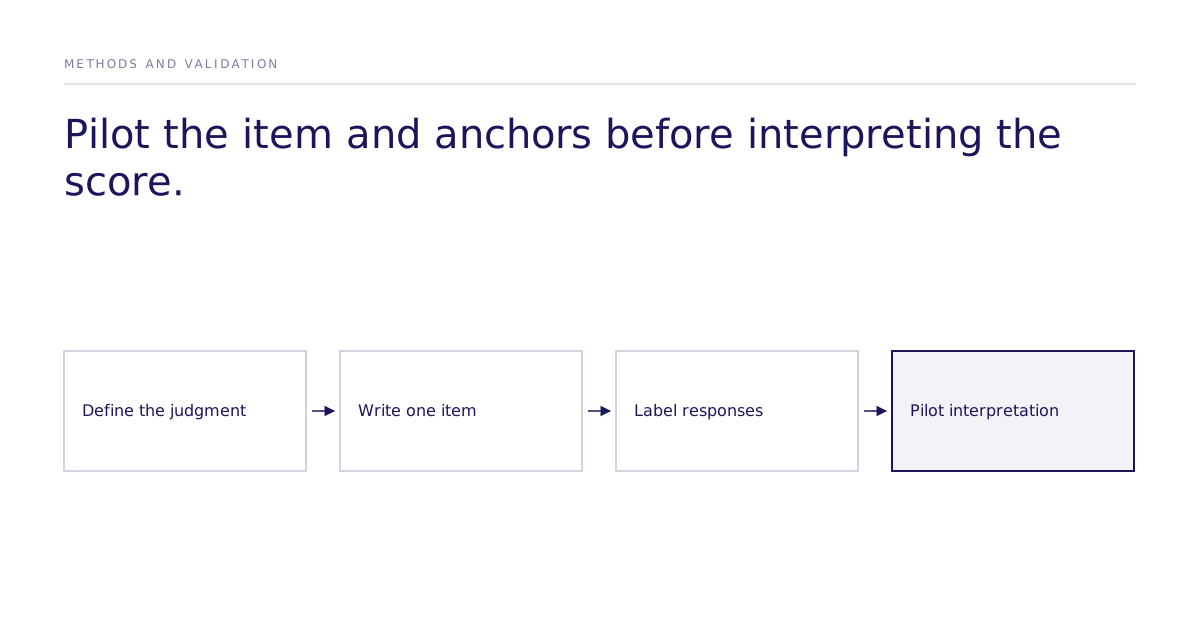
An effective Likert item states one idea, names a relevant context and provides interpretable response anchors. Piloting checks whether respondents understand the statement and can answer it. A rating measures reported agreement; randomized treatment can estimate an effect on that agreement. Purchase prediction requires separate evidence.
- Split statements that contain more than one judgment.
- Label every response category and keep the format consistent.
- Distinguish neutrality, lack of knowledge and non-applicability.
- Choose analysis and validation for the endpoint actually measured.
Repair a complete item
Poor item: “Our fast and affordable support always makes me happy.” Speed, price and satisfaction are different judgments. “Always” can rule out respondents with mixed experiences, and the wording encourages agreement.
Revised item: “Thinking about your most recent support request in the past month, I was satisfied with the time it took to receive a first response.” This still asks for one reported judgment, tied to a specific experience.
| Response | Treatment in analysis |
|---|---|
| Strongly disagree | Ordered agreement category |
| Disagree | Ordered agreement category |
| Neither agree nor disagree | Substantive midpoint |
| Agree | Ordered agreement category |
| Strongly agree | Ordered agreement category |
| I do not remember the response time | Separate missing-information response |
| I have not submitted a support request in the past month | Ineligible for this item; use screening or skip logic |
Do not code “not applicable” as the midpoint. A neutral judgment is different from having no relevant experience. If response time itself is the question, ask for an operational measure or an item-specific speed rating instead of inferring elapsed time from satisfaction.
Choose the response format deliberately
Preston and Colman (2000) compared response-category formats and found improvements on several measurement criteria up to about seven categories, with limited further gains. That study informs format selection; it does not establish seven categories as a universal optimum.
Five clearly labeled categories can be a reasonable starting point for an agreement item. Seven may distinguish more shades of agreement if respondents understand the anchors. Pilot the actual instrument and audience. A single Likert-type item is ordinal; a multi-item scale needs evidence that its items measure the intended construct before scores are combined.
| Format choice | Check before fielding | Best for |
|---|---|---|
| Agree/disagree statement | Acquiescence and statement interpretation | Reported agreement with one proposition |
| Item-specific satisfaction rating | Meaning of satisfaction anchors | Direct evaluation of an experience |
| Multi-item construct scale | Dimensionality, reliability and scoring | Measuring a defined latent construct |
What should the pilot reveal?
Ask pilot respondents to explain the statement in their own words. If one respondent evaluates speed and another evaluates staff politeness, revise the item. Ask why respondents selected their anchor and whether an answer option was missing.
Inspect missing and not-applicable responses separately. A concentration at the midpoint may reflect neutrality, ambiguity or insufficient experience; the distribution alone cannot tell which. Ceiling responses may reflect high satisfaction or wording that makes disagreement difficult. Compare those patterns with interview notes before changing anchors.
Check device display, order effects and completion burden. If wording changes during a tracker, assess comparability before interpreting a score change as an attitude change. Report the eligible population and denominator used for each item.
Can a Likert rating be a causal outcome?
Yes. Randomly assign two support messages, then administer the same satisfaction item to both groups. The resulting contrast estimates an effect of assigned message on reported satisfaction under the experiment's assumptions. It does not automatically estimate an effect on renewal or purchase.
A standalone attitude survey describes responses without that randomized contrast. Observational causal designs may also be possible under explicit identification assumptions; the response format alone does not settle identification.
For a product-choice question, randomly varied profiles can measure effects on stated choice. A one-factor experiment can answer a narrow question, while factorial conjoint can estimate several planned contrasts. Mixed Logit and ICLV are analysis models, not assignment mechanisms. Multinomial logit's independence-of-irrelevant-alternatives assumption requires attention when similar alternatives compete.
Validate the endpoint you need
Reliability concerns consistency. Predictive validity concerns performance against an external outcome. A repeatable rating may predict behavior in a particular setting, but that relationship must be tested rather than assumed from wording quality. A hypothetical choice task also needs behavioral validation; presenting a tradeoff does not remove hypothetical bias.
If using a simulator, its generated choices are modeled stated choices. An interval describes uncertainty inside the configured model. Human or live-market transfer requires matched evidence for the population, alternatives and endpoint.
The July 2026 Subconscious working paper, not peer reviewed, reports mean Spearman rank correlation on estimated choice parameters of 0.55 across roughly 300 replications and 0.73 across 43 design-filtered studies. These are not accuracy percentages or evidence that a rating predicts purchases. Published studies can appear in training data, so contamination remains a limitation.
Use the methods hub and comparison guide to plan that validation. Before revising an item, name whether the decision needs a description of attitudes, a treatment effect on ratings or a prediction of behavior. Then build and assess the instrument for that endpoint.