Estimating a Private-Market Benchmark When There Is No Public Price
A public equity index is built from transaction prices that happen constantly: every trade updates the number. A private-market portfolio has no daily price tick, no closing quote. Reported appraisal-based net asset values (NAVs) can be stale or smoothed. A cash-flow-based model instead uses capital calls and distributions to infer an unobserved return path. A quant or risk team that needs a benchmark for that portfolio has to infer one, and the inference method determines whether the resulting number is honest about how uncertain it is given the model it conditions on.
Which published model underlies this case?
Driessen, Lin and Phalippou's 2008 NBER working paper estimates private-equity risk and return from cash flows. The distinct Ang, Chen, Goetzmann and Phalippou latent-return model, developed in 2013/2014, is the source linked by the Everysk case below. It treats the return path as unobserved and infers it from calls and distributions. These are different papers, not a single method and its companion. A Bayesian implementation of that model uses priors (starting assumptions about plausible ranges for the hidden path) to constrain the inference, then reports a full posterior distribution rather than a single number, giving the resulting index its uncertainty band.
A standard machine-learning fit on the same cash-flow data can also produce an interval, through bootstrapping, quantile regression, or conformal prediction, but that interval doesn't condition on the same prior assumptions the Bayesian posterior does, and isn't interpreted as a probability statement about the hidden path the way a posterior is.
What changed when the model was rebuilt with modern samplers?
Ravin Kumar's PyMC Labs–Everysk case report, created February 25, 2021 and updated November 27, 2025, describes implementing the linked latent-return model for Everysk's multi-asset risk workflows. Kumar reports that newer samplers allowed faster iteration and that Everysk wanted to understand the inferred trend. This is the implementer's report, not an independently measured speed or accuracy comparison.
Interpretability comes from the model's structural specification: latent returns, factor loadings and the mapping from returns to cash flows. Bayesian fitting alone does not make a model interpretable; another fitting procedure applied to the same structure can expose the same assumptions. A posterior band also depends on whether the structure and priors represent plausible alternatives.
How was the result read against a known benchmark?
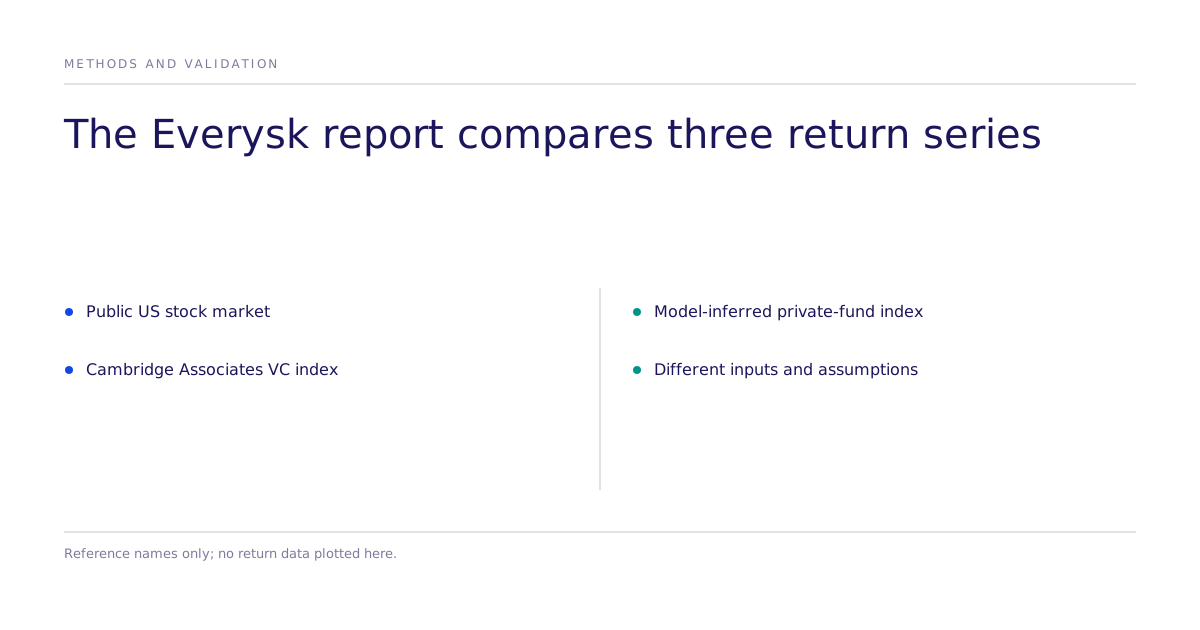
The output was a cumulative-return index compared against two references: the public US stock market and the venture capital index published by Cambridge Associates, an industry-standard performance benchmark for private funds. The inferred index tracked its own distinct path relative to both. Different information sets, portfolio composition and estimation conventions can produce different paths. A visual comparison does not establish that either benchmark is correct for the portfolio or quantify smoothing and beta differences.
The value of the comparison was not that the inferred index matched Cambridge Associates, but that it could be checked against an external reference at all, because it came from a documented, repeatable model rather than an unexplained trend line asserted without a method behind it.
Where does this pattern apply, and where does it not?
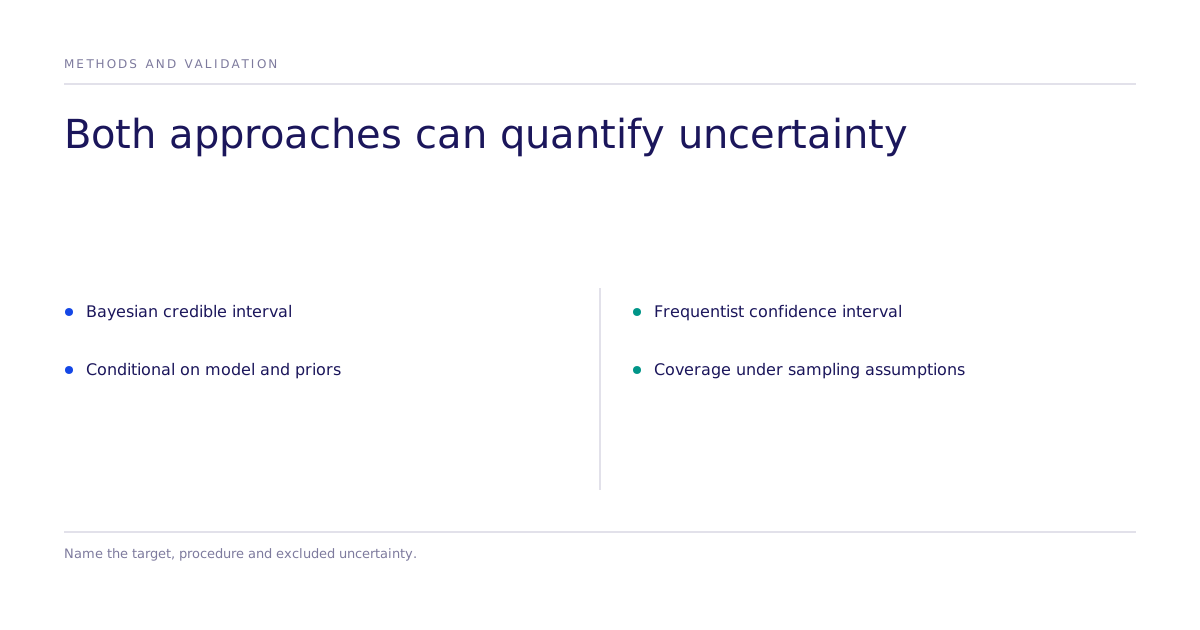
When a result is inferred from indirect signals, report the assumptions and uncertainty rather than presenting the estimate as an observed price. Both Bayesian and non-Bayesian methods can provide uncertainty estimates. Their intervals can concern different targets: a latent return path, an estimated parameter or a future observation.
A Bayesian credible interval describes posterior probability conditional on the model, priors and observed data. A frequentist confidence interval describes repeated-sampling coverage under its assumptions. A prediction interval concerns a future observation. Bootstrap, quantile and conformal procedures require their own validity conditions; adding a band does not make an unsuitable model reliable.
Before using an inferred index, ask:
- What cash flows, fund vintages and missing-data rules define the portfolio?
- What identifies the latent path separately from cash-flow timing and factor exposure?
- How sensitive is the path to priors, factor choices and observation assumptions?
- Do posterior predictive checks or held-out cash-flow checks expose systematic misses?
- What sources of uncertainty are excluded from the band?
The methods hub provides context for evaluating model assumptions. Subconscious's research evidence concerns modeled stated-choice experiments, a different target from private-fund returns. Transfer of either model to a new use requires evidence matched to that use; a documented method or an uncertainty band alone is insufficient.