Prediction and Intervention Answer Different Business Questions
A pricing team may forecast next month’s sales accurately and still lack an estimate of what changing the price would do. A prediction under current conditions and an intervention effect are different quantities; forecast error, identification error, and execution can each undermine the decision.
Prediction and inference answer different questions
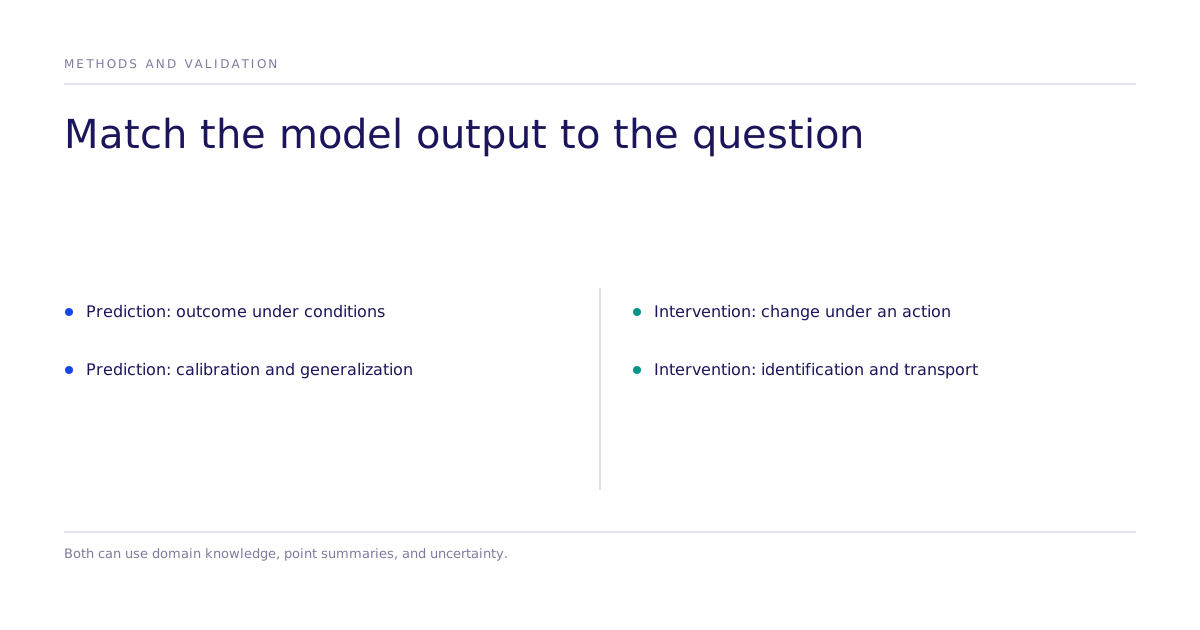
Predictive models estimate outcomes from patterns in data. Their value depends on the forecasting task, generalization, and calibration.
A price-change decision asks what would happen under a different action. Randomization or a defensible causal strategy identifies that contrast under assumptions. A predictive model may be part of the analysis, but its fit alone does not identify the intervention effect.
Why does domain knowledge count as model input?
Predictive ML can incorporate domain knowledge through features, architectures, priors, or constraints. For example, XGBoost supports monotonic constraints. Those choices guide prediction; they do not by themselves establish causal identification.
A decision analysis should specify both the target quantity and how it is identified. Model structure can encode useful knowledge in predictive or causal work, but unsupported structure can also bias the result.
| Prediction requirement | Intervention requirement | |
|---|---|---|
| Output | Forecast and appropriate uncertainty | Action contrast and appropriate uncertainty |
| Domain knowledge | Features, constraints, priors, or architecture | Design assumptions and outcome model |
| Data requirement | Evidence for target-case generalization | Evidence for identification and transport |
| Leadership question | What may happen under specified conditions? | What changes if we take this action? |
Where has this approach already worked?
A widely cited example is epidemiological forecasting during COVID-19, where researchers modeled the effect of interventions on disease spread and produced explicit uncertainty bounds rather than a single predicted curve (Flaxman et al., Nature). The value wasn't a sharper point prediction. It was a model that encoded epidemiological structure and reported a posterior interval conditional on that structure, in a situation where the data alone were noisy and incomplete; those NPI-effect estimates later proved highly sensitive to model structure and priors, with weak separate identification of individual interventions.
The same shape appears in any setting where the team has strong priors about structure and comparatively sparse or noisy data: polling, planetary detection from telescope signal, and Subconscious's own domain of testing a marketing or product action before it ships.
How does Subconscious apply this to go-to-market decisions?
Subconscious's causal action testing builds a structured, discrete-choice-style comparison across pricing, messaging, and product actions, rather than asking a generic model to pattern-match past behavior. The team states the actions under consideration, and the experiment is built to estimate the causal effect of choosing one action over another.
For an invented message test, suppose a stated-choice contrast is +4 percentage points with a design-supported interval from −2 to +10. If the business requires at least +2 points, the lower bound does not clear the threshold. The review should retain the baseline and commission a matched human or live conversion test before rollout. This is an illustrative output, not a Subconscious result; its interval describes the task assumptions and does not cover transport error.
What this does and doesn't replace
A structured simulated experiment and recruited human research produce distinct claims. To check the modeled contrast, specify a matched human population, treatment, endpoint and agreement criterion. Confirm recruitment, fieldwork ownership and deliverables with the provider. Changing from stated choice to actual conversion measures a different outcome and needs a separate protocol.
A study also needs a documented sampling frame and target population. Audience coverage does not establish representativeness or validate the intervention estimate.
The practical difference for a leadership review
A leadership review should name the baseline, proposed action, decision threshold, uncertainty, and evidence that would change the recommendation. Predictive and intervention analyses can both support that review when their outputs match the question.
Before committing budget, identify the quantity the decision needs and the evidence supporting it. See the experimental workflow.