Survey Response Rates Are Falling. What Replaces the Survey for a Decision That Needs a Causal Answer?
A research or insights leader facing a declining-response survey program has five common replacements: behavioral analytics, continuous in-product feedback, social and community listening, passive telemetry, and AI-assisted qualitative interviews. All five describe what customers already did or said. None answers what a defined population would choose under a specific alternative that has not shipped yet without first building and exposing that alternative to real customers, the question a launch, price, or messaging decision needs.
Why is the survey program shrinking?
Phone and email survey response rates have been declining for decades as people screen calls, ignore inbox requests, and get asked for feedback after every support ticket and purchase (Pew Research Center). Lower response rates raise a concern beyond sample size: whether the respondents who remain differ from the customer base a decision is meant to serve. Pew's own analysis found that after weighting, low response rates produced little bias on most measures, with bias concentrated in a few specific measures such as civic engagement (Pew Research Center).
The mechanical fix is a bigger sample. The structural problem: a shrinking, self-selected pool doesn't become representative by asking more of it.
What the common replacements actually measure
Research teams are not switching to a single new tool. They are assembling a portfolio, and each piece answers a narrower question than the survey it replaces.
| Method | What it tells you | What it can't tell you |
|---|---|---|
| Behavioral analytics (product usage, clickstream) | What customers did inside the product | Why they did it, or what they would do under a change that hasn't shipped |
| Continuous in-product feedback | Sentiment at the moment it forms | Whether that sentiment would shift under a different price, feature, or message |
| Social and community listening | Themes and sentiment already being volunteered | Reactions to something the market hasn't seen yet |
| Passive telemetry (load times, error rates, adoption) | Objective experience quality, without asking anyone anything | Preference between alternatives that don't exist in production |
| AI-assisted qualitative interviews | Depth on stated reasons and frustrations | A quantified estimate of which action would change behavior |
Each is a genuine improvement over a low-response survey. None answers a different kind of question: what happens if we change the price, the message, or the offer before we commit budget to finding out.
The question a decision needs, not a description
Behavioral analytics and listening data describe a world that already exists; they are observational, not experimental. Observing that customers who saw feature X converted more than customers who didn't is not the same as knowing that shipping feature X would raise conversion, because the two groups may have differed for other reasons before either saw the feature.
Answering "what would this specific population choose among these specific alternatives" requires a controlled experiment: present a defined population with structured, stated-preference trade-offs and measure the causal effect of each one within that population, with a stated confidence interval.
Where does a controlled experiment fit?
Subconscious runs controlled discrete-choice experiments on simulated populations to estimate the causal effect of a specific action within the simulated population: a price point, a feature, a message, before it ships. Details on the experimental design and validation process are at /research and /how-we-work.
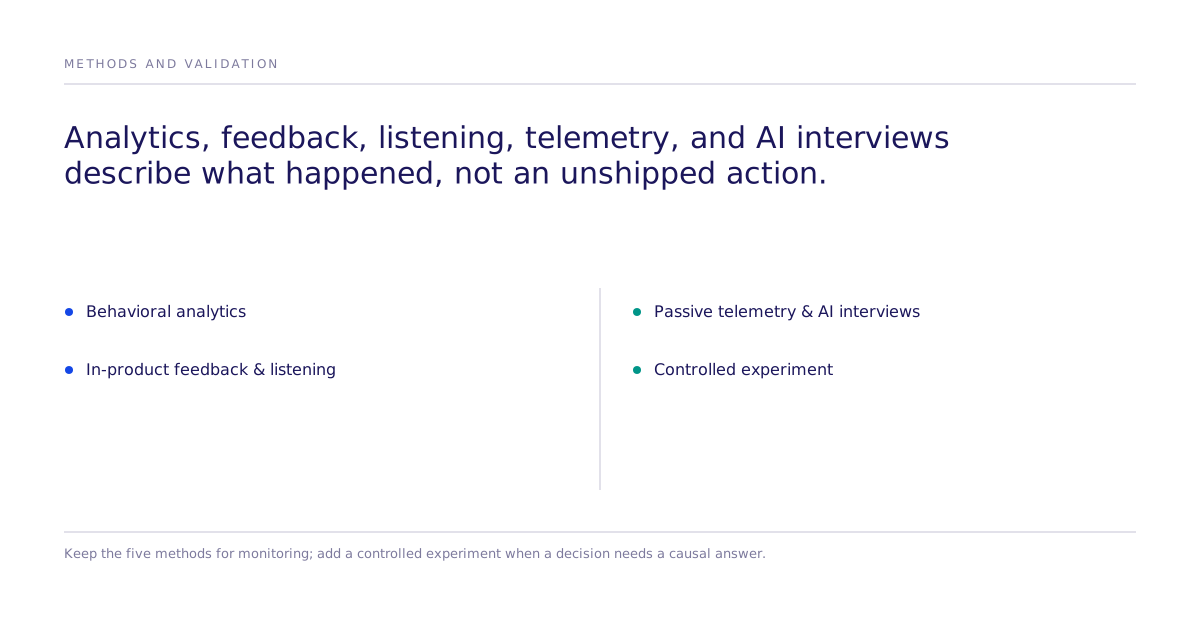
This doesn't replace the other four methods in the table above. A controlled experiment doesn't track NPS or CSAT over time, monitor product usage on an ongoing basis, or substitute for community listening or passive telemetry as continuous-monitoring tools. It answers one narrower question, at the point a team needs to decide whether to take a specific action.
The population size a simulated experiment can run against is not the same claim as how many real people have been recruited into a study. When a decision needs confirmation beyond the simulated result, the same causal question can be tested again with real-human participants.
What does this mean for a research team?
Stop expanding survey programs that fight declining response rates with more volume. Keep the survey where it still works: internal employee research, simple binary questions, and standardized cross-time benchmarks where a common yardstick matters more than precision. For decisions that hinge on a specific, unlaunched action, add a controlled experiment rather than making behavioral analytics or listening data answer a question they weren't built to answer.
Teams making this call on a live pricing, packaging, or messaging decision can book a walkthrough of the experiment structure described above.