Investigating an Unexplained Survey Result
A four-week brand tracking wave lands on your desk and a key metric has moved. Stakeholders want an explanation by tomorrow. Start by checking sampling, weighting, wording and fieldwork changes, then inspect open-ended responses, permitted recontact and relevant behavioral records. A simulated comparison can help prioritize hypotheses, but it cannot establish the historical cause of the movement on its own.
Guessing is the expensive option. If the "why" you present to stakeholders is a plausible-sounding story rather than a tested one, the messaging, pricing, or packaging decision built on top of it can be wrong in a way nobody catches until the next wave.
What can a fielded survey result tell you, and what can't it?
A survey can show that a metric changed, while leaving several explanations compatible with the result. Recontact may be possible when consent, the study design and the provider permit it. Existing open ends, previous waves and telemetry can also help. If 40 percent dislike packaging in an invented example, that share alone does not reveal which feature caused the reaction.
Define the question before designing a follow-up: what caused the historical movement, what mechanism might explain it, or which current intervention improves the outcome? A new randomized comparison can answer the third without resolving the first two.
Why ground a simulated experiment in your own data?
A simulated follow-up's credibility depends entirely on what it is grounded in: a model with no context about your specific respondents defaults to generic, average assumptions about the world. Argyle and colleagues addressed this gap in a Political Analysis paper, "Out of One, Many": conditioning a model on the detailed backstory of a real survey respondent produced response distributions that tracked human subgroup patterns in benchmark national surveys more closely than an uninformed model (Cambridge University Press, 2023).
In practice, the fielded wave itself (segment definitions, response patterns, the open-ended language your respondents actually used) becomes the grounding layer for a simulated population built to represent that same audience, which means a candidate explanation the population surfaces may reflect language already present in that wave rather than an independent read on causation. The simulation does not stand in for the survey; it is a way to keep interrogating the survey after the field window has closed.
Running the pressure-test
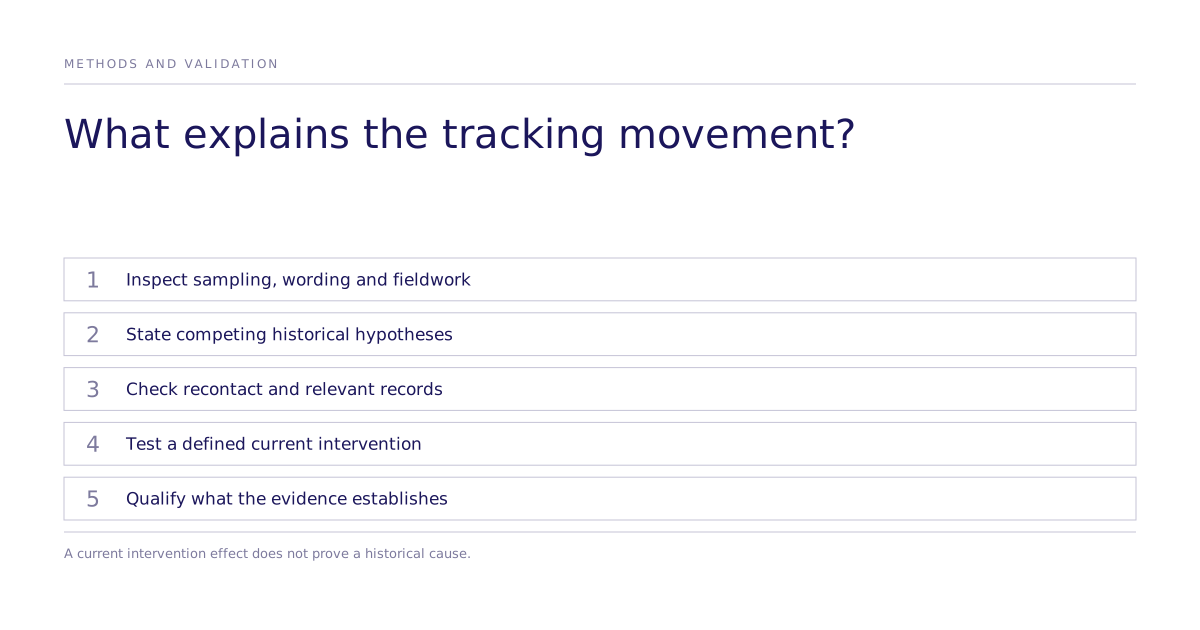
Start from the fielded baseline. Import the wave that produced the confusing result, along with the segment definitions that matter for the question at hand, instead of starting from a generic category description.
State the candidate explanations as testable alternatives. Instead of asking a simulated panel an open-ended "why," frame two or three specific hypotheses (a competitive price move, a messaging shift, a packaging change) and compare how a grounded population responds to each.
Check the segment and the comparator. A synthetic population's agreement with aggregate survey patterns does not establish that it represents the affected segment. Compare relevant held-out responses or behavior before using the ranking to discard explanations.
Treat the result as a hypothesis, not a conclusion. The output narrows the field of candidate explanations and tells you which one is worth testing further. It does not prove which mechanism is real in the market.
When a simulated pass is enough, and when it isn't
Choose evidence to match the question and the cost of error. A modeled pass can prioritize candidates; existing records, permitted recontact, observation or a field experiment may provide the needed external check.
| Task | Manual approach | Simulated pass | When to use which |
|---|---|---|---|
| Narrowing candidates | Inspect open ends, fieldwork changes and records | Compare stated hypotheses under modeled assumptions | Preserve plausible alternatives for external checking |
| Coding open ends | Human coding with a documented rubric | Suggest themes for review | Check a human-coded sample, disagreements and rare themes |
| Testing an actionable response | Randomize candidate interventions when feasible | Prioritize interventions for testing | Measure the relevant human or market outcome |
| Substantiating an audited claim | Evidence required by the applicable claim and standard | Supplementary analysis where appropriate | Determine whether participant data, records, technical measurements or another form of evidence is required |
What this method does not do
Publishing what a method cannot do is what lets a buyer check it before they rely on it. A simulated pass narrows explanations; it does not manufacture certainty.
A grounded follow-up query does not automatically produce a representative population estimate. That requires an appropriate sampling frame or justified model-based inference, with uncertainty and validation stated. A generated rationale is not a measurement of a respondent's psychological mechanism.
Grounding in a fielded wave can reproduce its omissions and language. Fresh context can be supplied, but it needs provenance and a check against current behavior. The cited October 2025 social-interaction preprint studies chatroom-style interactions, rather than validating a survey-follow-up pipeline. For survey predictions, Mumin and Jia report stronger aggregate than individual agreement, with limits on multivariate and heterogeneous responses. Neither result confirms a proposed historical explanation.
Keep the outputs distinct: a modeled response to a candidate intervention, a participant's stated explanation and an observed effect on behavior. Each supports a different claim.
Moving from a candidate to evidence for action
Before acting, name the outcome and estimand for the external check. A randomized human prototype test can estimate the effect of today's packaging alternatives on measured responses. A live experiment can measure purchase or retention effects. Establishing why an earlier tracking metric moved may instead require time-specific records, a credible counterfactual or additional mechanism measurements.
A simulated pass can narrow the intervention set, but can also prune the true driver. Keep competing explanations and check sensitivity to grounding choices. Read the methods and validation hub or discuss a design at a decision review.
Frequently asked questions
Does a simulated pass replace the survey wave that produced the confusing result? No. It uses that wave as its grounding, then lets an analyst keep asking questions of the population the wave already described, without a new field period.
Can this method process open ends from the wave? Theme suggestions can help an analyst review the full set. Validate the coding against a human-reviewed sample and inspect disagreements and rare responses.
When is an external check needed? Match the evidence to the decision, cost of error and applicable substantiation standard. A human study is one option; relevant records or measured behavior may answer a different part of the question. See our case studies.
What should an analyst distrust? A single narrative offered without alternatives, or an intervention effect described as proof of the historical cause. Check grounding, segment validity and the measured outcome.