When Is a Synthetic Consumer Response Ready to Inform a Real Decision?
A synthetic consumer response may support exploratory hypotheses when the decision is reversible and the limits are explicit. A consequential launch, claim or positioning decision needs evidence matched to its task, audience and cost of error. Alignment varies by context. A consumer insights team should inspect prior matched evidence and remaining uncertainty, comparing choice shares, willingness to pay or another declared outcome rather than assuming validity from plausible personas or raw utility coefficients identified only up to scale.
What is a synthetic consumer?
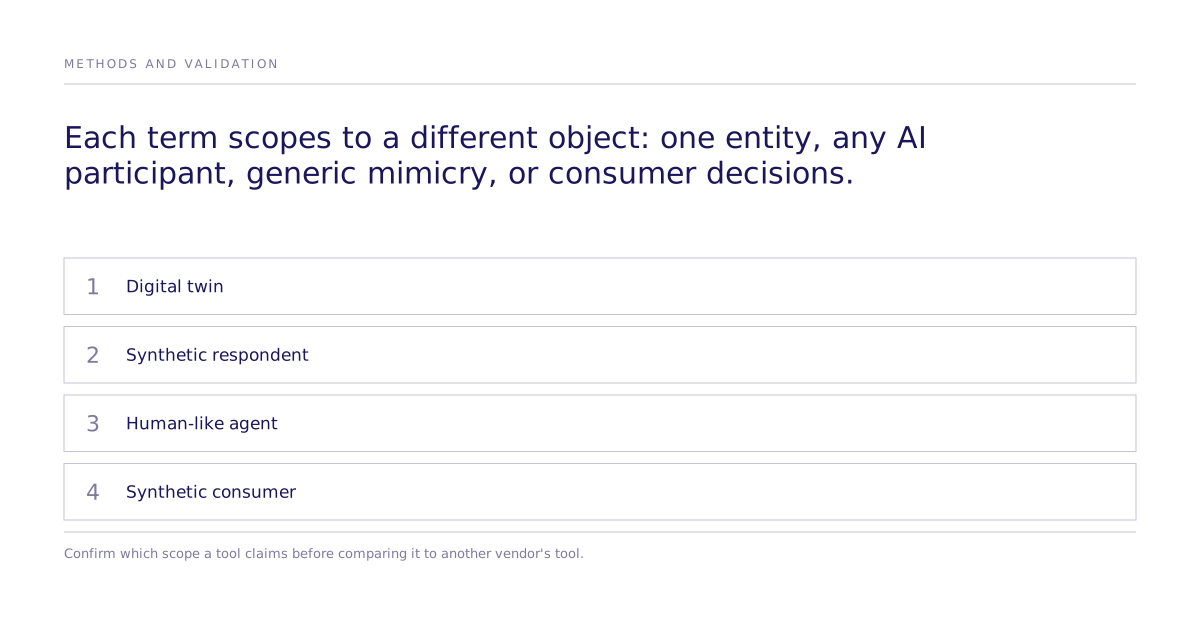
The term names an AI-generated persona built to simulate consumer preferences and decision-making, used to run research scenarios and collect directional feedback without recruiting human participants for every study. That is a distinct concept from a few adjacent terms teams sometimes use interchangeably:
- A digital twin mirrors a specific real-world entity or system, often at the individual or asset level, rather than a general consumer segment.
- A synthetic respondent is a broader category of AI-generated research participant, not specialized for consumer behavior.
- A general-purpose human-like agent mimics interaction patterns without being built for consumer research at all.
Keeping these terms separate matters because a team evaluating vendors or methods can otherwise end up comparing tools that answer different questions.
Why do teams use synthetic consumers?
Interest in synthetic consumers has grown because a few historical use cases kept recurring across consumer-facing organizations: running early product or variant tests before or alongside human studies, exploring new concepts and positioning directions, expanding existing datasets to cover more edge cases, and generating repeatable preference signals without commissioning a new field study for every question.
The appeal is exploring candidate concepts and segments. Compare actual lead time, cost, coverage and task validity for the proposed workflow; the category label does not establish an advantage on those measures.
The open question: how closely does it track real behavior?
Independent research on this question is still active, and the honest answer is "it depends on the category and the question." A 2026 discrete-choice study comparing GPT-generated and human food-choice decisions found that alignment between the two is not uniform across contexts (ScienceDirect, "Do large language models shop like people? Comparing GPT and human food choices using discrete choice experiments"). A broader review of experiments with synthetic users reaches a similar conclusion: synthetic outputs can be useful, but they are not established as a general substitute for recruited human data, and performance has to be evaluated case by case (MeasuringU, "A Review of Experiments with Synthetic Users").
That means a synthetic consumer output is not automatically wrong, and it is not automatically right. It is a hypothesis about how people will behave, and hypotheses need a check.
The decision this creates for a research leader
The practical cost of skipping that check is concrete: a team ships a product, claim, or launch decision on a synthetic signal that does not match how real customers actually behave, and only discovers the gap after the decision is already committed. Budget, roadmap capacity, or brand equity is spent on the wrong assumption before anyone tests it against a human baseline.
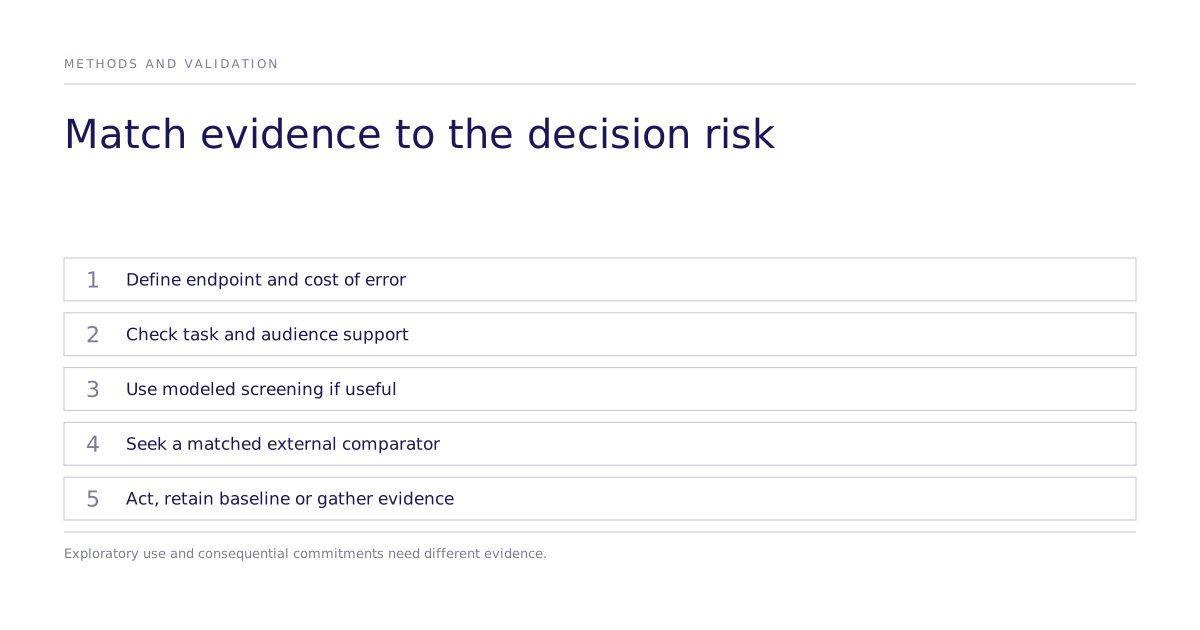
Define the decision, audience, endpoint and loss from a wrong action before choosing the method. Existing evidence may support exploratory use, a direct human study or a live pilot. If the decision uses a modeled result, seek matched external evidence and flag disagreement before relying on it for a consequential commitment.
Where a validation step changes the answer
For a Subconscious modeled choice result, define the matched population, stimuli, treatment, endpoint and agreement criterion. Confirm human recruitment, fieldwork ownership and deliverables in the brief. Applied cases provide context; a changed endpoint or instrument needs its own validation.
Teams that want to see how a study moves through that process, from a defined decision to a validated result, can review how a decision-specific study gets scoped and run.
What should synthetic consumer methods not be asked to prove?
A single well-performing example does not transfer automatically to another domain. Match the required evidence to the decision's loss, existing task support and remaining uncertainty. Use exploratory output to generate candidates; request relevant human or observed-outcome evidence before treating a modeled result as support for a consequential commitment.
A validation step also does not turn a synthetic causal experiment into a clinical trial, a usability session, or automatic proof of market performance. It tests whether the specified human comparison produces a compatible answer and can fail or remain inconclusive. That is a narrower and more useful claim than "this is now proven."
A working evaluation framework
Before acting on a synthetic consumer result, a research leader can ask:
- What category and question is being tested, and has alignment between synthetic and human data been measured for anything similar?
- Is the decision high-stakes enough that a validation pass against a human baseline is worth the time before committing budget?
- Does the synthetic output change what the team would have decided anyway, or does it mainly confirm an existing plan?
- If the synthetic and human results disagree, which one does the team currently trust more, and why?
None of these questions require abandoning synthetic methods. They require treating a synthetic result as an input to a decision, not the decision itself.
Where to see this in practice
The public research record reports aggregate choice-parameter-rank benchmark evidence. Per-study replication data are not public; request project-specific workflow, protocol and validation records separately. Teams evaluating whether a specific decision is a good fit for this process can also scope a study directly.
Limitations and open questions
The domains where synthetic consumer alignment has been tested closely are narrower than the domains where teams want to apply it. A research team should expect to keep measuring alignment rather than treating any single benchmark as settled.