When Partial Pooling Helps a Thin Segment Estimate
A segment-level causal estimate can look strong for a reason that has nothing to do with the segment. When a niche buyer persona, a single region, or one price tier has few observations, its estimate carries more noise than the pooled estimate for the whole population. Treating that noisy number at face value is how a team rolls out a change to a segment that never actually outperformed: the apparent lift was sampling variance, not a real effect.
What's wrong with estimating each segment alone?
An unpooled model estimates each segment separately. Sparse groups can have large uncertainty; larger samples reduce sampling variance under the model but do not eliminate misspecification, confounding or measurement error.
The opposite extreme, complete pooling, ignores segment differences entirely and reports one estimate for everyone. That erases real variation between segments, which is usually the reason a team wanted a segment-level view in the first place.
What is partial pooling?
A hierarchical model assumes a relationship among group parameters and estimates how much they vary. Partial pooling can regularize sparse-group estimates when that relationship is credible. Groups need not shrink by a fixed fraction based only on sample size: uncertainty and the estimated population variation also matter. See the PyMC hierarchical regression example.
Christopher Fonnesbeck's PyMC Labs sports-analytics tutorial provides a related illustration. Before applying pooling to buyer segments, justify exchangeability conditional on relevant covariates, check prior sensitivity and compare held-out-group predictions.
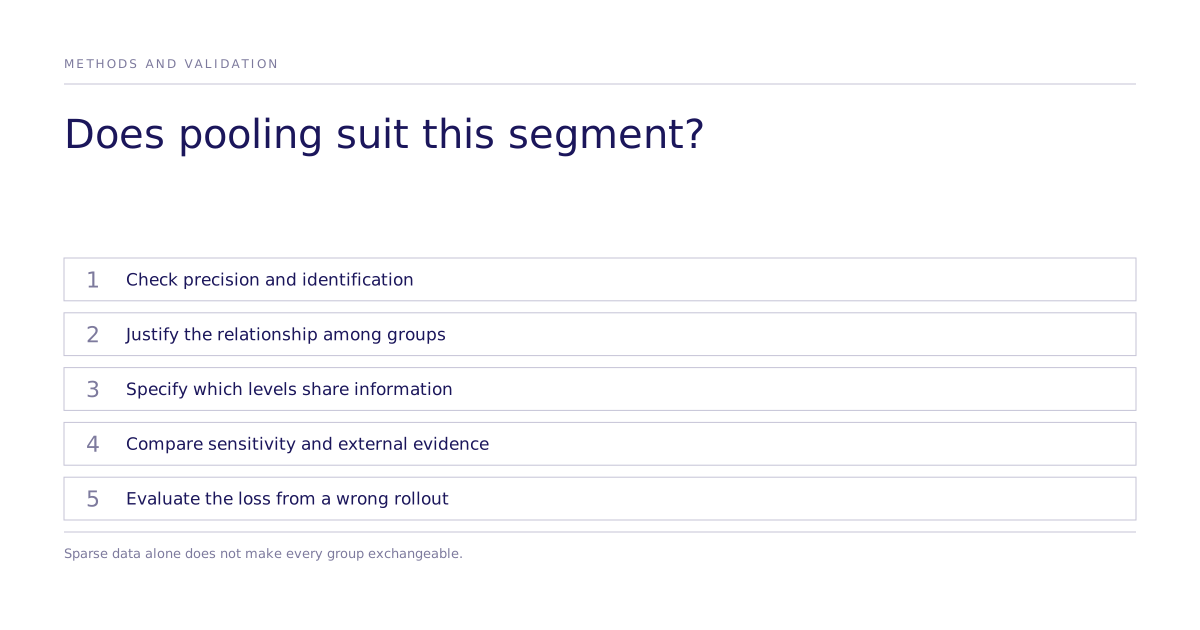
What this means for reading a causal experiment's segment output
Ask how the named segment effect is estimated, which levels share information and how uncertainty is computed. Mixed logit can represent taste heterogeneity without shrinking your specific region or persona coefficient. Do not shrink an already hierarchical estimate again; also do not assume every mixed-logit segment summary has been partially pooled.
The rollout decision depends on segment precision, identification, group assumptions and the cost of a wrong action. If using a modeled segment effect, plan a matched human or market comparison with a declared audience, treatment, endpoint and agreement criterion. Document any protocol changes and confirm recruitment, outcome access, fieldwork and reporting responsibility in the study brief. The external check can disagree or remain inconclusive.
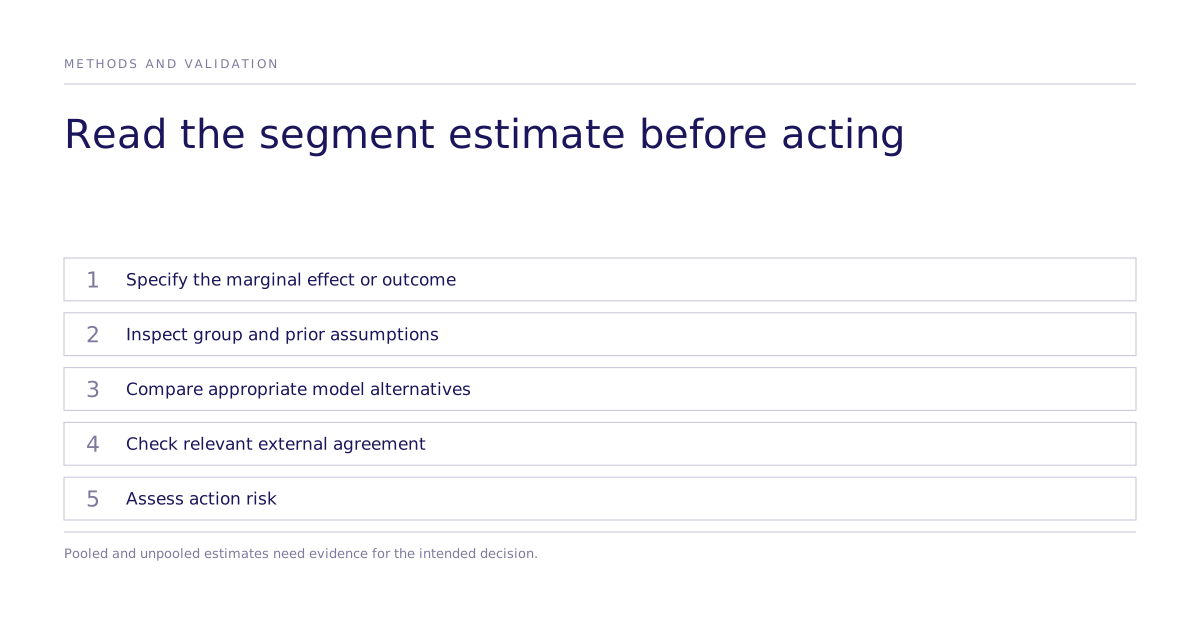
The takeaway for a buyer decision
Before acting on a segment marginal effect, choice probability or WTP estimate, inspect precision, identification, group assumptions and relevant external evidence. Compare pooling alternatives when the segments are plausibly related. A noisy estimate is uncertain evidence, rather than proof that the effect is zero. Review methodology or discuss the segment decision.