AI Ad Creative Testing in 2026: Four Approaches
A performance marketing lead running paid social can end up with more creative variants queued in a single week than any pre-launch study could review before the budget goes out the door. The instrument that screens those variants isn't the same instrument that explains why an audience responds the way it does, and picking the wrong one for a given decision either wastes spend or wastes weeks.
Why one instrument stopped being enough
In an invented high-volume workflow, a team has dozens of variants and a fixed testing budget. Screening, human reactions, stated-choice experiments and modeled campaign scenarios answer different questions. Compare actual input requirements and measured turnaround rather than assuming a universal variant count or timetable.
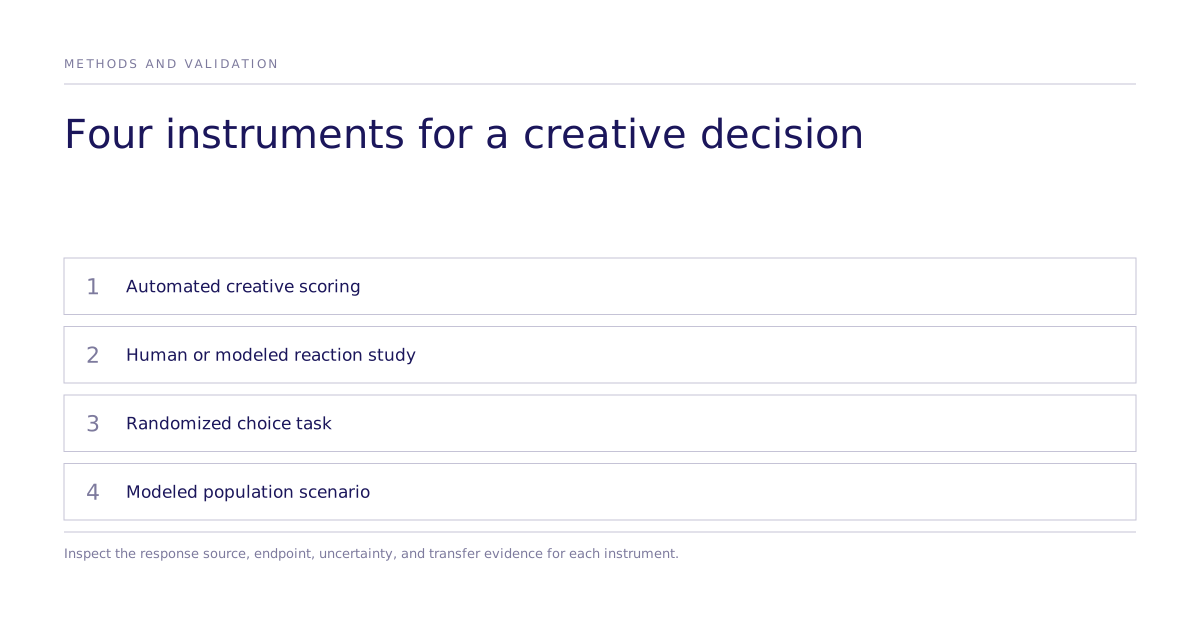
Four instruments, four different questions
What is automated creative scoring?
Automated scoring can help prioritize assets when its prediction is calibrated for the format and audience. System1's Test Your Ad Screen is a current example. Review its output construct and false-rejection risk before discarding a fixed fraction of the shortlist; a score may support diagnostics as well as ranking.
What is panel-style reaction testing?
Reaction studies can examine interpretation and objections from actual or modeled respondents. Attest offers real-consumer research. Verify respondent source, stimuli, coding and subgroup support; a short qualitative session does not automatically estimate population effects.
Large-scale campaign simulation
A simulation can compare modeled population scenarios. Aaru's product-innovation page describes modeled adoption and switching scenarios. Inspect whether the offered product supports the specific campaign question, inputs, outcome, and validation needed.
Controlled causal experiments
A discrete choice experiment uses designed multiattribute profiles, often varying several attributes together. Randomization and support allow estimable contrasts; inspect restrictions and interactions. Multinomial or mixed logit are analysis models. The ISPOR analysis task-force report provides analysis guidance. Subconscious's working paper reports benchmark parameter-rank agreement, rather than validating every creative effect or observed sale.
Matching the instrument to the decision
| Instrument | Outcome | Evidence to request | Fit |
|---|---|---|---|
| Automated scoring | Predicted creative metric | Format-specific calibration and false-rejection checks | Prioritization |
| Reaction study | Reported interpretation or reaction | Respondent source, coding and coverage | Discovery and diagnosis |
| Randomized choice task | Effect on stated choice | Assignment, attribute support, interval method and transport | Trade-offs among alternatives |
| Population simulation | Modeled scenario outcome | Population representation, held-out outcomes and uncertainty | Scenario exploration within validated scope |
What does a causal experiment not cover?
A randomized choice task can estimate contrasts on stated choice. A field campaign test measures delivered behavior; a modeled scenario estimates an outcome under its assumptions. Each requires evidence for its own endpoint and population. A generated explanation does not independently establish why a creative worked.
Building a stack instead of picking one tool
A team may combine instruments if they answer distinct parts of its decision. For example, screening can prioritize variants for a human study, and a choice task can examine attribute trade-offs. Use a live test for the deployed conversion outcome when required.
Name the decision, endpoint, evidence required, and consequence of error before comparing features. Review the published research or discuss the comparison.