8 AI Buyer Simulation Approaches for B2B Sales Teams in 2026
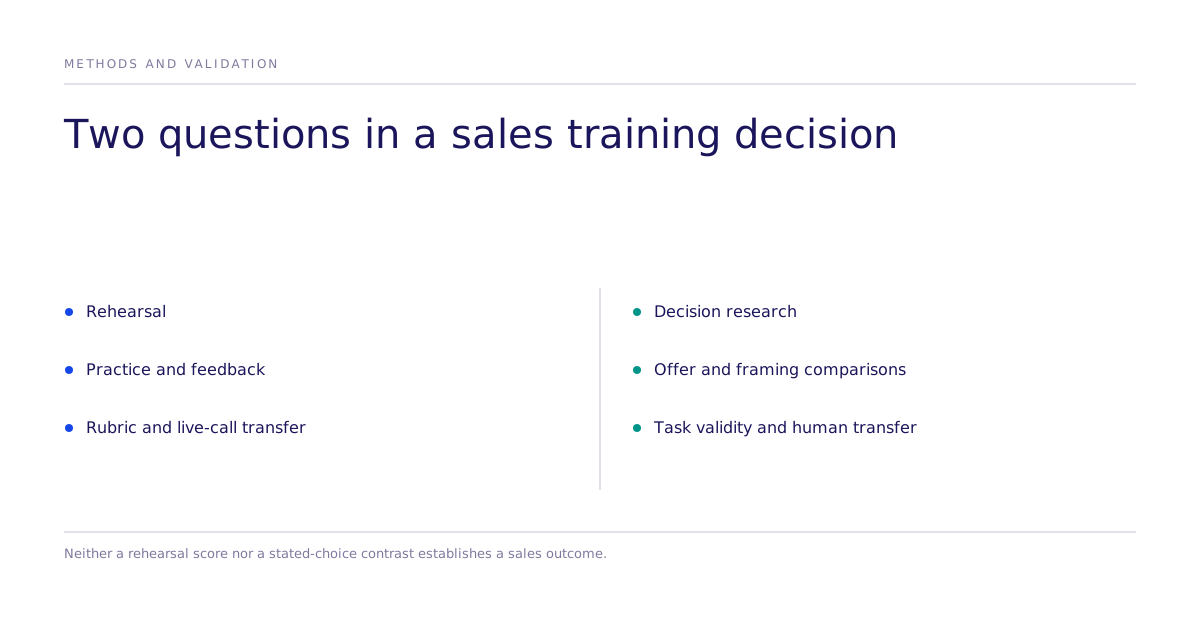
A sales-enablement leader evaluating buyer simulation needs to answer two questions: does the tool provide useful practice and feedback, and what evidence grounds the counterpart's objections? This article compares eight ways to configure rehearsal. Inspect each product's inputs and validation rather than assuming plausible dialogue predicts an actual buyer's decision.
That gap has a cost: a rep who has rehearsed twenty plausible objections can still hear the one nobody scripted, because the tool never tested whether it moves the buyer's decision at all.
Two different jobs wearing the same label
Rehearsal tools provide repetition through simulated conversations and feedback. Evaluate whether practice improves the team's defined skill measures and transfers to live calls.
Decision research compares defined offer terms or messages on a specified outcome. A randomized discrete-choice design can estimate stated-choice contrasts; grounding and human validation determine how those contrasts transfer. The design does not test an entire conversation or guarantee a closed deal.
A rehearsal score measures the behavior included in its rubric. To check whether the script raises relevant objections, inspect customer calls, win-loss interviews, account evidence, and targeted experiments. A tool may use those sources, but its validation must match the claim.
What is a rehearsal platform actually built from?
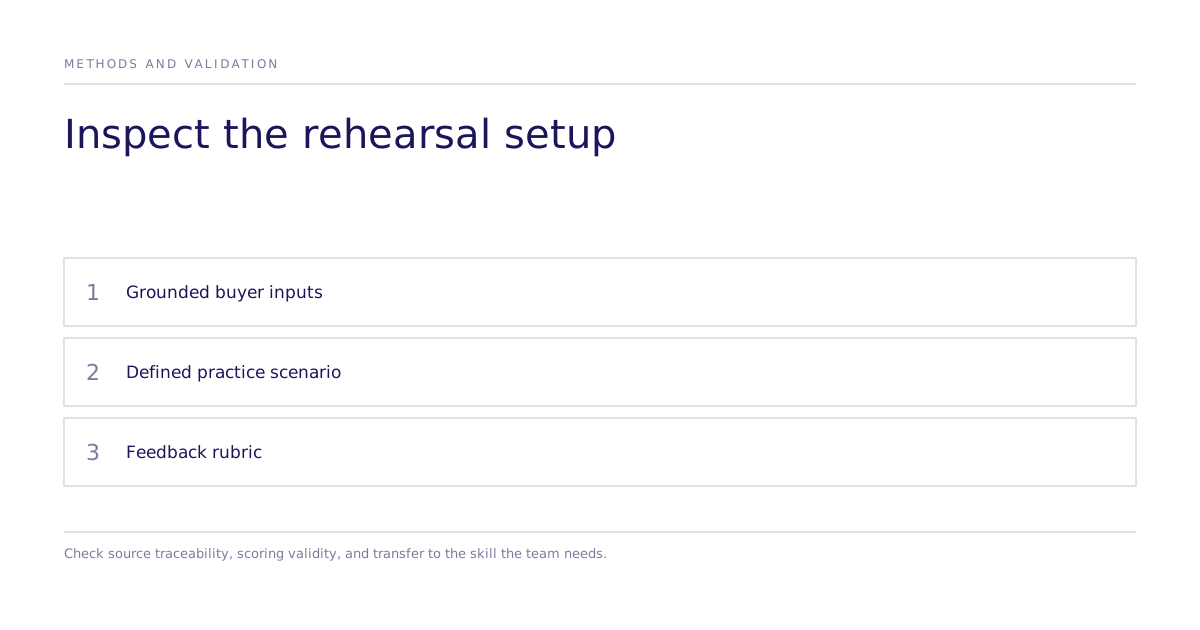
Three components provide a useful inspection framework for rehearsal software:
A buyer profile built from role, company context, priorities, and objections. Ask which inputs are evidenced, which are inferred, and how they stay current.
A simulated conversation that walks through discovery, a demo, a pricing discussion, or a procurement exchange, with the simulated counterpart pushing back the way a real buyer might.
A feedback layer that flags a missed signal, a weak question, or an objection the rep handled poorly, then rolls that up into a team-level view of where the gaps sit.
8 approaches to rehearsal software worth understanding
These eight configurations are a buying framework, not an exhaustive market taxonomy or a vendor ranking. Match the setup to the training bottleneck and request evidence for the specific product.
1. Cold-call and discovery-call scoring
Built for structured outbound, this pattern grades call mechanics: talk-listen ratio, pacing, and whether the rep covered the discovery questions the playbook calls for. It fits SDR and BDR teams where volume and consistency matter more than deep account context.
2. Named-account buyer rehearsal
This pattern ties a simulated counterpart to a specific account already in the pipeline, so an account executive rehearses against something closer to the actual deal than a generic role. It suits reps preparing for one high-stakes call, not a broad practice cadence.
3. What is new-hire ramp simulation?
For example, sequence scenarios around a new rep's ramp plan. Define scored competencies before using a simulation as a readiness gate for live calls.
4. Broad enablement suites with roleplay attached
Some platforms bundle rehearsal into a larger training system that also handles product certification and other competencies. Buyer simulation is one module among several, not the core product, which suits an organization consolidating multiple training tools into one system.
5. What is communication-mechanics coaching?
This pattern treats buyer simulation as secondary to delivery: voice, pace, filler words, and structure. It is closer to a presentation coach than a buyer-modeling tool, and fits teams whose main gap is how a pitch is delivered, not what is in it.
6. Playbook and certification bundles
Here rehearsal sits inside a wider enablement stack that also tracks playbook adherence, certification status, and ramp progress. The value is one system of record, not depth on any single piece, including the buyer model.
7. Research-plus-rehearsal bundles
This configuration places account research next to a practice session. Check source traceability and how the research changes the counterpart, then compare the resulting objections with actual account evidence.
8. Self-serve buyer-cloning platforms
A reusable persona or account configuration can support objection mapping, discovery practice, demo rehearsal, and pricing practice. Check whether sharing it across teams preserves version history and the distinction between known facts and inferred behavior.
Where the practice ends and the decision research starts
A practice scenario does not establish that a buyer would actually have that conversation. Account evidence and evaluation with real customers can check its relevance.
A Subconscious study can compare specified offer, price or framing alternatives in a modeled audience. The public causal-fidelity working paper, not peer reviewed evaluates agreement on estimated choice parameters. It does not validate call rehearsal, objection realism, ramp speed, or sales outcomes. Request evidence for the task that will inform the training script.
For the offer or framing comparison, request the task, audience, estimator, uncertainty and independent comparator. If the engagement also needs call scoring or rehearsal, confirm those features and deliverables separately. Confirm recruitment, fieldwork and reporting responsibility for any human comparison. Inspect the case studies and method evidence for the outcomes each actually supports.
A sequence that avoids the blind spot
A team evaluating a high-stakes pitch or objection set can run both tools without conflating their jobs:
First, test the underlying decision: run the controlled comparison described above against the target buyer segment before any script gets written.
Second, combine the measured finding with customer evidence when writing the scenario. A choice effect does not supply a verified account of the buyer's reasoning.
Third, run practice sessions against the skills and objections the team needs to assess. For an illustrative pilot, assign comparable reps to the proposed training and current training, specify the competency rubric, and observe transfer on live calls.
Measure ramp using a defined endpoint, such as independently meeting the qualification rubric or reaching a first qualified opportunity. Compare cohorts while accounting for pipeline, territory, and tenure. No achieved ramp reduction is claimed here; the pilot must establish the result for this team.
Limitations to keep straight
Naming this failure mode here is what lets a buyer check it against how their own team uses both tools. A rehearsal tool that scores delivery mechanics is not decision research, and decision research is not a substitute for repetition: conflating the two leads a team to over-trust a scorecard as proof a pitch works, or skip rehearsal because the offer was already tested.
A matched human study can check an offer or framing contrast on the same task. It does not establish that reps will deliver a script well or close more deals. Validate those endpoints in the training and sales workflow.