AI Consumer Behavior Analysis: Move from Events to Causes
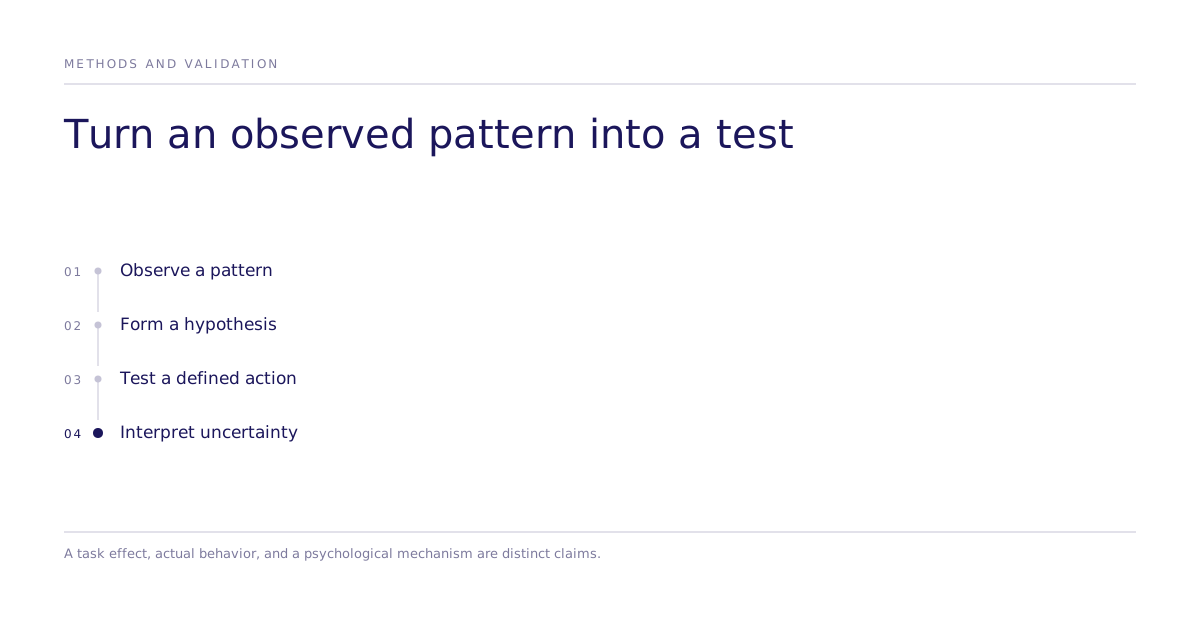
For an illustrative analytics pattern, suppose 34% of users leave after the third screen and churn rises in month four. Those observations identify where to investigate; they do not by themselves establish what caused the drop.
Behavioral data records events. Consumer behavior analysis studies the triggers, tradeoffs, habits, and context that produced them. Causal experiments test whether a specific action changes an outcome.
What does consumer behavior analysis study?
Consumer insights cover attitudes, preferences, and perceptions. Behavior analysis focuses on the decision process: triggers, heuristics, emotional changes, and post-purchase rationalization.
The discipline draws from behavioral psychology, cognitive science, and decision theory. Useful questions include:
- What starts an evaluation?
- Which heuristics dominate the category?
- When does habit replace deliberate choice?
- What causes a loyal customer to switch?
- How does a post-purchase explanation affect repeat behavior?
Why can't analytics alone identify the mechanism?
Customers who use a feature may retain better because the feature creates value, or because they belong to a segment already more committed.
A discount may change renewal, postpone cancellation, or affect revenue without improving retention. An experiment with suitable outcomes and follow-up can compare those possibilities. Observational event data can also inform causal inference when a defensible design and assumptions support it.
Surveys also have limits. People often cannot accurately report the mental process behind a choice, and instead construct a plausible-sounding account after the fact (Nisbett & Wilson, "Telling More Than We Can Know," Psychological Review). Treat stated reasons as evidence to compare with behavior, not as the cause by default.
Use simulations to form behavioral hypotheses
Build the audience profile around how a person decides, not just who they are: the habits that govern the category, how much risk they carry into the choice, how they hunt for information, and the brand history they bring. Causal experiments can then test the resulting hypotheses against a specific choice.
Probe the search trigger, first criterion, information source, moment of friction, and final tradeoff. Map when a repeated behavior shifts from deliberate choice to habit and what might interrupt it.
Generated probes can broaden the hypotheses considered without recruiting a new participant for every prompt. Setup and validation still matter. They do not observe lived experience or provide an equivalent substitute for ethnographic evidence.
Decisions that benefit
Product design
Study the habits a product must fit or displace: one requiring a new routine needs a different adoption plan than one that fits an existing workflow.
Retention
Map the sequence that precedes cancellation. Identify when value erodes, when switching feels easier than staying, and which intervention might alter the path.
Messaging
Compare messages against the decision mechanism. A segment motivated by regret avoidance may respond differently from one motivated by aspiration.
Competitive strategy
Model what keeps a competitor's customers and what might prompt reconsideration. Use public evidence and validate the hypotheses.
Pricing
Compare how segments interpret price points and value arguments. Frame the output as decision-specific scenario testing, not a live automated price optimizer.
Start with one decision
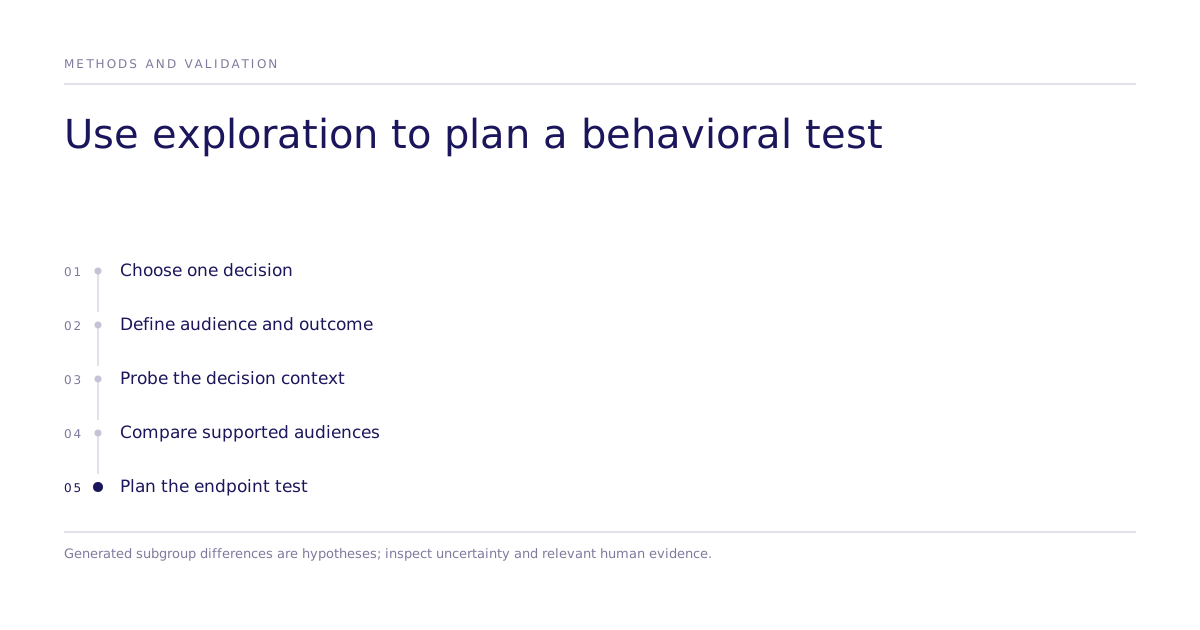
A team does not need a six-figure research budget to frame a behavioral question. Pick one decision based on an unexplained pattern. Define the audience, alternatives, and outcome.
Probe a defined path from trigger to commitment, then repeat the protocol across audience variants supported by the available evidence. Treat disagreements as hypotheses; inspect uncertainty and human evidence before concluding that a policy is too broad.
Simulation supplies hypotheses and analytics supplies observed patterns. A designed experiment can estimate an action effect for a defined endpoint. An effect does not automatically identify its psychological mechanism. See how we work for scoping and validation.