AI Customer Service Training with Simulated Customers
Training customer service reps forces an uncomfortable trade-off. Classroom cases are safe but tidy. Live calls are realistic, but the customer pays for the agent's learning curve.
A service-training lead can use simulated drills to practice a defined skill before live customer contact. This article gives general guidance for evaluating a rehearsal tool; it does not describe a Subconscious call-simulation product.
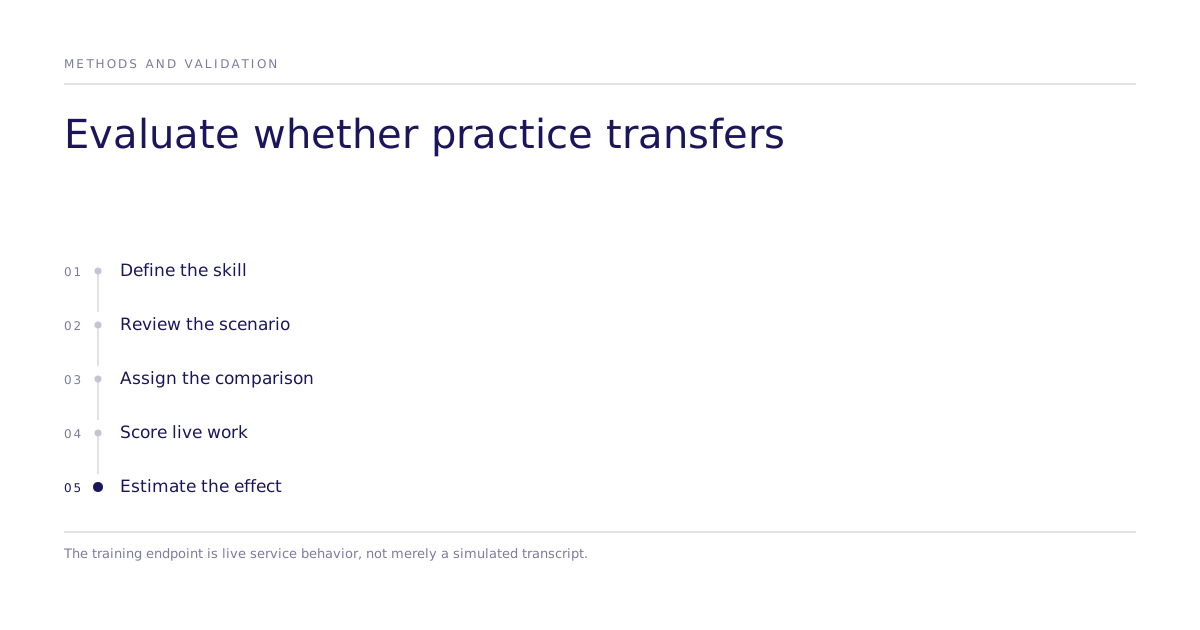
Why service training breaks down
Three problems recur.
Roleplays do not feel real. When two trainees play an angry customer and an agent, both know the script. Real callers interrupt, ramble, and change the subject.
Live coaching is scarce. Senior agents split time between escalations and coaching, leaving little for repeated drills.
Edge cases arrive late. A new hire may not see a rare regulated dispute, a bilingual call, or an unusually confused customer during the first month. When the case finally appears, the agent has not practiced it.
Training quality and retention depend on the role, team, workload, and support. The CallForce vendor article discusses call-center attrition; it is not evidence for a universal ninety-day turnover spike or a causal training effect. Measure those endpoints in the team being evaluated.
What should a useful simulation test?
A useful simulation responds to the agent's choices. If the agent acknowledges the problem in the first thirty seconds, the scenario should change. If the agent moves straight to policy, the scenario should expose the consequence. The exercise should produce a transcript that a coach can inspect line by line.
The same case should support repeated runs with different openings, questions, and escalation points, plus meaningful variation across customer contexts. The point is not to prove that a persona is a real person; it is to test whether a training action changes the behavior being measured.
Scenarios worth practicing
What does an angry caller scenario look like?
For an illustrative scenario, the caller has been transferred twice, believes the bill is wrong, and wants to cancel. Score whether the agent acknowledges the concern and diagnoses the issue under the team's rubric, rather than imposing a universal thirty-second rule.
A billing dispute
The customer believes they were overcharged while the account record shows the charge as correct. A workable script moves through four beats: verify what was billed, walk through why, name the surprise the customer is feeling, then lay out what happens next.
Technical confusion
The customer's description and the underlying issue differ. The agent must ask one or two well-placed questions without making the customer feel dismissed.
A compliance edge case
The exercise can test whether required language appears in the transcript. The scenario and scoring rules need review by the organization's legal and compliance owners before use.
A non-native speaker
The agent must slow down, reduce jargon, and confirm understanding. The exercise should measure the agent's adaptation, not judge the customer's language.
What measures support coaching?
Useful measures include de-escalation speed, acknowledgment before problem-solving, diagnostic accuracy, required-language adherence, and resolution-path quality. Each measure needs an explicit scoring rule. A transcript can show what happened; it does not establish that the score predicts live performance without validation against real calls.
Simulation should complement the CRM, knowledge base, quality process, and human coaches. Text reduces the load while an agent learns the structure. Voice adds pacing, interruption, and tone.
Teams often look for three patterns: faster progress toward acceptable quality, better preparation for unfamiliar cases, and lower early attrition. Those are hypotheses to measure, not guaranteed outcomes. Even hundreds of practice repetitions only matter if the practice transfers.
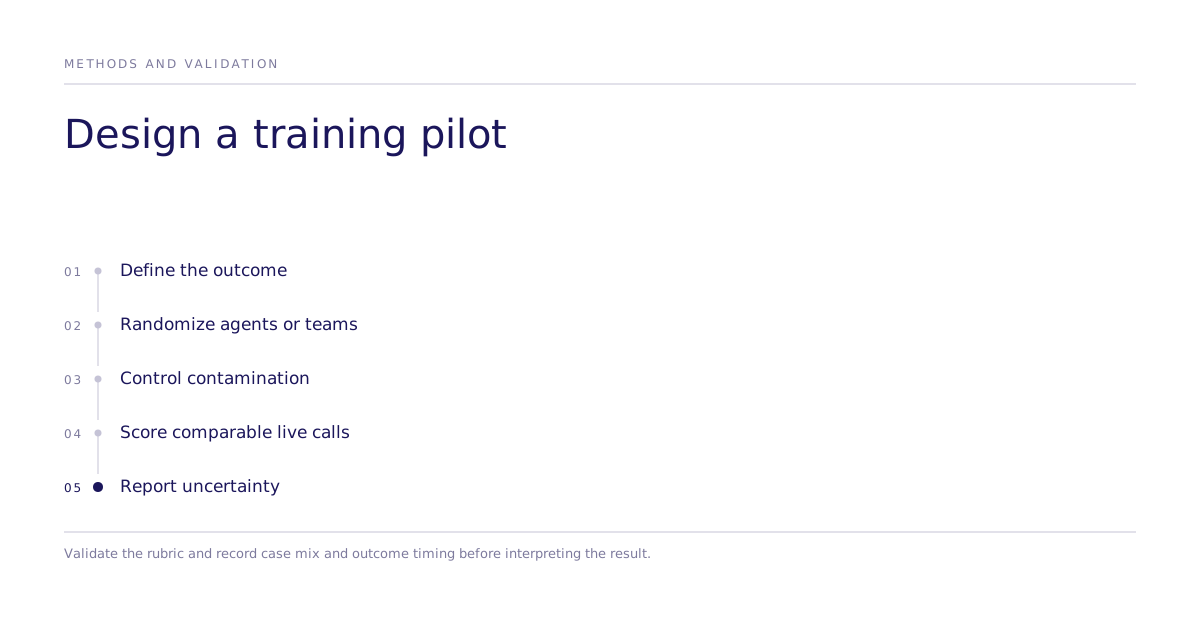
A small evaluation design
Choose a third-party rehearsal tool or the team's existing practice process. Scope scenarios, scoring, review, and lead time from the actual call types. Subconscious's design process concerns decision experiments; branching calls and transcript coaching are not asserted as product features here.
For an illustrative pilot, select the call types that matter and randomize eligible agents or teams to the proposed drills or current training. Define baseline skill, comparable case mix, a blinded quality rubric where feasible, outcome timing, and uncertainty. Control sharing between groups where it could contaminate the comparison. Discuss a decision experiment separately from procuring the rehearsal product.
The causal question is whether the training improves the specified service behavior under the tested conditions. Validate the scoring and evaluate live work; a successful simulated transcript alone does not establish transfer.