AI Persona Tools vs. a Controlled Behavioral Experiment: Which One Answers Your Question?
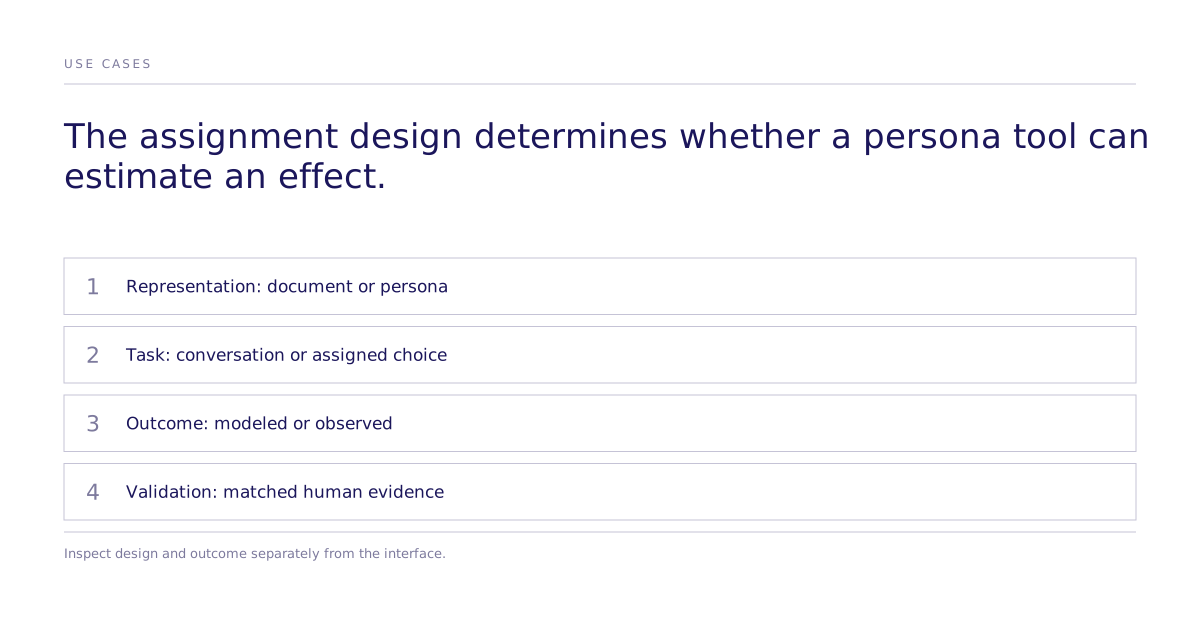
Teams comparing AI persona tools should first identify the task: describing an audience, proposing hypotheses, or estimating a contrast between assigned actions. An experiment defines alternatives and an outcome; its interface alone does not establish human fidelity.
Why the persona-tool comparison misses the buyer's actual decision
Persona software has moved through three phases. Early tools produced a static document: a name, a quote, a few attributes, meant for a slide. A second wave grounded that document in analytics, CRM records, or interview transcripts, trading imagination for real customer data. A third wave made personas conversational, so a team could ask a simulated buyer questions instead of reading about them.
A detailed persona can suggest a response to a hypothetical price, but the answer needs evidence before being used as a buyer forecast. Batzner and colleagues reviewed 63 peer-reviewed persona-based LLM studies and found gaps in task and population specification; only 35% discussed persona representativeness. That finding concerns reporting in the reviewed studies, not how convincing a persona sounds or the fidelity of this buyer audience.
Four things buyers say they need from a persona tool
Teams evaluating persona software are usually trying to solve one of four separate problems:
- A static reference document for a deck or brief.
- A queryable profile they can ask follow-up questions.
- A panel of profiles they can run the same question across, to see how answers vary.
- A programmatic library engineers can wire into other tools or simulations.
These formats serve different jobs, but format alone does not determine whether an experiment is possible. A persona or panel system can participate in a randomized design. Ask how alternatives are assigned, which outcome is measured, and which evidence validates the result.
Comparing what each method actually produces
| Method | What it produces | Best used for | What it can't tell you |
|---|---|---|---|
| Static persona document | A written profile: goals, quotes, demographics | Aligning a team on who the target buyer is | Whether a specific message, price, or feature changes that buyer's choice |
| Data-grounded persona | A profile built from a company's own analytics or CRM data | Keeping a persona current with real customer signal | How the buyer would respond to something the company hasn't tried yet |
| Conversational persona | A chat interface that answers questions in a buyer's voice | Early-stage ideation and stress-testing a concept before it's built | Whether the fluent answer reflects what a real population would choose |
| Programmatic persona library | Code-level agents for engineering-side simulation | Building custom tooling or research infrastructure | A ready decision recommendation without additional experimental design |
| Controlled behavioral experiment | A measured comparison between alternatives on a defined outcome | Deciding which price, message, or launch action to commit to | Open-ended exploration outside the decision the experiment was designed to test |
What does a controlled experiment add that a persona conversation can't?
A controlled experiment assigns alternatives according to a design; it can vary one attribute or several through a factorial design. Scope the generated endpoint and relevant human evidence with Subconscious, documenting recruitment and instrument differences. A within-model contrast and an observed human contrast are separate evidence.
A persona conversation can suggest why a buyer might prefer a headline. A randomized simulated comparison estimates how changing the headline affects modeled choices under the test conditions. A human experiment measures choices from its recruited participants; neither result alone establishes realized sales.
When is a persona tool still the right call?
A static document can align a team on a provisional audience description. Conversational tools can propose questions during exploration. Programmatic persona libraries require additional design and validation for the actual research task.
Subconscious is built for a narrower, later moment: once a team has a specific action to decide on. A price. A message. A launch narrative. A feature to ship or kill. That's the point where a description of a buyer stops being enough, and a measured comparison between real alternatives becomes worth the setup.
The practical next step
If the question concerns audience definition, inspect customer evidence and use persona representations provisionally. If it compares actions, define the measured choice outcome and assignment design, then assess the human evidence needed before a consequential decision.