Before You Trust a Simulated Buyer Study, Ask What Validates It
Assess a simulated study through its configured audience, assignment design, measured endpoint, and relevant human evidence. A CMO preparing a production commitment needs to know what corresponds to real buyer response. A fluent transcript alone does not establish that correspondence.
The real choice: prompt-based reactions or a validated experiment
The question for a CMO or VP of Insights is rarely whether to test messaging before it ships. It is whether a prompt-based reaction from a language model is sufficient evidence to greenlight that message, or whether the decision needs a controlled, causal experiment validated against real human behavior.
A modeled panel that reads as confident and directionally positive, but has quietly collapsed the variance and reasoning diversity a real audience would show, sends a campaign into production on a false signal. The message ships, real buyers don't move, and the miss stays invisible until the media budget is spent and the launch window has closed.
Why can fluent output still mislead?
Peer-reviewed work on large language models as stand-ins for real survey respondents documents specific, repeatable failure modes, not random noise. Models conditioned on demographic or attitudinal backstories can flatten the diversity of real opinion, understate disagreement, and produce answers that look more internally consistent than any real population is (Cambridge University Press, Political Analysis). A related study on digital personas approximating human survey findings concludes reliability is conditional: it depends on question type and calibration method, not the underlying model alone (arXiv).
Neither paper concludes that modeled respondents are useless. Both put the burden of proof on whoever ran the simulation: an ungrounded conversation is a hypothesis, not evidence.
What does a controlled experiment change?
A controlled design estimates effects of assigned alternatives within the simulation. It reduces ambiguity about the comparison but does not eliminate demographic flattening, shared model bias, or variance collapse. Validate those failure modes separately before interpreting segment differences.
Ask which data defines the audience, which segments are covered, and what human evidence calibrates the modeled responses. A population model is not a pool of recruited participants.
Close the loop with relevant human evidence
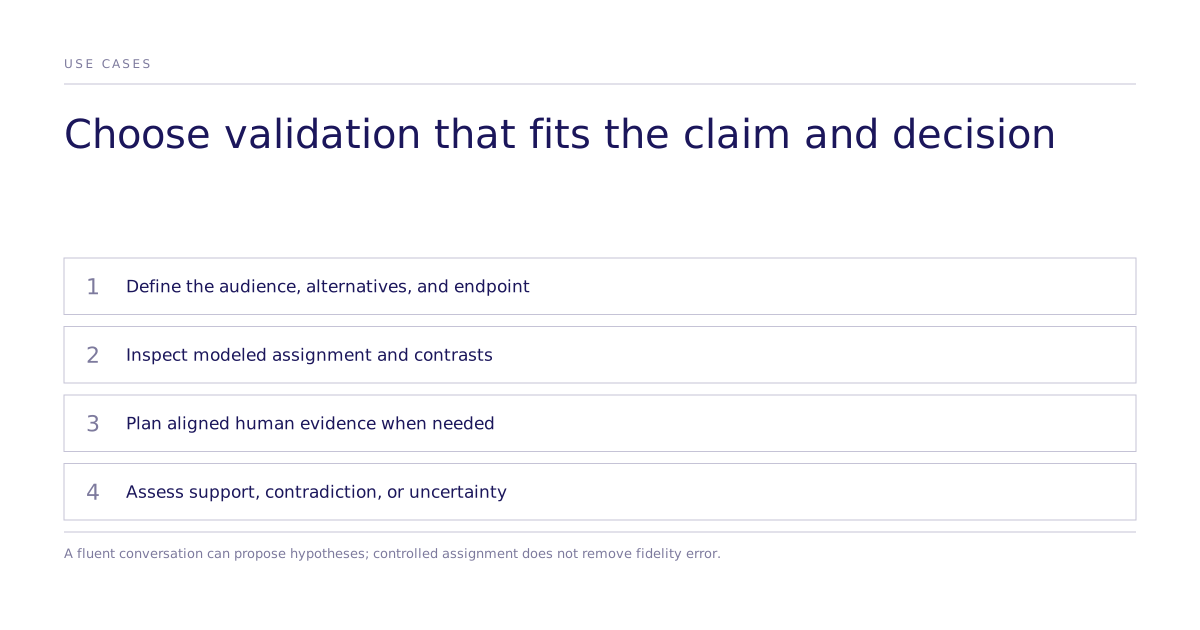
Plan an aligned human comparison when the decision requires evidence beyond the configured model. Preserve the alternatives and endpoint where possible, document recruitment and instrument changes, and agree delivery. The check can support, contradict, or leave the generated result inconclusive.
A matched human replication can confirm, contradict, or leave the simulated result unresolved. Open-ended conversation tools can also be checked against independent interviews; the relevant question is whether the validation matches the claim.
| Question the study answers | Instrument | What the answer is worth |
|---|---|---|
| Which alternative should advance to production? | Controlled experiment on a simulated market | A directional comparison, useful for screening before spend commits |
| Does the contrast hold with relevant people? | Aligned human comparison with documented recruitment and task differences | Human evidence may support, contradict, or leave the model unresolved within the tested scope |
| What share of the market will buy? | Neither result alone | Relevant sampling and observed purchase evidence; choice-task precision does not certify adoption |
Where does the method still fall short?
A controlled simulation, validated or not, has real limits a CMO should weigh before treating any result as final:
- It does not certify a market-share or adoption number. A comparison showing message A outperforming message B is not a forecast of real market share.
- Novel behavior weakens extrapolation. A new category, crisis, or cultural moment may lack a comparable baseline. Treat a modeled result as a hypothesis until relevant human evidence tests it.
- It does not substitute for regulated or safety-relevant human-subject research. Contexts carrying legal, medical, or safety weight require real participants under the applicable protocol.
- Real-human validation checks one study, not the method generally. Confirming one finding with real participants does not certify every other simulated result the team has run.
Sequencing the test before the budget commits
- Define the decision, the alternatives, and the population before touching any tool. Vague segments and vague messages produce vague comparisons.
- Run the controlled comparison against the simulated population and look at which alternative moves the outcome, not which one sounds most persuasive.
- When fidelity or decision consequences require it, check the finding with suitable human evidence using aligned alternatives and endpoint.
- Treat an unvalidated conversation with an AI stand-in as a starting hypothesis for a real study, not the study itself.
Inspect the aggregate replication evidence and limits, review the research approach, and scope the decision using the actual alternatives, population, and required evidence.