The Future of Market Research: Where Simulation Stops and Human Evidence Starts
A research budget should match each decision to the evidence it needs. Simulated comparisons can examine defined product, pricing, messaging, and go-to-market alternatives. Human research and observed outcomes remain necessary where the decision depends on evidence that the simulation has not established.
That boundary belongs in the research budget and headcount plan. Without it, a team can mistake a simulated result for human evidence or keep every question in the same fielded workflow, even when the questions carry very different costs of error.
Plan research around decision evidence
Greenbook’s June 2025 commentary on the GRIT Business Outlook discusses growing AI use and data-quality concerns. The commentary does not establish buyer adoption rates or task-specific validity. Evaluate synthetic respondents through their relevant validation evidence.
A team considering generated or simulated material needs to decide which questions it can support, how the results will be checked, and where another study is required. Make those choices from population coverage, measurement, calibration, and the consequence of error.
Separate the study’s jobs when planning the workflow. Exploration can frame hypotheses. An assigned comparison can estimate differences between defined actions within its design. Human research can supply direct testimony, calibrate assumptions, or independently check a simulated result.
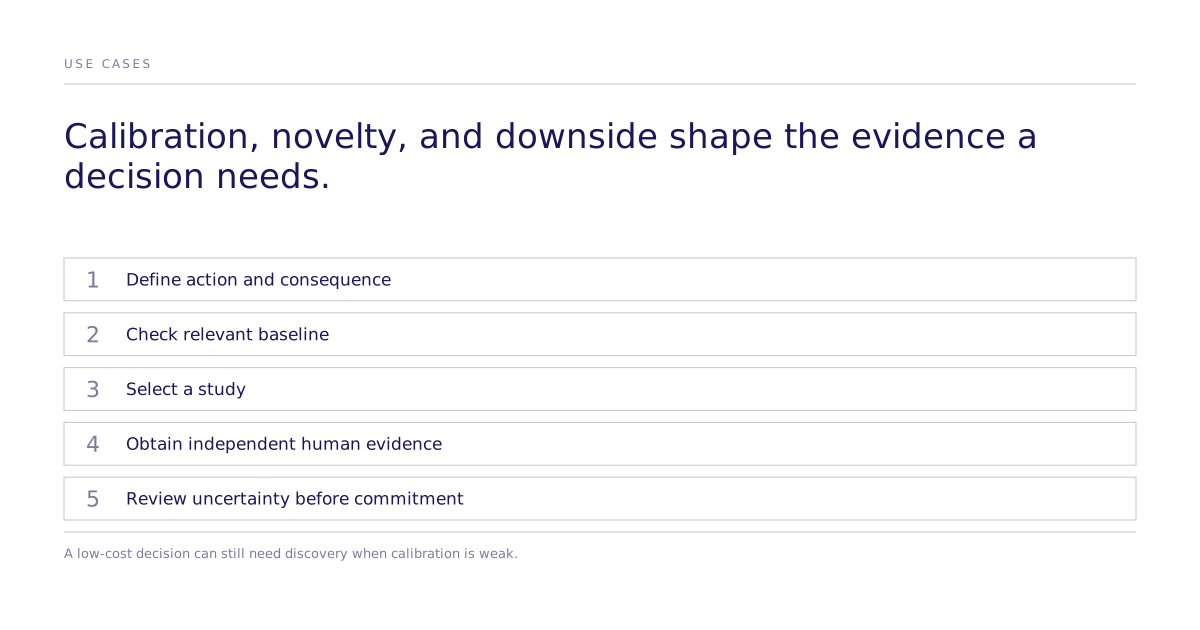
Allocate rigor according to the cost of error
Novelty matters because it can weaken calibration. Stakes, audience coverage, measurement, and the reversibility of the action also shape the validation plan.
| Decision class | What the team needs to learn | Appropriate evidence path |
|---|---|---|
| Early concept or audience hypothesis | Which ideas deserve a defined test | Exploration, then a human, simulated, or live comparison selected for the question and available evidence |
| Product, messaging, or go-to-market choice | Which defined action changes a specified outcome in the study | An appropriately assigned comparison, with simulation results labeled as modeled and interpreted within their validation limits |
| Pricing, claims, or regulatory-adjacent message | Whether the evidence supports a consequential commitment | Relevant human or observed-outcome evidence and applicable legal review; simulation can be a preliminary stage where useful |
This allocation helps teams avoid spending fieldwork effort on every preliminary question and committing budget on a modeled result that lacks relevant validation. It does not guarantee that a study will settle the decision.
Convert the business choice into an action test
The most useful research question names an action and a consequence. Instead of asking what an audience thinks about a launch, define the launch choices and the behavior that would distinguish them. Instead of asking whether a price feels acceptable, compare the actual price actions under consideration.
Subconscious structures assigned alternatives and specified outcomes on a simulated population. Confirm whether audience coverage, calibration, and measurement fit the proposed comparison. The result remains modeled evidence for that task; aggregate method comparisons do not validate every new product or market.
Qualitative work can clarify language, surface concerns, and propose explanations to investigate. An assigned action test estimates differences in a specified outcome. Neither a participant’s explanation nor a generated rationale alone establishes why the effect occurred.
Preserve the human evidence boundary
A simulated population is not a recruitable human group. Audience reach in simulation and recruited participants in a validation study are separate stages.
Preserve the decision question when moving to human evidence, while adapting recruitment, measurement, and power as needed. A matched human study may confirm, contradict, or leave the simulation unresolved; it is not automatic proof of market performance.
Fielded interviews and surveys can calibrate assumptions, investigate language, and reveal conditions that a defined experiment did not represent. They should remain in the plan wherever the decision needs direct testimony, population-specific recruitment, or evidence that a simulation cannot supply.
Write the boundary into next year's plan
The budget decision becomes more defensible when every major research question is assigned an evidence path before a study begins:
- Name the action the business may take.
- Record the cost of choosing poorly, including capital, roadmap, brand, or compliance exposure.
- Define the population, alternatives, and behavioral outcome that the experiment will represent.
- Specify what validation the decision needs, including independent human or observed-outcome evidence where current calibration and measurement leave a consequential gap.
- Keep exploratory findings, simulated experimental evidence, and human evidence labeled separately in the final recommendation.
This produces a portfolio of evidence rather than a contest between methods.
Choose the decisions that deserve a causal test
Start with the decisions that carry the largest cost of error and the clearest competing actions. Review how the workflow runs from question to evidence, then discuss a specific decision and its validation boundary.