Grounded AI Conversation Tools vs. Causal Experiments: Which One Answers Your Launch Question
A grounded conversation tool is useful for exploring what a type of buyer might say. It is not evidence for what that buyer will do. Those are different questions, and mixing them up is how a directionally clean-looking test ships a launch decision the market doesn't confirm.
What does a grounded conversation tool actually do?
This category of tool builds a structured model of a customer type: role, context, history, values, decision patterns, communication style. It then grounds that model in real data such as interview transcripts, domain knowledge, or product-usage patterns. A consistency layer keeps the model's answers stable across different questions and phrasings, which is what separates it from typing "act like a procurement manager" into a general-purpose chat model. The output comes through a conversation interface: one exchange, a multi-model session comparing several customer types at once, or a structured interview script. A synthesis layer then compares the responses and pulls out themes.
That stack answers qualitative questions well: what objections would this buyer raise, what language lands, what's confusing about a concept. It is not built to answer a quantitative one, such as what share of buyers would pay a given price, because a single grounded model produces one consistent point of view, not a distribution of real buyer behavior.
Where does the accuracy break down?
Grounding quality drives the ceiling: a model calibrated on real customer interviews produces better signal than one built from assumptions, and the discipline is younger than traditional survey methods, so calibration practice varies by vendor. Independent research on this exact failure mode found that pushing a language model to sustain many distinct conversational identities compresses their diversity over long sessions, with output drifting toward a smaller set of default responses even when the prompts describe different people (Chameleon's Limit: Investigating Persona Collapse and Homogenization in Large Language Models, arXiv). Separate work on aligning generated profiles to real population distributions treats that alignment as an open research problem, not a solved one (Population-Aligned Persona Generation for LLM-based Social Simulation, arXiv). Neither result makes the category useless. Both mean a conversation transcript from a grounded model is a hypothesis about a market's reaction, not a measurement of it.
"Counter-intuitively, the models achieving the highest per-persona fidelity consistently produce the most stereotyped populations"
Xiao and colleagues, "The Chameleon's Limit: Investigating Persona Collapse and Homogenization in Large Language Models," arXiv (source)
The comparison that matters for a launch decision
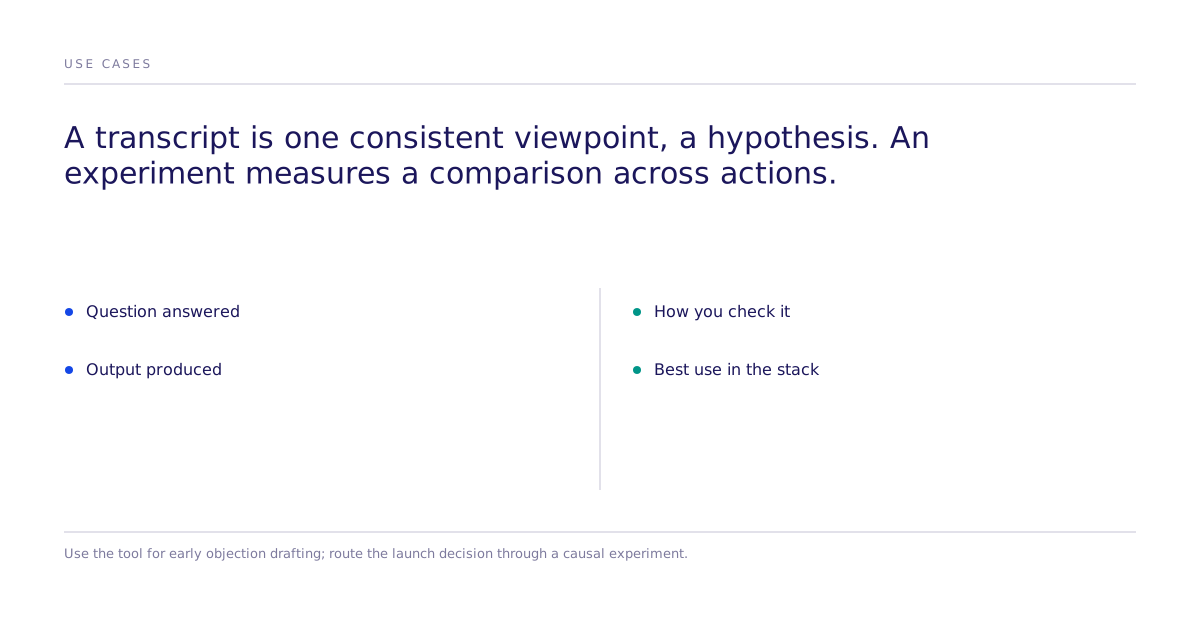
| Grounded conversation tool | Controlled causal experiment | |
|---|---|---|
| Question it answers | What might this type of buyer say or object to | Which specific action changes a specific behavioral outcome |
| Output | A conversation transcript reflecting one consistent viewpoint | A measured comparison across actions, with uncertainty stated where the study design supports it |
| How you check it's right | Read it against what you already know about the buyer | Compare the result to a human baseline, or validate with real participants |
| Best use in the research stack | Early qualitative exploration, message and objection drafting | The decision itself: launch, price, or message choice with budget behind it |
What does a causal test add once exploration is done?
Subconscious runs controlled experiments on simulated populations to estimate which action moves a specific behavioral outcome, with uncertainty reported where the study design supports it. Those studies run against a person-level audience graph covering 800 million real people, an audience definition for the experiment rather than a chat window to interview one buyer type at a time. Subconscious can also validate a study with real human participants when the decision calls for it, without changing the underlying causal question. See how the experiments run.
What this doesn't cover yet
Subconscious doesn't package a general-purpose multi-model conversation interface for qualitative exploration as a standalone product. A fast round of objection-drafting or message brainstorming across several buyer types in a chat window calls for a different tool at a different research stage. Discrete-choice-style experiment types, uncertainty ranges, and decision write-ups are specific to how a given study gets configured; they describe what a particular test can produce, not a standard feature of every engagement.
Deciding which stage you're actually in
If the open question is "what would this buyer say," a grounded conversation tool is the right instrument, and a research team will still want to read the transcript before designing a study. If the open question is "which version of this launch, price, or message actually changes behavior," that's a measurement problem, and it calls for a controlled test with a way to check the result, against a human baseline or against real participants. See how a study moves from design to a validated result, or bring the decision to a working session.