How to Evaluate an AI Simulation Tool Before You Trust It With a Launch Decision
Before trusting an AI simulation result with a launch decision, inspect the audience, task, outcome, and validation. Specific, confident prose can conceal a gap between a modeled response and observed behavior. Name that gap before committing positioning, pricing, or campaign budget.
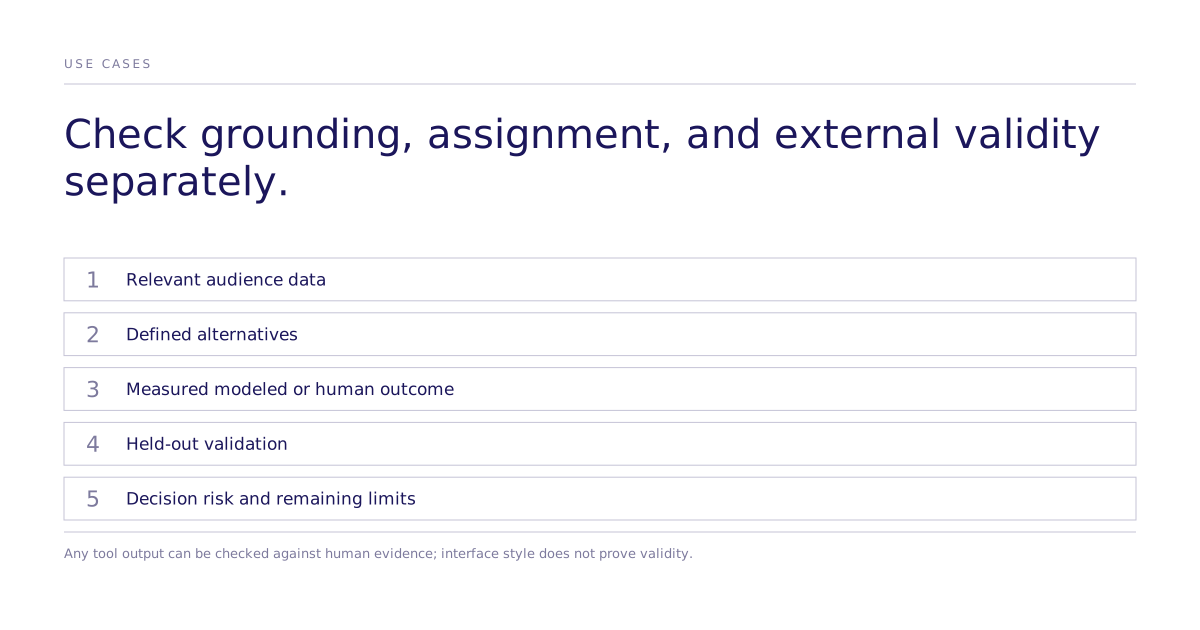
Check audience grounding, assignment or identification, the measured outcome, and held-out validation separately. Conversation depth, persistence, and persona fidelity can matter to a task, but interface format alone does not establish validity. Conversational and choice-task outputs can both be compared with relevant human evidence.
What do these AI simulation tools actually do?
A proposed persona workflow defines an audience, generates responses to concepts or messages, and summarizes differences. Inspect each tool’s actual inputs, state, sampling, and run records rather than assuming all simulation products implement the same protocol.
Generated responses can propose concepts, language, or hypotheses for further investigation when the task is appropriate. They do not observe purchases. Claims about actual behavior or its causes require measurement and identification suited to those claims.
The four categories, and where each one breaks
Use these four approaches as a procurement checklist. Their properties depend on the implementation and study design:
| Approach | What it produces | Where it breaks down |
|---|---|---|
| General LLM prompting | Persona responses under a chosen prompt and protocol | Uncontrolled prompts, state, assignment, or run records can make results hard to reproduce or audit |
| Survey automation | Question generation, response collection, or synthesis, depending on the tool | Inspect which responses are human or generated and whether sampling, assignment, and measurement support the inference |
| Dedicated simulation platform | Generated responses with product-specific state and collaboration features | Persistence or consistency alone does not establish population fidelity or causal validity |
| Assigned experiment with independent validation | A comparison for a defined population and outcome | Requires an identification design and relevant validation; neither task format nor a matched task alone proves market transfer |
Subconscious can structure a simulated intervention comparison. Confirm audience fit and outcome, then scope relevant independent evidence and actual recruitment or measurement arrangements. Aggregate method evidence documents its reported scope.
Modeled coverage and recruited sample size are separate. Ask for evidence of the intended segment’s representation rather than inferring it from a large audience claim.
Questions worth asking before you buy
- What inference does the design support? Request the population, sampling, assignment or identification, outcome, and uncertainty method. A structured task can still lack valid effect identification, while open-ended responses can be collected under an assigned design.
- How was the output checked? Request relevant held-out human or observed-outcome evidence, including weak cases. Independent validation can be arranged separately; a vendor’s lack of an in-house recruitment service does not make validation impossible.
- Who owns your input data? If personas are calibrated on your customer interviews or CRM notes, know where that data is processed and under what terms before uploading it.
- Is the reach claim about targeting or recruitment? A large audience graph is not the same claim as a large recruitable respondent panel. Ask which one a vendor is describing.
When is simulation alone the wrong tool?
Judge reliance on simulation from calibration, audience coverage, measurement, and decision risk. Early-stage work or a hard-to-reach audience does not establish validity by itself. When a decision requires direct testimony, observed behavior, or proof of recruited participants, obtain that evidence.
A matched human study can support, contradict, or leave a modeled result unresolved. Preserve the question while adapting recruitment, measurement, and design as needed. Review the study workflow and applied examples, or scope the actual decision and validation gap.
Jia and colleagues’ May 2026 preprint compares digital personas with held-out LISS survey responses. It reports improved distributional alignment alongside limitations for individual prediction and multivariate structure. Those survey findings do not establish launch or purchase effects.
Hoq and Weninger’s 2026 preprint compares off-the-shelf LLM and human responses in an accuracy-perception experiment. Directional effects sometimes align, but magnitudes and moderation differ across models. Check the relevant outcome rather than treating aggregate agreement as universal human-surrogate validity.