How to Test a Price Before You Commit to It
A pricing, product, or growth leader choosing a price, tier, or billing model needs evidence matched to the alternatives and downside. A survey can embed an assigned choice experiment; inspect its design rather than treating the format as evidence of validity or invalidity.
Why the pricing decision matters
McKinsey’s February 2003 pricing analysis estimated that a 1% price gain would increase operating profit by 8% for the average S&P 1500 company if volume remained stable. It is an arithmetic scenario, not a forecast for a new offer when demand changes.
A price decision needs demand, cost, and customer evidence. A proposed test can still leave uncertainty about the launch, especially when alternatives, participants, or market conditions differ from the actual purchase setting.
What can mislead a price comparison?
Stated responses may differ from observed behavior. In de Corte and colleagues’ 2021 study, English blood donors overstated intended donation frequency compared with linked records. Design revisions reduced the discrepancy, and constraints helped explain residual differences. This human health-service study does not establish a generic software-price overstatement rate or validate simulated purchasers.
Plan live-test costs and risks. A randomized price test can measure actual buyer responses under the tested conditions. Scope operational complexity, customer treatment, and revenue exposure before running it.
Context can change the comparison. Inspect budget authority, existing contracts, alternatives, and approval requirements. Comparable assignment conditions help interpret a task effect, but the study must also represent context relevant to the purchase.
What can a choice task establish?
Conjoint or discrete-choice tasks can compare complete product-and-price bundles under specified designs. They remain stated choices unless actual consequences or purchases are measured. Choice format alone does not remove hypothetical bias or establish causal identification.
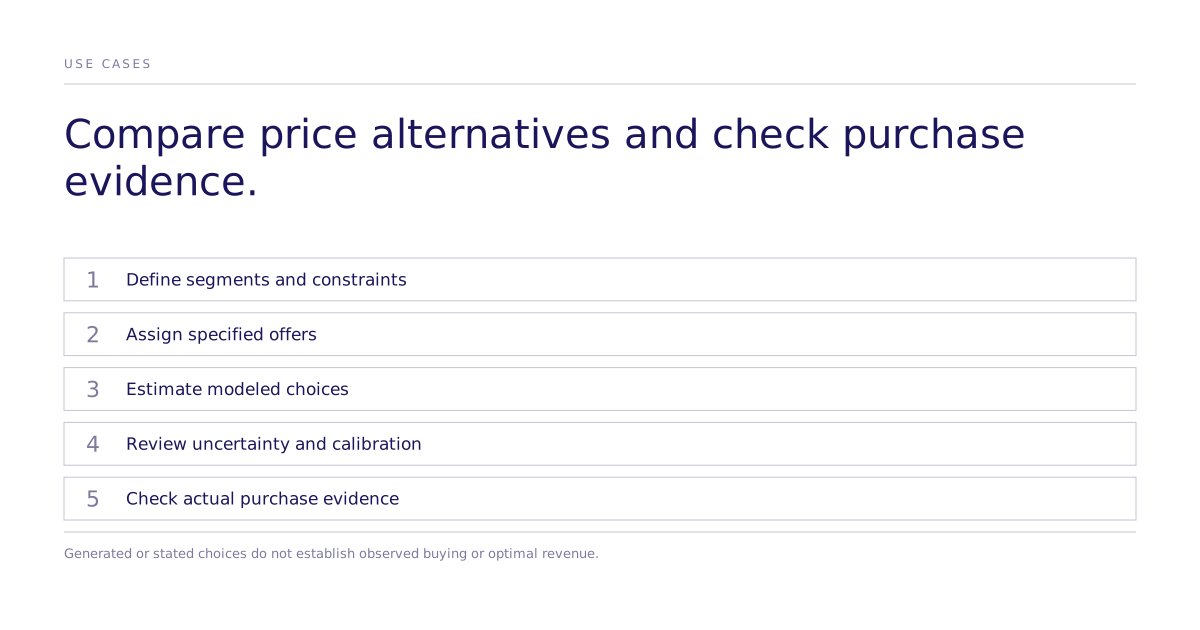
Subconscious can compare assigned price and packaging alternatives across defined modeled segments. Specify the endpoint as modeled choice or stated upgrade/downgrade intention. Randomization does not turn a hypothetical response into actual buying or eliminate model error.
Options and trade-offs
| Method | What it measures | Where it fits |
|---|---|---|
| Human survey or stated-choice task | Reported willingness or choice under the specified task | Useful when sampling, design, uncertainty, and relevant validation fit; hypothetical bias may remain |
| Assigned live price test | Actual choices or purchases under the tested offers | Relevant behavioral evidence when assignment and measurement are credible; scope operational, fairness, and revenue implications |
| Conjoint analysis | Estimated preferences or willingness to pay across tested feature-price bundles | Requires an appropriate task, estimator, uncertainty method, and validation for the intended decision |
| Assigned simulated comparison | Differences in generated choices under specified offers and segments | Can inform further testing when calibration fits; does not observe purchasing |
Choose among these methods from the decision and existing evidence. A simulated result may help select offers for further testing, but it does not establish a viable range or an optimal price without relevant validation and commercial analysis.
Recommended decision process
- Define relevant segments and constraints, including role, company size, category spend, and budget authority. Treat their relationship to price sensitivity as something to examine.
- Define the specific alternatives to compare: price points, tiers, or pricing models such as flat fee, per-seat, and usage-based, not an open-ended "what would you pay."
- Compare choices across assigned offers and inspect supported uncertainty. Proposed reasons such as approval requirements need checking against actual buyer and account evidence.
- Compare billing models as well as price levels when both matter. Define an assignment design that can address their separate or interacting effects; do not assume the billing model matters as much as the dollar amount.
- Take shortlisted offers into appropriate human or purchase validation, a renewal discussion, or a scoped live test. Treat them as candidates, not a validated optimum.
Where does Subconscious fit?
Subconscious can structure assigned price and packaging comparisons on simulated audiences. Check segment calibration and label the generated-choice endpoint. Scope independent human or purchase evidence as needed, with actual recruitment and measurement arrangements confirmed. Review aggregate method evidence within its reported scope and applied examples.
Limitations
A pre-launch pricing experiment is not a substitute for a live A/B test in the market, for sales and renewal negotiation evidence, or for judgment in a novel category or a very small B2B segment where no comparable behavioral data exists yet.