Persona-Based Research: When One Chatbot Answer Is Not Enough Evidence
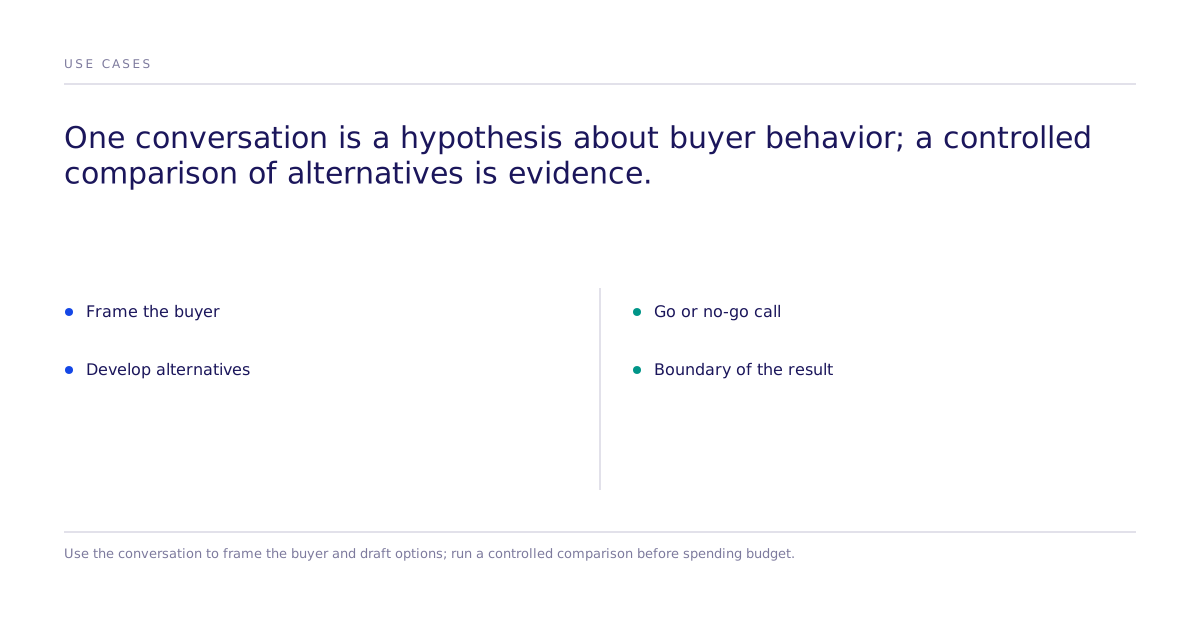
A product or research leader has a decision to make: ship a feature, set a price, or launch a message. A persona-conditioned chatbot can help the team frame the buyer and rehearse possible reactions. Its answer should not decide the launch. A single conversation is a hypothesis about buyer behavior, while a controlled test of two or more alternatives is evidence about a defined choice.
Use the persona to sharpen the question
Persona-based research organizes what a team knows about a buyer group so that product and market questions become specific. The useful output is not a fictional biography. It is a sharper account of the buyer's goals, constraints, purchase context, and decision criteria.
That account can help a team:
- form an early product hypothesis;
- draft messages for a defined buyer;
- prepare questions for customer interviews; and
- identify concrete alternatives that deserve a test.
A number posted without its limits reads as marketing, so this one comes with its boundary attached. An inherited planning benchmark put conventional persona construction at weeks to months. Treat that figure only as historical context, not as a current Subconscious delivery claim or a market-wide norm.
Do not mistake fluency for observed choice
The limits of a method belong on the same page as its evidence, published where a buyer can check them. Published research reports that persona-conditioned language-model outputs can diverge from human survey and choice behavior through stated-preference distortion, reduced variation, and sensitivity to option order or labels (Distorted Perspectives of LLM-Simulated Preferences: Can AI Mislead Design?).
Naming where a method breaks is what lets a buyer decide whether it fits their question. A separate reliability study found that agreement with human data varies by question type and population, so no single persona configuration should be assumed to reproduce human responses across decisions (Assessing the Reliability of Persona-Conditioned LLMs as Synthetic Survey Respondents).
This does not make the conversation worthless. The answer can expose assumptions and improve the alternatives. It does not measure how a target market chooses between those alternatives.
Match the method to the commitment
The required evidence should rise with the cost of being wrong. Early exploration can stay conversational. A decision that commits product work or launch budget needs a designed comparison.
| Research task | Persona conversation | Controlled comparison |
|---|---|---|
| Frame the buyer | Useful for organizing assumptions | Requires a defined population and outcome |
| Develop alternatives | Useful for drafting and critique | Requires concrete alternatives before the study |
| Support a go or no-go call | Produces a plausible answer, not a choice estimate | Estimates how alternatives affect a defined decision outcome |
| Main boundary | May reflect the model's conversational tendencies | Says only what the study design and tested alternatives support |
Subconscious fits the controlled-comparison side of this decision. For a study built around a concrete choice, it compares two or more alternatives in a controlled experiment on a simulated market and estimates which is more likely to change a defined outcome. Uncertainty is reported where the study design supports it.
The scope of the study is also the boundary of the result. It does not automatically establish segments, rank every possible scenario, or prove market performance. When the cost of being wrong warrants another evidence layer, the same causal question can move from a simulated experiment to real-human testing without changing what the team is asking.
A practical handoff
Keep the persona conversation when the open question is:
- Who is the buyer?
- What constraints shape the purchase?
- Which hypotheses or alternatives should we examine?
Move to a controlled experiment when the open question is:
- Which price point changes purchase choice?
- Which message changes preference?
- Which feature framing changes adoption intent?
The experiment answers the buyer decision the conversation cannot. Review case studies for applied examples, or define a comparison for your decision in a research consultation.