What Is AI Market Research? Definition, Methods, and Where It Still Needs a Human Check
AI market research uses artificial intelligence to conduct, accelerate, or interpret market research: AI-generated synthetic respondents, automated analysis of qualitative data, AI-assisted survey design, and predictive modeling of how a segment will respond to a change. The common thread: AI generates or synthesizes evidence, rather than storing and displaying data collected traditionally.
The buyer question that matters is narrower than "does it work?" It's whether simulated evidence can stand on its own for the decision in front of you, or needs a real-human check before you commit budget or roadmap time.
The methods that fall under the label
- Synthetic respondents. AI personas configured against demographic and psychographic profiles answer research questions, standing in for unrecruited segments.
- Automated qualitative analysis. Natural language processing scans transcripts, open-ended survey responses, and support tickets for themes and sentiment at scale.
- AI-assisted research design. Language models help draft questionnaires, discussion guides, and flag bias in the instrument.
- Predictive behavioral modeling. Models trained on behavioral and attitudinal data predict how a segment responds to a product change, price move, or message.
What it replaces in the traditional research timeline
Traditional research can involve question definition, instrument design, recruitment, collection, analysis, and reporting. Ask for a timeline tied to the actual population, task, quality checks, and deliverable.
AI market research compresses specific stages, not the whole pipeline:
- Recruitment becomes optional when synthetic personas stand in for real participants.
- A generated session does not require participant scheduling. Measure total execution and review time before claiming a speed advantage.
- Analysis assistance can extract candidate themes from transcripts; measure processing and human review together against the same quality target before claiming a speed advantage.
- Report drafting gets a head start from generative summarization, freeing analyst time for interpretation.
How reliable is a synthetic respondent?
Persona fidelity varies by item and subgroup. Taday Morocho and colleagues evaluated two open-weight models on US World Values Survey microdata and found heterogeneous effects of demographic conditioning, including poorer alignment in some settings. Synthetic Personalities evaluates held-out responses using socio-economic microdata. Neither comparison establishes a general advantage for established closed questions over open questions about novel behavior.
That means accuracy isn't answerable as a single number: it depends on what's being asked and what the answer is used for.
Reframing accuracy as a validation question
The useful question isn't whether a persona sounds convincing, but whether the result reproduces what a real study would find, and whether a team can check that when needed.
Subconscious’s July 2026 working paper, which is not peer reviewed, reports mean Spearman correlation of estimated choice-parameter ranks of 0.73 across 43 design-filtered studies and 0.55 across roughly 300 replications. These are rank-agreement results, not accuracy percentages, effect-magnitude guarantees, or evidence for a new market. A consequential decision needs matched evidence for its audience and endpoint.
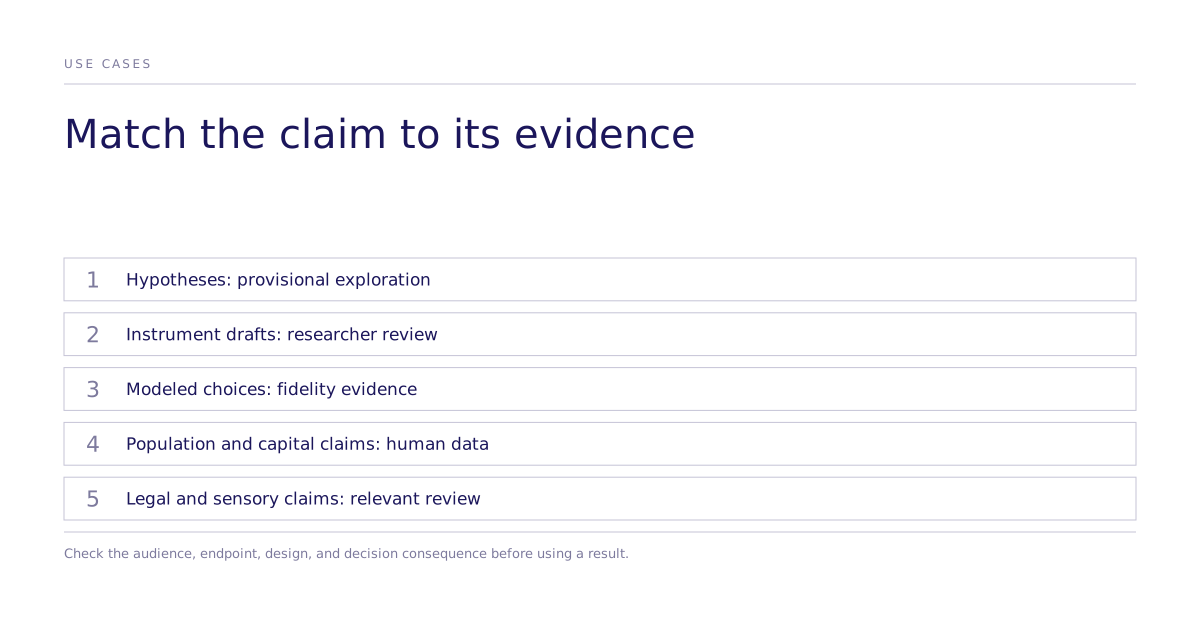
What to trust simulated evidence for, and what still needs a human check
| Use simulated evidence for | Get a real-human check before acting |
|---|---|
| Hypothesis generation early in a research program | Final quantitative validation of market size or incidence |
| Pre-testing an instrument before fieldwork | Decisions that set major capital allocation |
| Rapid concept and message testing | Predicting response to a genuinely unprecedented market event |
| Early-stage segmentation and exploration | Research where regulatory or legal precision is required |
The right column is where the cost of being wrong outweighs the time saved: a launch built on a synthetic signal that doesn't hold in market.
Why are teams adopting AI market research despite the gap?
Teams may consider AI assistance when research budgets or schedules constrain a specific project. Compare the actual workflow's total cost, review burden, and evidence quality before assuming an advantage. A product or marketing manager can use an interface without being a methods specialist, but the study still needs qualified design and review.
The adoption reasons do not establish fidelity. Check how well the actual task agrees with relevant human evidence before deciding whether its generated result is useful.
How do you run a first study?
Start with the decision, target audience, alternatives, and endpoint. Use exploratory output to propose hypotheses and compare it with existing evidence. A single interview cannot establish population fidelity; plan the human study and analysis needed for the consequence of the decision, whether or not the simulator produces an interval.