Where a Causal Experiment Belongs When Anyone Can Ask AI for an Answer
A stakeholder can now open a chatbot, describe a pricing move or a new message, and get a confident-sounding answer in seconds. An insights leader's real decision isn't whether to allow that: it's which questions a fast AI answer can settle and which require a randomized experiment before anyone commits budget, roadmap capacity, or a public launch.
Why a Confident Answer Isn't the Same as Evidence
A number without its limits is marketing, so this gap gets named directly. A language model can generate a plausible reaction to a concept, a price, or a message. It cannot tell you whether that reaction predicts what a real market will choose once the alternatives are in front of people and something is at stake. A stakeholder who mistakes one for the other ships a decision that was never tested against an alternative.
The misses belong on the record next to the hits, so this one gets stated plainly. The risk isn't that AI replaces research; it's narrower: a stakeholder bypasses the research function because a chatbot answers faster than the team can respond, and the team has no faster alternative that's still trustworthy. The Bureau of Labor Statistics projects 7 percent employment growth for market research analysts from 2024 to 2034, even as AI tools reshape daily workflow. The open question is where a team's evidence should sit on the ladder between "AI generated a plausible answer" and "we know what changes behavior."
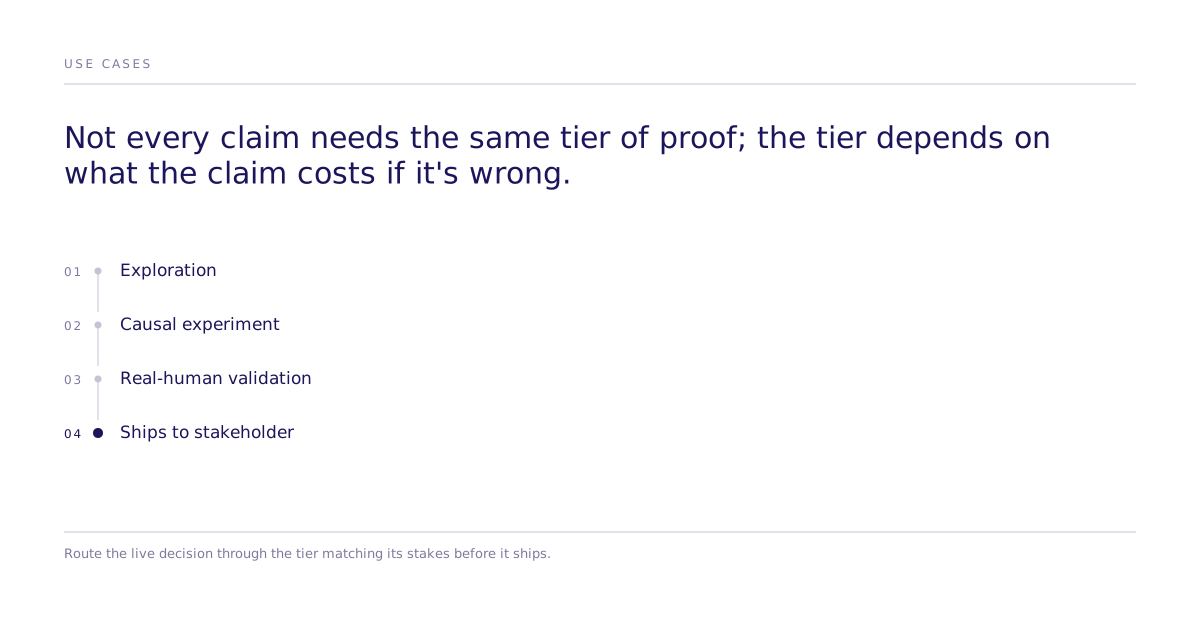
An Evidence Ladder, Not an AI Habit
Most research questions don't need the same tier of proof. A useful way to sort them:
| Tier | What it answers | What it proves |
|---|---|---|
| Exploration | What hypotheses, objections, or angles exist? | Nothing on its own. Generates candidates for testing. |
| Causal experiment | Which action is more likely to change the specific behavior in question? | A treatment effect with a confidence interval, on a controlled population. |
| Real-human validation | Does the causal result hold with real respondents? | Confirmation before an expensive or public decision. |
Fast AI exploration is useful at the first tier, but it answers none of the questions it raises. The failure mode is treating a fluent exploratory answer as if it already occupies the second or third tier.
Where Does a Randomized Experiment Belong?
A randomized discrete-choice experiment belongs at the point where a stakeholder is about to act on a specific choice: this price against that one, this message against that one, this feature against the status quo. The question changes from "what do people think" to "which alternative moves the outcome, and by how much."
Subconscious runs that experiment on a controlled synthetic population and returns a causal effect with a confidence interval for the specific action, not a single confident-sounding sentence about the general topic. That output is the middle tier: past exploration, short of a go/no-go decision that's expensive or public enough to warrant real-human confirmation. Current experimental methodology and how an engagement runs end to end show what that looks like in practice.
When the decision is consequential enough, that same causal question can move to real-human validation without changing what's being asked. Subconscious can test or validate studies with real human participants. A team isn't forced to choose between speed and confirmation: it can get a causal read quickly, then confirm with real respondents before the decision becomes public or expensive to reverse.
A Decision Rule for Insights Leaders
The question to ask before any AI-generated answer reaches a stakeholder deck: does this claim change what the business does, and if it's wrong, what does that cost? If the answer changes nothing consequential, exploration is enough. If it changes a pricing, launch, or positioning decision, it needs a controlled comparison between the specific alternatives, not a general answer. If the decision is expensive enough to be hard to reverse, or public enough that a wrong call is visible, the causal result should be checked against real-human data before it ships.
What Doesn't a Causal Experiment Replace?
Naming a failure mode is what lets a buyer check it, so the boundaries are stated here. A causal experiment does not replace the exploratory or hypothesis-generation stage of research. Someone still has to decide what's worth testing, and no experiment picks its own question. It also doesn't replace human judgment on which decision is consequential enough to warrant real-human validation. Those calls stay with the insights leader, not with any tool downstream of them.
Put the Ladder to Work
Start with one live decision already on a stakeholder's desk. Write down the specific alternatives being weighed, not just the general topic. If a chatbot answer is already circulating about that decision, treat it as an exploratory hypothesis, not a settled result, and route the actual choice through a controlled comparison before anyone commits to it. A demo is the fastest way to see what that comparison looks like for a decision your team is facing this quarter.