Which Market Research Tasks to Automate, and Which Still Need Real Humans
Route fast, low-stakes exploratory questions to automated testing. Reserve real-human validation for decisions that are expensive to reverse or that the business will defend in public. That split is the decision a Head or VP of Market Research has to make once stakeholders expect AI to handle the first pass.
Why the question is forcing a decision now
Draft findings can land before a researcher finishes going through the data. A manager asks whether the team can just automate the first pass. None of that means research demand disappears; it means the mechanical parts of the job get faster, cheaper, and easier to access from outside the research function.
The risk for a research team is narrower than "AI replaces researchers." It is spending most of the week defending manual first-draft work as craft, so stakeholders route around the function and act on unvalidated automated output. The opposite failure is just as costly: treating a fast, exploratory read as decision-ready evidence, then shipping a pricing, messaging, or launch decision on unvalidated signal and discovering the gap only after it's public or expensive to unwind.
The U.S. Bureau of Labor Statistics' Occupational Outlook Handbook for market research analysts projects the occupation adding jobs steadily between 2024 and 2034. The job is not vanishing. The share of it spent on mechanical production is.
How should each market research task be routed?
A workable rule sorts tasks by what happens if the answer is wrong, not by how good the automated output looks.
| Task type | Example | Where it belongs | What still requires a human |
|---|---|---|---|
| Exploration | Generating hypotheses, objections, alternative framings | Automated first pass | Confirming the framing matches the actual business question |
| Directional testing | Screeners, message or concept reactions, quick comparisons between options | Fast exploratory testing | Reading results for generic themes, bias, and irrelevance to the decision |
| Reporting mechanics | Formatting, transcript summarizing, verbatim clustering | Automated first pass | Deciding which findings belong in the final narrative |
| Decisions that are expensive or public | Pricing changes, launch go/no-go, claims made externally | Real-human validation before the business acts | The causal question itself, and whether the sample and method support the claim |
What should a research team build instead of running more tests?
The strongest research teams in 2026 will be defined not by how many automated tools they use, but by a clear system that draws three lines: the boundaries of automated exploration, the findings a human has to check, and the claims that need validation with real people before the business relies on them.
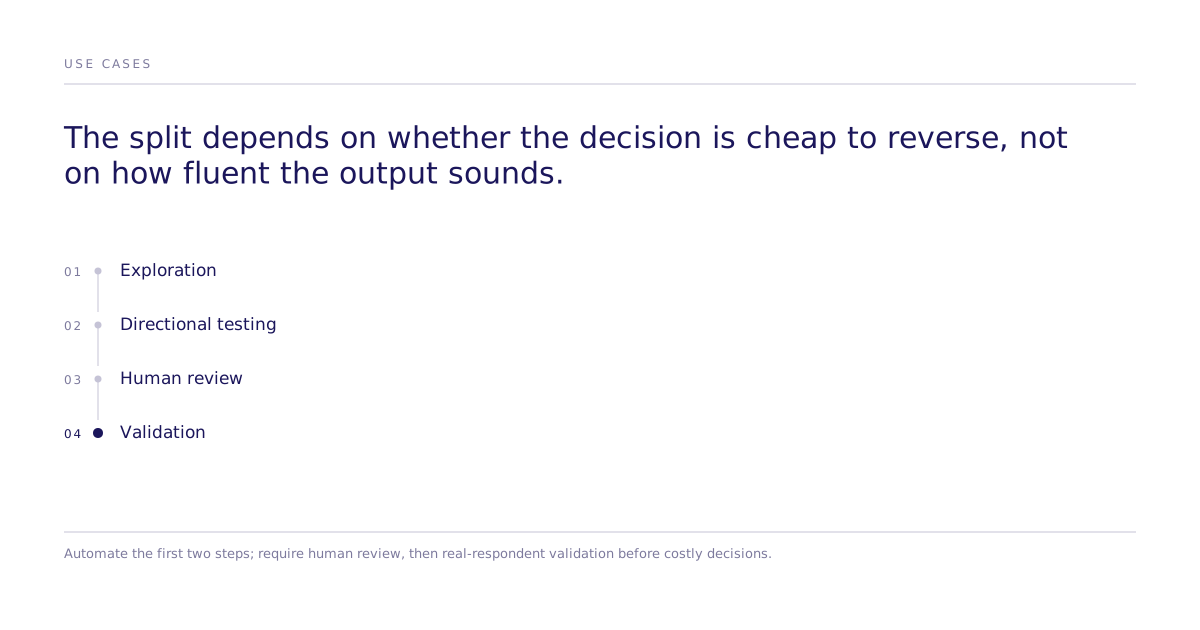
A workable version has four layers:
- Exploration: generate hypotheses, objections, and alternative explanations quickly.
- Directional testing: compare options fast, before committing time or budget to a full study.
- Human review: check the audience definition, the framing of the questions, and whether the result answers the business question.
- Validation: bring in real respondent data or fielded research when the decision is expensive or will be defended publicly.
The value is not the exploratory output on its own. It is the disciplined path from a question to a decision the business can defend.
How Subconscious supports that same progression
This four-layer system maps onto how Subconscious works. Exploration and directional testing run as controlled, causal experiments: discrete-choice comparisons with quantified uncertainty, not a single fluent-sounding answer. Subconscious can run these controlled studies against a person-level audience graph covering 800 million real people for the exploratory stage.
That audience graph is not a recruitable group of 800 million people, and it should never be described as one; it is the reach behind the exploratory stage. When a decision moves from directional to expensive or public, the same causal question can move to validation with real human participants, without redesigning the study or changing what is being tested.
Keep the two claims distinct in any report: what the exploratory stage measured, drawn from the audience graph, and what real-human validation confirmed. Blending them into one number misrepresents both.
The mistake that makes automated research dangerous
That habit takes hold under pressure: speed is expected, the tool's answer sounds fluent, and a deck is due by end of day. A research function stays credible only if it can tell an output apart from actual evidence. Automated exploration can produce useful output. It cannot decide whether that output is valid for the decision in front of the business.
The fix is to make limits part of the deliverable. State what the automated work was used for. State what it was not used for. State what still needs validation before the business acts on it. That reads as more disciplined, not less confident, because the limits are explicit instead of implied.
What to do this week
Start with one visible workflow, not a full rewrite of the research process.
- Pick a real project with a live decision behind it.
- Write the business decision in one sentence.
- Define the audience and how expensive it would be to get the decision wrong.
- Use automated exploratory testing only for the exploratory stage.
- Go through the output by hand and flag each piece as useful, weak, or unsafe to act on.
- Present the answer with a clear caveat and, when the decision warrants it, a recommended validation step with real participants. See how Subconscious runs that step.
Run that cycle weekly across a month, and the team ends up with a working system that demonstrates speed, judgment, and quality control.
Limitations
This workflow does not remove the need for judgment about which questions deserve validation and which don't; that call still belongs to the researcher who understands the decision. Naming exactly what a figure covers is what lets a buyer check it against their own use case. Subconscious's audience-graph reach describes the population available for exploratory testing, not a guarantee about any single study's result, and it is not a substitute for real-human validation when a decision is expensive or public. Real-human validation confirms a causal question; it does not turn exploratory testing into a clinical trial or an automatic proof of market performance. Review Subconscious's current case studies and talk through your specific decision before committing a workflow to production. Book time here.