How Marketing Managers Can Test Campaign Actions Before Spending the Budget
A marketing manager rarely gets to choose between "test it properly" and "ship it now." The decision that lands on their desk is narrower: which tagline, hero image, offer, or campaign sequence should go out the door, this week, with the budget already committed. Getting that choice wrong costs wasted spend, a delayed launch, and a rebuild cycle that eats the next sprint too.
Why the usual research options don't fit this decision
Marketing managers absorb every decision that is too small for a formal research project but too consequential to leave to whoever argues loudest in the room: a hero image for Monday's paid social launch, a tagline going onto the landing page, whether to lead with price or features in a demand-gen email, which of three agency creative directions earns the budget.
Traditional research tools were not built for that cadence:
| Method | What to scope | Timing question |
|---|---|---|
| Focus group | Recruitment, incentives, moderation and analysis | Can participants and a moderator be booked before the decision? |
| Survey research | Audience, sample, questionnaire and reporting | Can fieldwork and analysis finish before launch? |
| Controlled comparison | Variants, assigned conditions, population and outcome | Is there enough time for the required validation? |
Drive Research's pricing guide gives vendor ballparks tied to method and scope, including 400 responses for an online-survey estimate. It does not establish a turnaround for this campaign. Get a quote and delivery date for the actual brief. Method labels alone do not establish cost or turnaround. A simulated comparison can help narrow candidates, but the validation needed for the campaign outcome determines whether the result is ready to support spend.
What does a controlled comparison actually answer?
The buyer question is not "what do people think of this idea?" It is "which of these actions is more likely to produce the outcome we want, for the audience we're targeting?" That is a causal question, and it calls for a randomized comparison of defined alternatives rather than an open-ended poll.
Subconscious runs that comparison as a controlled experiment on a simulated audience: it defines the audience, exposes it to the alternatives under consideration, and estimates which action the audience chooses in the task. The outcomes are elicited and simulated: stated choice, stated intent, or stated message recall. Actual click-through and actual recall are behaviors. Measure them with a suitably designed human study or a live test, not with a simulated comparison. The result is a directional answer with its uncertainty, not a single number presented as guaranteed truth.
Three hypothetical examples show the kind of decision this fits. None reports a real result:
- A launch-day headline decision. A team might compare three headline variants for a paid-social ad against a defined target audience and see which one leads on stated choice, plus the objections the losing headlines raise, before the campaign ships.
- A stalled homepage debate. Two hero-copy options have been argued over for a week. A comparison might show a split in stated preference. The reasons the minority gives for preferring the other option could surface a consideration the team had missed.
- An agency pitch review. Three creative territories could be compared against the audience segments a campaign needs to reach. One might work across all three segments while another fails with the most important one, which would change the agency conversation.
These are illustrations, not a promise of a specific outcome, turnaround, or price for a given engagement.
Where does this method stop?
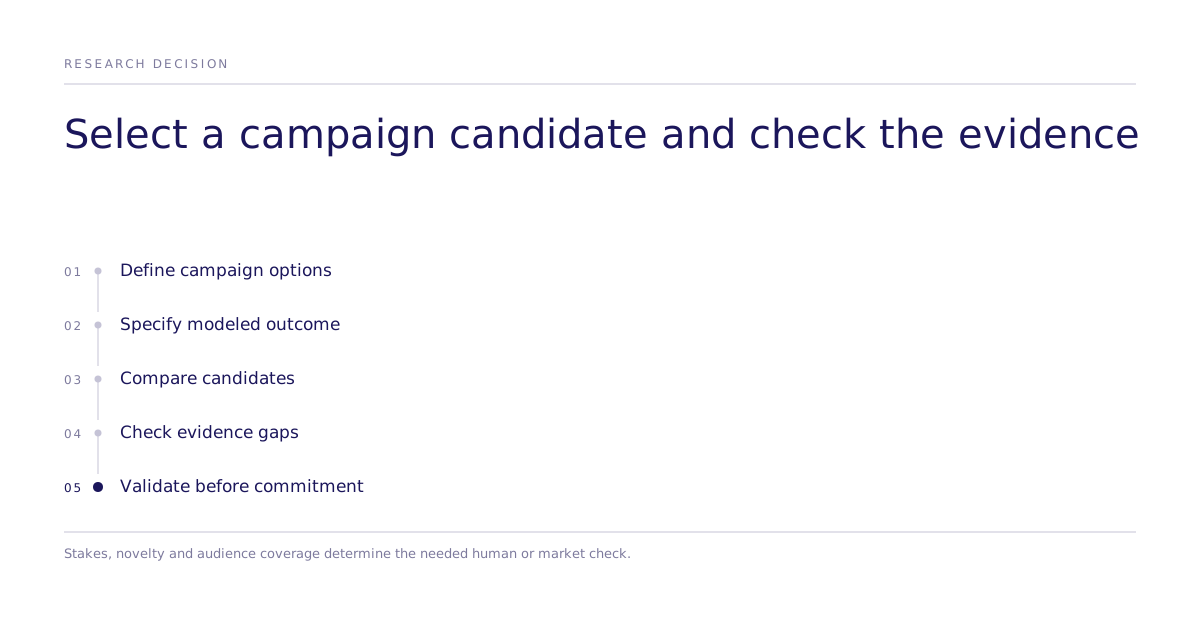
A controlled pre-launch comparison does not replace in-market testing for a high-stakes spend, the kind of decision where a €500K TV buy is on the table. The responsible sequence: compare the candidate actions first to choose a candidate, then decide on a human or in-market check from the stakes, how novel the creative is, how well the simulated audience covers the target and what customer evidence already exists. A matched human study can put the same question to real participants; scope it per campaign.
It also does not replace foundational discovery work: comparing candidate messages assumes the team already knows what to test, not the interviews or field research that generate those candidates in the first place.
And it will not hand a marketing manager a lift number, or say a tagline lifts conversion by a fixed percentage. What it estimates is which candidate action the simulated audience chooses more often under the outcome the team defined, and by how much, with the uncertainty that estimate carries.
When audience granularity matters
Some of these decisions are local. A campaign built for the UK does not automatically work in Germany or France, and guessing which version to run in each market is its own expensive bet. Scope a simulated comparison to the intended market, then inspect its population grounding and validation. Country labels alone do not establish that the modeled audience captures local purchasing behavior.
What does this replace in the marketing manager's week?
The realistic alternative to a controlled comparison is not "no research." It is a Slack thread, a design review, or a coin flip disguised as consensus. The value of testing every asset is not a perfect prediction; it's a paper trail. When a campaign underperforms, "we compared the messaging, the creative, and the positioning, and this one still missed" is a materially different conversation with leadership than "we made the best guess we could."
The practical next step: pick one action already in the queue, a headline, a hero image, a positioning line, and bring it to a decision review with the alternatives, the target audience and any campaign evidence you hold, so you can compare it before it ships, rather than after. See how other teams have used a controlled comparison to make a specific campaign or pricing decision, and why the buyer's decision, not a simulated customer conversation, is the right starting point for this kind of test.