What a Simulated Replication of Lüthi and Prässler's Wind-Developer Study Must Show
An energy-policy team may need to understand how permit procedures, grid access and financial support affect developers' assessment of a wind market. Developers form a specialized population. A plausible simulated developer is useful for developing a questionnaire, but its preferences need a matched human check before informing an investment or policy recommendation.
The original developer study
Lüthi and Prässler's 2011 Energy Policy study surveyed 119 onshore wind developers using adaptive choice-based conjoint analysis. The research compared policy conditions in Europe and the United States, including legal certainty, administrative procedures, grid access, financial support and financing. It examined which conditions mattered to developers' market assessments. Original publisher record.
Those stated preferences describe a particular professional sample and historical market context. They are not observed project completions or a causal estimate of a policy's effect on installed capacity.
What a matched simulation would need
A simulated replication should retain the original adaptive task, attribute levels and outcome coding. If the simulator uses a different fixed-choice questionnaire, document that difference and determine which estimates remain comparable. Also establish whether the modeled respondents represent the same developer roles and regions.
This page has no public Subconscious run record for this study, so it reports no correlation or p-value. The developer paper supports the human-study description; it does not establish a later simulator's performance.
| Evidence item | Question for the researcher |
|---|---|
| Developer population | Which roles, markets and experience levels are represented? |
| Choice task | Does the adaptive design match, or has the instrument changed? |
| Policy levels | Are legal, grid, process and financial conditions comparable? |
| Estimated preferences | Which effects agree, disagree or remain uncertain? |
| Current use | Which present-day conditions differ from the historical task? |
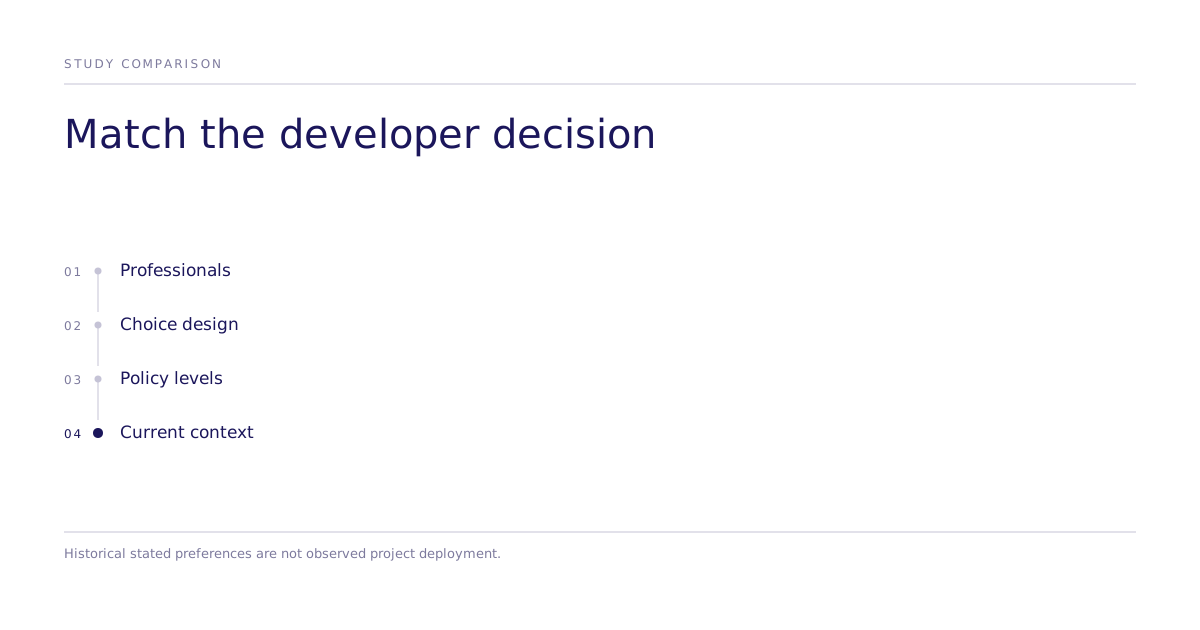
Scope a current policy decision
Start with the policy instrument the team can change. For example, a study of administrative procedures should distinguish processing time, uncertainty and the information developers receive. Avoid treating those changes as one interchangeable attribute. A grid-access question also needs the relevant commercial and technical context.
A simulation can identify ambiguous alternatives and candidate tradeoffs. Compare its estimates with qualified developers under the same task before claiming current preference validity. For a claim about actual project investment or deployment, obtain the relevant observed or experimental outcome evidence; conjoint preferences alone do not establish that result.
Decide what would change the recommendation
Specify the smallest difference that would change a policy recommendation and inspect uncertainty at that level. A positive aggregate rank correlation cannot establish that every policy lever is correctly ordered or that effect sizes are calibrated.
The public method evidence describes the available validation task. Bring the proposed policy conditions, developer population and intended decision to a decision review so the study and the evidence threshold can be scoped together.