Customer Panel Software: Sequence the Method to the Decision
A consumer insights, product, or marketing leader without a dedicated research team faces one recurring decision before a concept, price, or message ships: run a controlled simulated experiment first, or go straight to a real-respondent panel study. The wrong call in either direction is expensive: shipping a launch decision off an unvalidated synthetic read that doesn't hold up with real customers is one failure mode; burning weeks and an enterprise research budget on a real-respondent panel to answer a question a validated simulated experiment could have settled first is the other.
What are the three shapes of customer panel research?
Panel research for consumer, product, and marketing questions comes in three structural shapes, independent of any single vendor:
- Real-respondent panels. A provider recruits actual people from an established panel and fields a survey, interview, or structured study against them. This produces real-respondent provenance and stated-preference data, typically over a period of days to weeks, usually under an enterprise contract.
- AI synthetic panels. A platform builds AI personas from public data and psychological models and aggregates their simulated answers, usually within a single working session.
- Hybrid platforms. Real respondents are recruited through panel partners while AI tooling supports study design, moderation, or analysis of what those respondents say.
Independent research on whether large language models can stand in for human choice behavior finds that model-based predictions can track some patterns in stated preference but should not be treated as an automatic substitute for measured human choice without validation (arXiv, 2026). That finding is why the sequencing question below matters more than the category label on the tool.
Compare by evidence, not by interface
| Shape | What it produces | Typical timeframe | Access model |
|---|---|---|---|
| Real-respondent panel | Real-respondent provenance, stated preference | Days to weeks | Usually a research-team operator, enterprise contract |
| AI synthetic panel | Simulated persona responses, directional read | Same working session to a few hours | Often self-serve |
| Hybrid platform | Real-respondent answers plus AI-assisted design or analysis | Days | Mixed, often research-team operated |
Two structural tradeoffs sit underneath this table. Synthetic methods win on speed and iteration count: a team can run a new version of a study as soon as the last one raises a new question. Real-respondent methods win on stakeholder perception and regulatory standing, because the answer came from an accountable, recruitable person rather than a model. Most teams that use both are not choosing one over the other; they are sequencing exploration first and confirmation second.
Where a controlled simulated experiment fits
Subconscious runs controlled experiments on a simulated population and reports validation results from the causal fidelity paper: its best configuration reaches 87% of the measured human ceiling on one study (0.832 rank correlation against the published human result, versus 0.959 between two independent samples of real humans). Across all 43 studies that pass design filters, drawn from roughly 300 published human studies across 9 domains, the mean is 0.73. That is the evidence a team can act on before committing budget to a real-respondent panel: does the simulated read hold up against a known outcome, not whether the tool feels convincing.
Subconscious can also test or validate the same study with real human participants without changing the underlying causal question. That sequencing, not a claim that either method alone is sufficient, is the practical advantage over choosing a single panel type up front.
What does the simulated pass not cover?
A controlled experiment on a simulated population is not a self-serve price table. The person-level audience graph behind the simulation covers 800 million real people, but that graph is a modeling input, not a pool of individually recruitable respondents who can be scheduled for a survey. Where a decision needs a real, individually recruited human to answer directly, a real-respondent panel or interview is the right instrument, whether that happens before or after a simulated pass.
Real-human validation also has its own boundary. It confirms or corrects a simulated read; it does not turn a causal test of one action into a usability session, a clinical trial, or automatic proof of how something will perform after launch.
Four questions that decide the sequence
- What is the cost of being wrong? A reversible, low-stakes decision, such as an early concept screen or a message iteration, can usually run and ship on a simulated read. A launch-scale, hard-to-reverse decision should route through real-human confirmation before spend commits.
- Does the decision depend on a number, or a direction? Directional reads travel well through simulation. A specific willingness-to-pay figure or conversion estimate needs the real-human pass for the number itself.
- Who owns the research function? A self-serve simulated experiment fits a team without a dedicated research operator. A real-respondent panel program generally needs someone accountable for recruiting, fielding, and interpreting it.
- How many iterations does the question need? A question that will be re-asked as the concept changes benefits from starting in simulation, where a new version can run again without re-recruiting a panel.
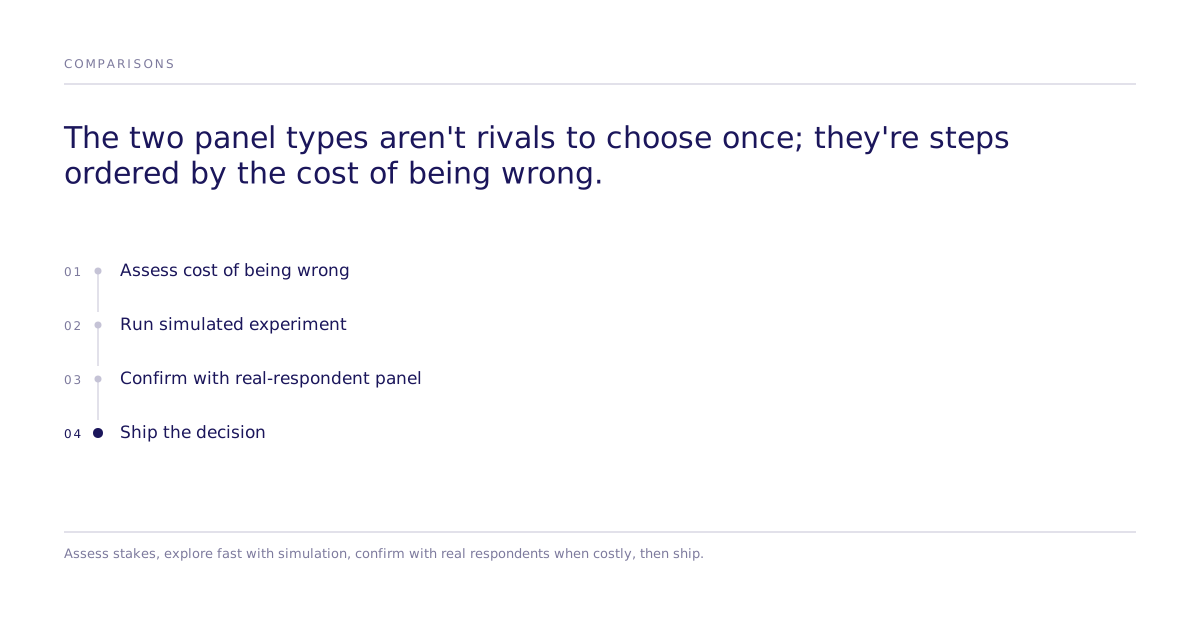
For most teams, the workable pattern: use a controlled simulated experiment to explore and narrow the field of options, then confirm the option that is actually going to ship with real human participants before the decision that carries the real cost.
See how the study process works end to end, review research methodology and validation results, or book time to walk through where a specific decision sits on this sequence.