SparkToro vs. Causal Testing: How to Divide a Pre-Launch Research Budget
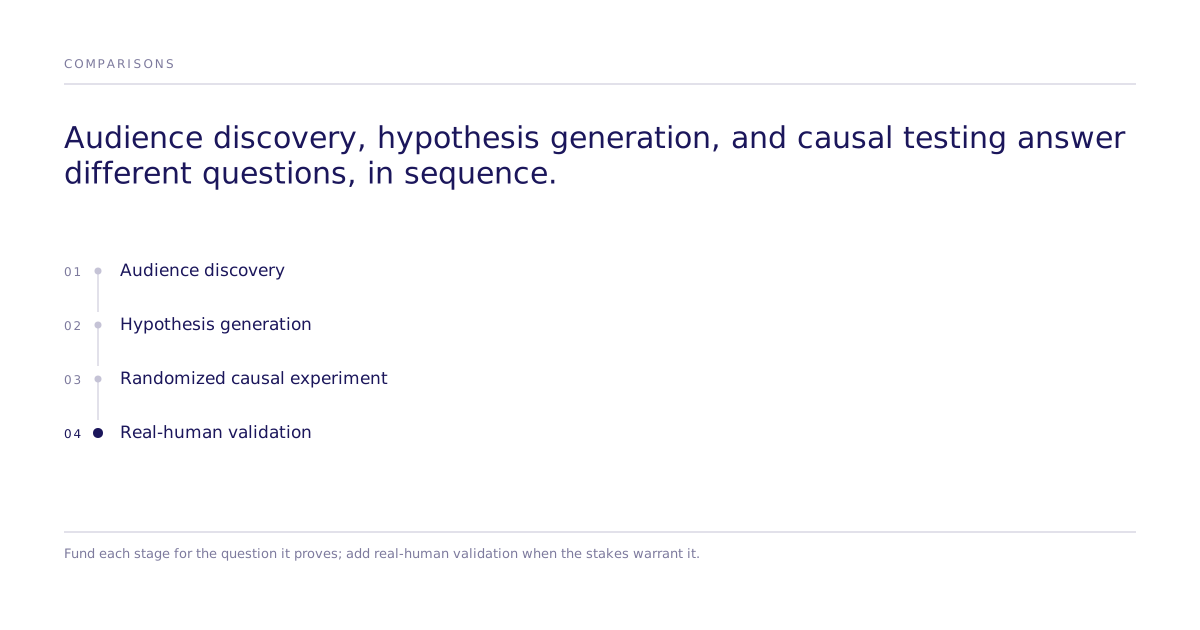
A pre-launch research budget should cover distinct decisions. Use SparkToro to map where an audience already pays attention. Use simulated conversations to develop hypotheses about possible reactions. Use a causal experiment to estimate which message, concept, or positioning action changes the target behavior. None of these outputs proves the others.
That separation matters before media, creative, and launch spend are committed.
Match the method to the launch question
| Launch question | Best-fit method | What the output supports | What it does not prove |
|---|---|---|---|
| Where does this audience spend attention online? | Audience and channel discovery | Channel, affinity, and outreach planning | That a message will change behavior |
| What objections or language might be worth testing? | Simulated conversations | Hypothesis development and early screening | A calibrated behavioral effect |
| Which message or concept causes the target outcome to move? | Randomized causal experiment | A directional comparison between defined actions | Guaranteed market performance |
This is a budget-allocation decision, not a vendor scorecard. A CMO can fund more than one method while refusing to let one method answer a question it was not designed to answer.
What does SparkToro's audience research actually measure?
SparkToro says its audience research uses anonymized clickstream data, Google search results, and public social profiles to describe behaviors, demographics, and affinities across websites, podcasts, YouTube channels, social networks, and search terms. SparkToro product overview
That output is useful when the open question is where to place a campaign, which communities matter, or which publishers and creators may reach the intended buyer.
A channel map without its limits is a sales pitch, so the boundary is published here before spend is committed. It cannot establish that a headline, claim, or positioning choice caused consideration or preference to change.
What are simulated conversations useful for?
Simulated conversations can help a team surface possible objections, vocabulary, and message directions. Their value is generative: they give researchers candidates to examine more carefully.
Agreement without its failure modes is marketing copy, so the misses are named here before a buyer trusts the reaction. Their limit is evidentiary. Language-model reactions can show variance collapse, demographic flattening, over-rationality, and prompt sensitivity. Agreement can therefore look more conclusive than the underlying method warrants. The safe use is to turn a reaction into a testable hypothesis, not a launch verdict.
How does causal testing work?
Subconscious is the causal AI company. It runs randomized experiments on a simulation of a market to compare defined actions against a behavioral outcome. For a launch, the action might be message A versus message B. The outcome might be consideration, preference, or another decision named in the study.
The practical difference is control. A causal design holds the question steady, changes the action, and estimates what moved.
Subconscious can run controlled studies against a person-level audience graph covering 800 million real people. That describes audience-graph coverage for study design. It is not a recruitable human sample. Separately, Subconscious can test or validate studies with real human participants. A team can keep the causal question intact as it moves from a simulated experiment to real-human validation.
Build the sequence around the risk
A defensible pre-launch sequence has three gates:
- Define the buyer and map where that buyer already pays attention.
- Generate candidate messages and objections, then write the behavioral decision each candidate is supposed to change.
- Randomize the viable alternatives against that outcome. Use real-human validation when the consequence of being wrong warrants it.
Know what remains unproven
A causal result without its scope is marketing, so the boundary is published next to the finding. A causal experiment needs a defined audience, explicit alternatives, and a measurable decision. It cannot repair a vague launch question. It does not replace channel discovery, creative judgment, or observation of actual market performance.
A validation step without its limits reads like a guarantee, so the boundary sits on the record next to the result. Real-human validation is a separate evidence step. It does not turn a study into automatic proof of future sales or campaign performance. Confidence intervals, segment heterogeneity, willingness-to-pay, and scenario rankings depend on the configured study. They are not guaranteed standard outputs.
Before committing the launch budget, write down the action, alternative, audience, and outcome. Then assign each research method only the part it can prove. Read the research approach for the validation boundary and how studies are designed for the operating sequence.