Video Research or a Causal Experiment First: Choosing Between Voxpopme and Subconscious
A consumer insights or CX leader can collect customer testimony directly or use a synthetic screen before human research. Two mistakes matter: shipping on generated responses when human evidence was required, or funding a screen that adds little to the actual research question. Define the endpoint and evidence threshold before choosing the sequence.
What Is Voxpopme Built to Answer?
Voxpopme's current platform includes video surveys, live interviews, AI moderation, analysis, and a research repository. Its customer-video workflow can supply actual testimony, expression, and tone. Those observations support qualitative understanding; the configured study determines whether a separate controlled comparison is included.
A video study needs a relevant sample, question, collection procedure, and analysis. Genuine testimony is useful for discovery, but it does not automatically estimate the causal effect of a changed price or claim.
Where Does a Causal Experiment Fit Before a Video Study?
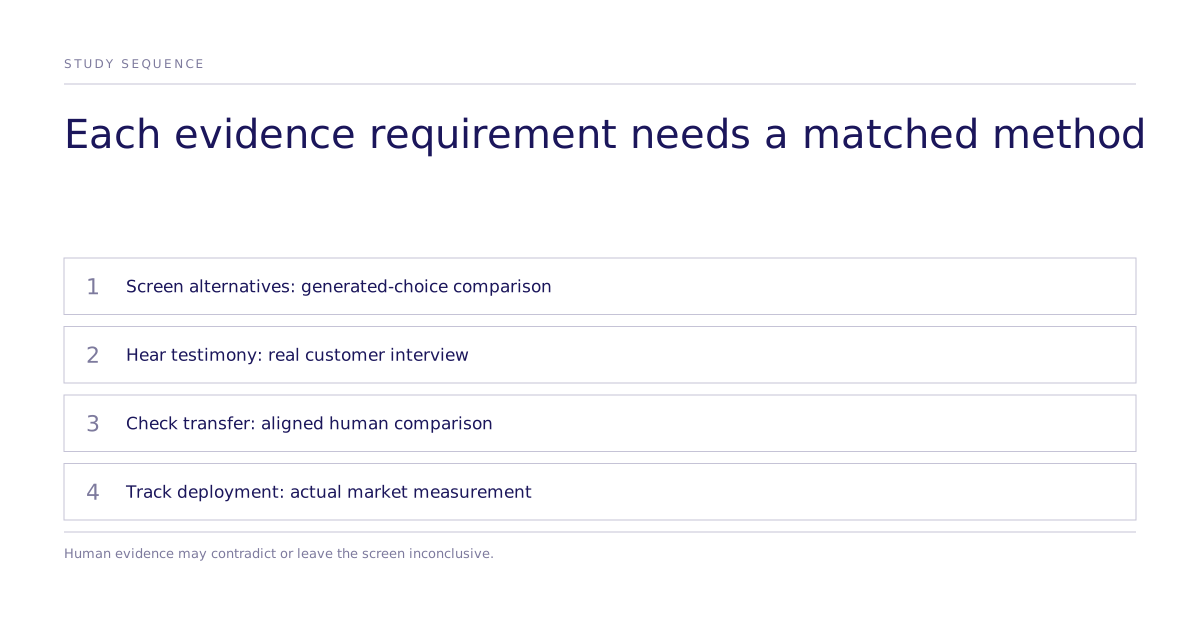
Subconscious's causal choice method estimates contrasts on generated choices under a controlled task. It can screen defined messages, prices, or feature descriptions. The result remains distinct from recorded customer testimony and observed market behavior.
A synthetic screen can prioritize candidates before qualitative interviews. Pre-specify the screening rule, and check some rejected options with people if discarding a useful alternative would be costly. A video interview can investigate language and experience; it need not serve as the same endpoint as the original choice comparison.
An aligned human choice study checks the synthetic contrast. Document population and instrument differences, and retain contradictions or inconclusive findings. A qualitative video study addresses a different requirement unless its protocol also implements the required comparison.
Request population assumptions, source provenance, and generator configuration for the synthetic study. The modeled audience is not a standing recruitable video panel.
Matching the method to the stage of the decision
| Stage of the decision | Better fit | Why |
|---|---|---|
| Screening defined messages, prices, or concepts | A controlled synthetic choice study where relevant calibration exists | Estimates a task-specific contrast; checks finalists and costly false negatives with people |
| Understanding why a segment reacts the way it does, in their own words | Video research (Voxpopme) | Captures tone, spontaneous language, and open-ended discovery a simulated experiment is not built to produce |
| Checking a simulated choice result before commitment | An aligned human comparison | Assesses whether the contrast transfers; can contradict it or remain inconclusive |
| Tracking deployed market response over time | Relevant customer or in-market measurement | Observes actual responses; repeated simulations alone do not track deployment |
What Does a Simulated Experiment Not Do?
Publishing a method's limits alongside its results is what lets a buyer check the fit before committing budget. A controlled experiment on a simulated market does not capture facial expression, tone, or the open-ended discovery a real interview surfaces. It is not the right tool when the decision hinges on hearing customers describe a problem in their own words rather than on which of several actions is likely to move a measurable outcome. Confidence intervals, segment-level detail, and decision memos are specific to what a given study is designed to test, not a universal output attached to every result.
The causal-fidelity working paper evaluates rank agreement between estimated human and synthetic choice parameters. That validation endpoint does not establish launch performance or reproduce a particular Voxpopme study. Inspect the actual task and limitations before applying the evidence.
Deciding which one to run first
Use video research when the open question needs customer testimony or observed expression. Use a controlled comparison when the decision requires an intervention estimate, and a matched human check for transfer from generated choices. Inspect study design, decision examples, and the validation record, or scope the requirement.