Choosing Attributes and Levels for a Discrete Choice Experiment
The decision before the study runs
Before fielding a conjoint or discrete choice study, define the attributes and levels respondents will compare: prices, features, packaging, or claims that matter to the decision. Select the response source after specifying the question and endpoint; a market simulation is one possible study configuration.
Omitted attributes can make the task unlike the decision buyers face. Too many or confusing attributes can increase burden. Check the vocabulary, level ranges, and plausible bundles with relevant people before locking the instrument.
What is an attribute in a discrete choice experiment?
An attribute is any dimension of the offer that could plausibly change a customer's decision. For a product, that might be price, a feature, packaging format, or a messaging claim. For a service or policy proposal, it might be coverage terms, delivery timing, or a benefit's wording. Each attribute needs multiple levels: the concrete variations respondents will actually see and compare, such as three price points or two versions of a feature.
The discipline here is narrowing, not listing everything that could conceivably matter: a well-specified attribute list holds the small set of variables that plausibly change the outcome.
How to narrow the list
Three checks separate a usable attribute list from an overloaded one:
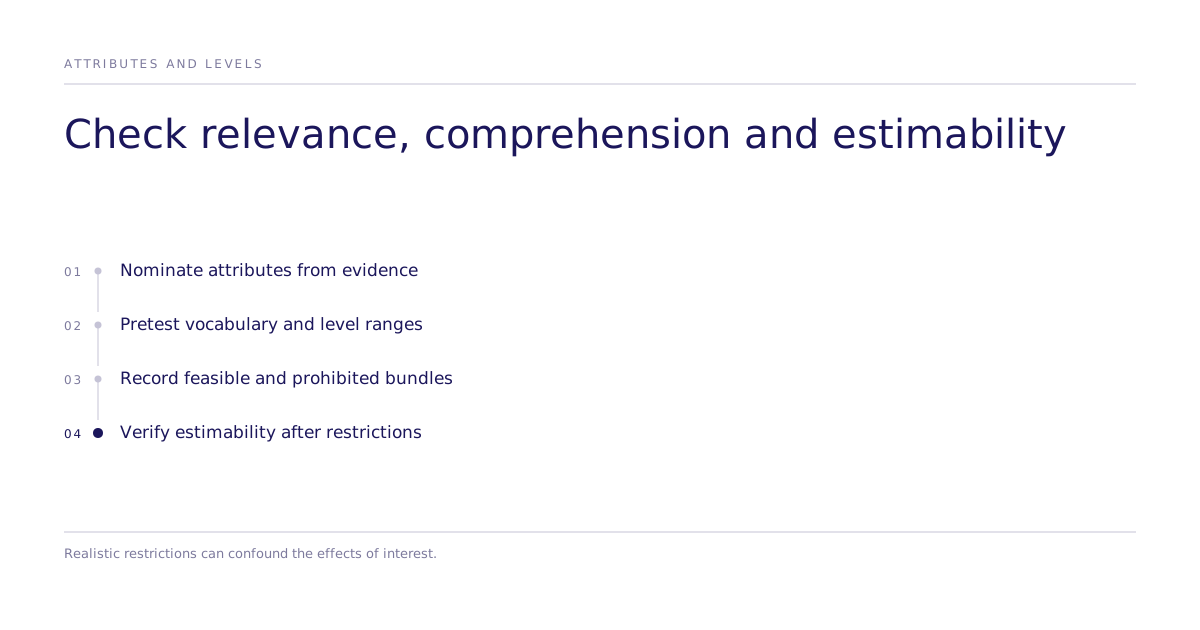
- What evidence nominates the attribute? Use customer interviews, prior studies, and operational feasibility to identify plausible attributes. Pretest the terms rather than assuming the team already knows which attribute changes choice.
- Which bundles are feasible, and can the effects be estimated? Record prohibited combinations. Check that the remaining design varies the attributes needed for the planned model; exclusions can confound effects.
- Can participants understand the task? Cognitively pretest wording and ranges with relevant people. Revise the task when participants cannot explain or distinguish the alternatives.
The ISPOR 2013 experimental-design report emphasizes model identification before efficiency. A design must supply the variation needed to estimate each parameter of interest, including after constraints are applied.
How does attribute selection fit into the experiment workflow?
For a hypothetical software offer, test monthly price ($40/$60), support (next-business-day/24-hour), and onboarding (self-service/assisted), with a keep-current-service option. Suppose the supplier cannot deliver 24-hour support with self-service onboarding: document that restriction, then inspect the design matrix and choice sets to determine which effects and interactions remain estimable. Do not promise a separate support effect if support and onboarding cannot vary independently.
Subconscious uses controlled choice designs on generated responses. Its July 2026 working paper reports mean Spearman correlation of 0.73 for estimated choice-parameter ranks across 43 design-filtered studies. That aggregate does not validate the new attribute list. The ISPOR analysis guidance explains how analysis choices affect interpretation.
What are the limitations of attribute selection?
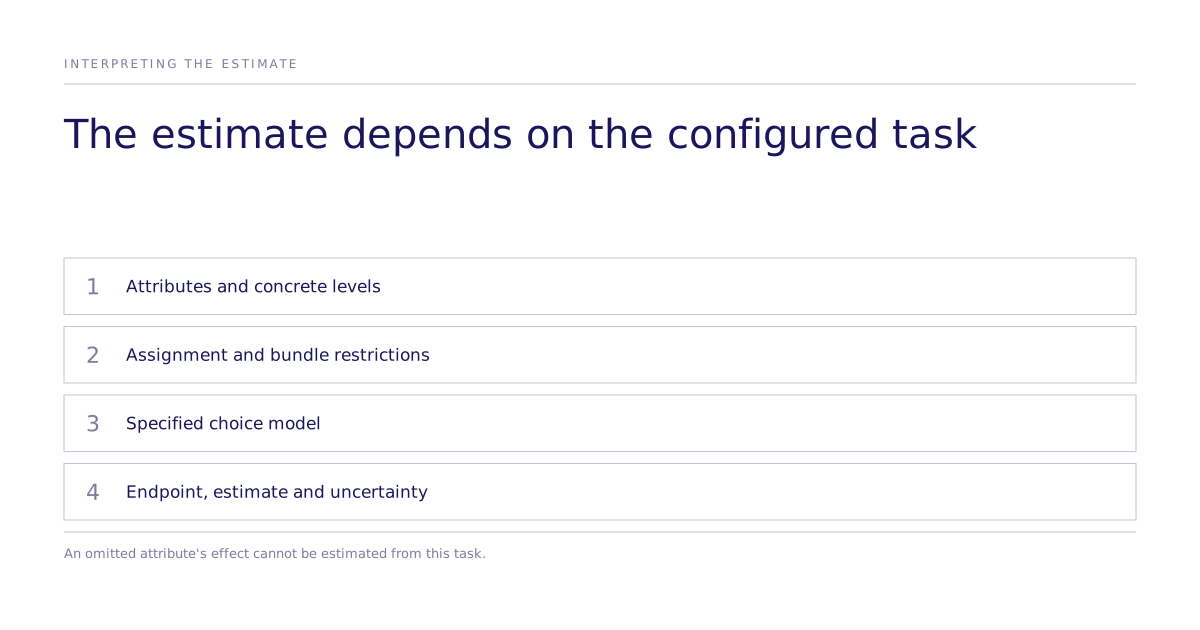
Attribute selection combines domain evidence, feasible offers, and pretesting. The study cannot estimate an omitted attribute's effect, but omission need not invalidate every specified contrast. Interpretation depends on the task, model, and context held fixed.
Next step
After pretesting, check the design, estimator, response source, and uncertainty calculation. Plan aligned human evidence when using generated choices for a material decision. Read the study process, review aggregate validation evidence, or discuss the proposed study.