MaxDiff vs. Conjoint vs. NPS: Which Instrument Matches the Decision
An insights lead scoping a study has three common instruments to choose from, each answering a different question. Picking the wrong one does not just weaken the results: it fields a study that cannot answer the business question, after the programming and recruiting budget is already spent.
What each instrument actually measures
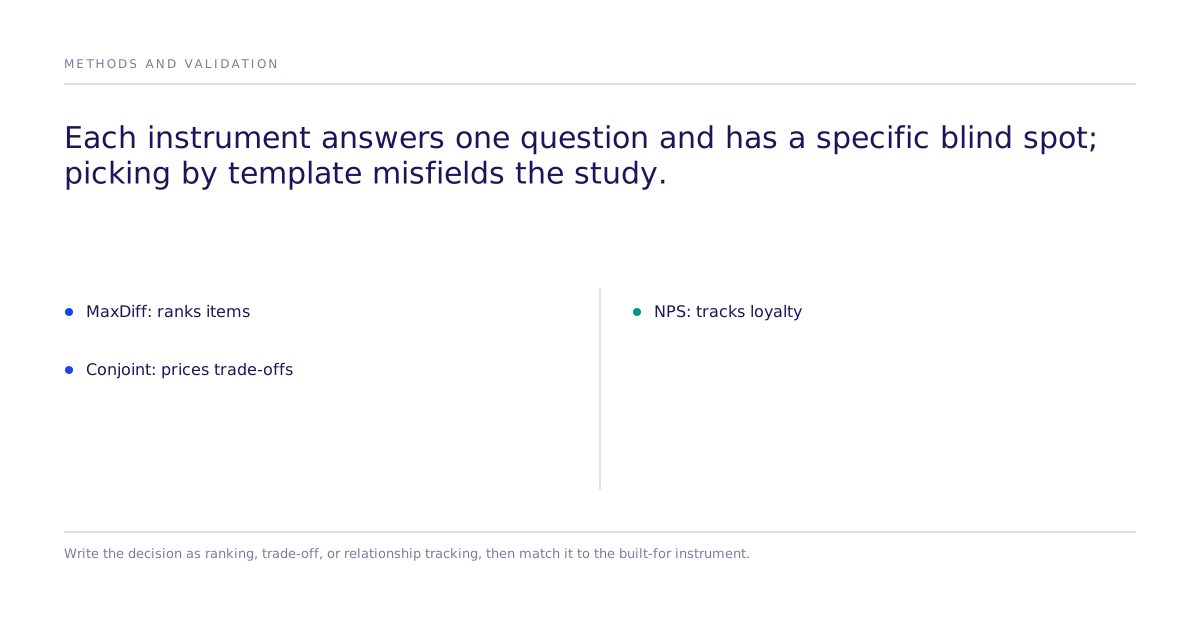
- MaxDiff (best-worst scaling) asks respondents to pick the best and worst item from small, rotating subsets of a list, producing a forced ranking of items (features, claims, messages) on a shared scale without the halo effect of plain rating scales.
- Conjoint analysis (including discrete choice) shows respondents full product or offer profiles built from varying attributes and prices, then asks them to choose between profiles. It estimates each attribute level's utility, letting a team simulate trade-offs such as how much a price increase needs to be offset by an added feature.
- Net Promoter Score (NPS) asks a single relationship question, likelihood to recommend, tracked over time, diagnosing loyalty and satisfaction trends rather than feature or price trade-offs.
quantilope's comparison frames the MaxDiff-versus-conjoint choice around whether the goal is prioritizing items or estimating trade-offs among interacting attributes; aytm's guide makes the same distinction from a survey-design angle. Neither method substitutes for NPS.
A decision table, not a preference
| Question you're actually asking | Instrument | What it will not tell you |
|---|---|---|
| "Which of these features matters most?" | MaxDiff | Price sensitivity or combined attribute trade-offs |
| "How much would customers pay for feature X, and does it beat a price cut?" | Conjoint / discrete choice | A stable ranking of unrelated items outside the tested attribute set |
| "Is customer loyalty improving or declining, and where?" | NPS | Which specific product or message change would move the number |
Treat this table as a first filter, not a substitute for the two guides above, which go deeper into sample-size and attribute-count tradeoffs than a summary table can.
Where Does the Cost of Choosing the Wrong Instrument Show Up?
The failure mode is rarely a survey bug. It's fielding the wrong instrument: a full discrete-choice conjoint when a simple MaxDiff ranking would answer the question, or an NPS trend stretched to justify a feature trade-off it was never designed to measure. Both mistakes surface only after the study is in field, when there's no cheap way back.
Where Does a Pre-Fieldwork Check Fit In?
Before committing budget to any of the three, a team can run controlled comparisons of the actions (features, messages, prices) on a simulated population to see directionally which alternative moves the outcome. Subconscious runs this kind of experiment and can validate the result with real participants, so a team moves from a simulated first pass to fielded confirmation without changing the underlying causal question.
This is a scoping step, not a replacement for the instruments above. Subconscious does not package MaxDiff scoring, formal conjoint utility estimation, or longitudinal NPS tracking as ready-made outputs. A team that needs a defensible utility estimate, a representative statistical ranking, or a tracked loyalty metric still needs the dedicated method and real respondents.
Choosing between the three, in practice
- Write down the decision in one sentence: ranking, trade-off, or relationship tracking.
- Match the sentence to the instrument above. Resist the urge to pick the method the team already has a template for.
- If the decision and stimulus are still fuzzy, sharpen the target group and stimulus definition before writing a single survey question, not add a fourth method to the study.
- Where the stimulus set or action space is still broad and the fieldwork cost is high, run a directional simulated comparison to narrow the candidates, then field the already-chosen instrument on the comparison's shortlist.
Next step
See how a causal experiment frames a trade-off question before fieldwork, or how prior studies used real-human validation to confirm a simulated result. For hands-on scoping, book time to walk through a specific instrument decision, or read how the method works.