Pricing Research Methods: Choosing the Right Method Before You Field
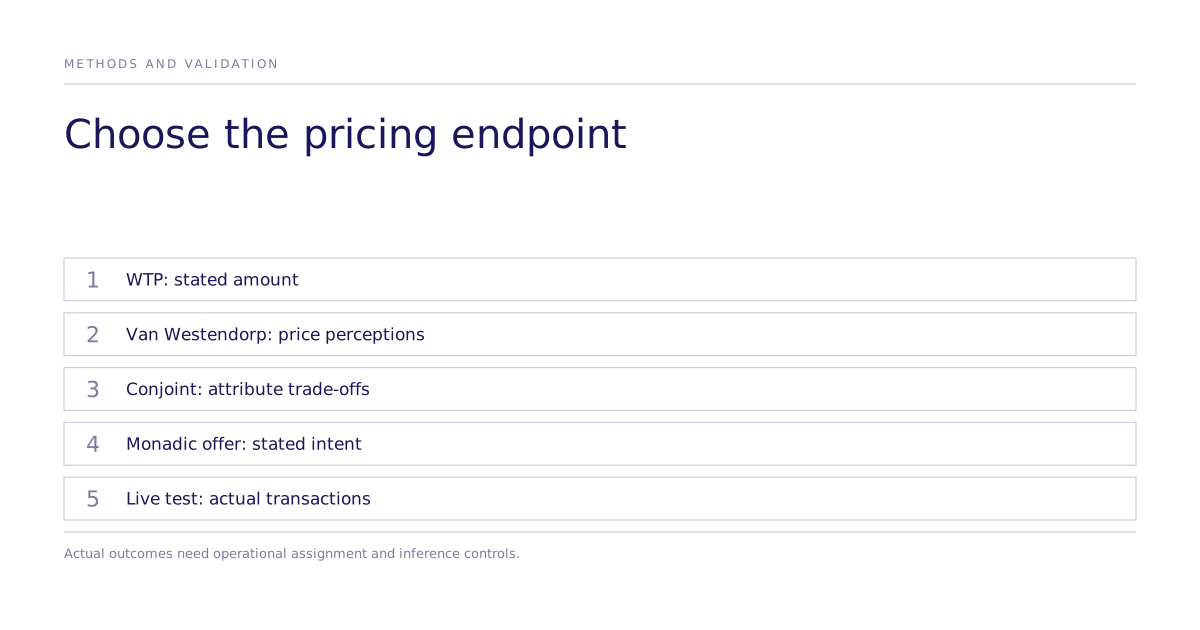
A pricing or product leader facing a launch, a tier change, or a repricing decision must choose a research method before fielding: willingness-to-pay, price sensitivity, conjoint or trade-off, or direct offer testing. Picking the wrong one produces a confident-looking number that does not measure the behavior the decision actually depends on. That is a wasted research spend and a mispriced launch, dressed up as evidence.
Pricing methods answer different questions
Each method answers a narrower question than "what should we charge."
Willingness-to-pay asks how much a buyer would pay for a defined offer, usually through open-ended or scaled questions. It is fast to field but vulnerable to hypothetical bias: buyers tend to overstate what they would actually pay when no real transaction is at stake.
Price sensitivity, most commonly run as a Van Westendorp Price Sensitivity Meter, asks buyers to name the price points at which a product feels too cheap, a bargain, expensive, and too expensive. The method produces a range rather than a point estimate, and it depends on buyers being able to reason clearly about a single price in isolation (Sawtooth Software, Van Westendorp Pricing Model).
Penn State’s teaching page reproduces Mike Pritchard’s 5 Circles Research explanation. It distinguishes acceptable-price perceptions from purchase likelihood and treats pricing research as one input to a decision.
The Penn State course page, prepared by Andy James, provides teaching context; the embedded explanation is credited to Pritchard.
Conjoint and trade-off methods present buyers with bundles of attributes, including price, and ask them to choose or rank alternatives. This captures how price trades off against features, tiers, or positioning, closer to how a real purchase decision gets made (Penn State University, Van Westendorp Meter course notes).
Monadic offer-intent testing shows one defined offer to each respondent and asks about purchase, upgrade, or cancellation intent. It remains a hypothetical response. Live randomized price or offer testing instead measures actual transactions or account actions. It needs operational controls, an appropriate assignment unit, sufficient traffic, and analysis of interference and customer effects. Cost and duration depend on recruitment, traffic, design complexity, and the number of comparisons; neither method is universally slowest or most expensive.
Which method belongs before fieldwork
The choice depends on what the team can already describe clearly, not which method is best in the abstract.
| Method | What it measures | When it fits | Main risk |
|---|---|---|---|
| Willingness-to-pay | A single stated price point | Early-stage concept, rough anchor needed | Hypothetical bias, no trade-off context |
| Price sensitivity (Van Westendorp) | A range of acceptable prices | One product, no bundled alternatives to compare | Assumes buyers can isolate price from features |
| Conjoint / trade-off | Price against other attributes | Tiered products, bundles, feature-price trade-offs | Requires realistic attribute design |
| Monadic offer intent | Stated response to a specific offer | Near-final offer research | Hypothetical behavior and sample quality |
| Live randomized price/offer test | Actual purchases, upgrades, or cancellations | Operationally feasible rollout test | Exposure, interference, power, and bounded test conditions |
A team that cannot yet describe its target buyer group and the specific pricing question clearly should close that gap before selecting a method.
How can you pressure-test a pricing plan before fieldwork?
Before committing budget to formal fielding, a team can run a controlled experiment that compares the pricing actions under consideration against a defined buyer segment and estimates the causal effect of each action on simulated choice within the experiment, with confidence intervals scoped to the simulated population where supported. This is a way to pressure-test which method and price points deserve real-buyer fielding, not a substitute for it.
A simulated pass can suggest which prices or trade-offs need further evidence. Use a predeclared conservative retention rule: preserve the baseline, retain uncertain or strategically important alternatives, and check sensitivity to audience assumptions and outside options. Apparent dominance in simulation can reverse in human fieldwork.
What still requires real buyers in pricing research?
A human study can test agreement for the same stated-choice endpoint. A live transaction experiment asks a further behavioral question and may require a different design. Financial or compliance claims need evidence suited to the claim; recruited respondents alone do not settle them.
The main failure mode across every pricing method, simulated or fielded, is false precision: a number that looks more certain than the underlying evidence supports. The discipline that prevents this is the same regardless of method: define the target buyer group, state the exact decision, list the assumptions the number depends on, and decide upfront which parts of the answer require real human data before anyone treats it as final.
Next step
Before fielding, write down the exact pricing decision, the buyer segment, and the alternatives under consideration. Match that description against the table above to identify the method. If the team wants to pressure-test the plan first, compare pricing actions in a controlled experiment, or read more on how Subconscious runs controlled experiments.