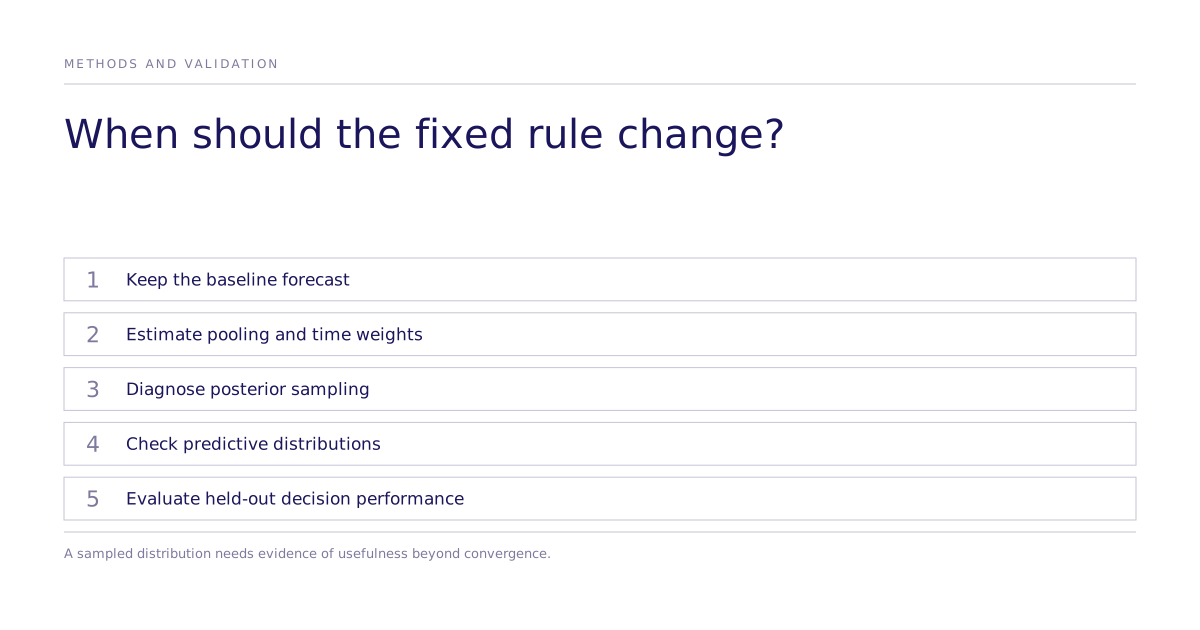
When a Fixed Forecasting Rule Should Become a Distribution
A fixed shrinkage rule can be a useful forecasting baseline. A hierarchical alternative estimates pooling parameters and represents uncertainty, but it still needs to outperform the baseline on relevant held-out decisions. A PyMC Labs baseball example illustrates that comparison for hard-hit rate.
The Baseline: MARCEL
MARCEL is a deliberately simple system for forecasting Major League Baseball player performance, developed by Tom Tango. The name is a nod to Marcel the Monkey, and the underlying idea is a bar: whatever a forecaster builds should beat this baseline of three years of historical data, with recent seasons weighted more heavily, regression toward the league mean, and an age adjustment.
MARCEL rests on three hard-coded rules:
- Fixed recency weights. Each season is weighted 5/4/3: the most recent season counts as 5, the one before as 4, the oldest as 3.
- Fixed mean regression. A constant total of league-average plate appearances is added to a player's own data, regardless of how much individual data that player has produced.
- Fixed age adjustment. A linear age curve applies a constant slope before and after an assumed peak age of 29.
None of the three is estimated from the data it forecasts.
Recasting the Same Structure as a Bayesian Model
The original model is deterministic: one point projection per player, no attached uncertainty. A Bayesian version preserves MARCEL's three-component structure while replacing each fixed constant with a parameter the data estimates directly.
Hard-hit rate counts batted balls at an exit velocity of 95 miles per hour or higher. The original MARCEL specification provides the deterministic baseline.
The three substitutions:
- A hierarchical beta-binomial estimates pooling parameters. Baseline MARCEL already shrinks players with less data more strongly: its fixed league pseudo-count implies a sample-size-dependent shrinkage fraction. The Bayesian rebuild estimates the population distribution instead of fixing that pseudo-count by hand.
- A Dirichlet distribution replaces the fixed 5/4/3 weighting scheme. The model estimates season weights directly from the evidence rather than assuming Tango's ratio is correct for this metric.
- A triangular aging function with an estimated peak age replaces the fixed age curve. Both the slope of the aging effect and the peak age itself become free parameters instead of assumed constants.
| Component | MARCEL (fixed rule) | Bayesian rebuild (estimated parameter) |
|---|---|---|
| Recency weighting | Constant 5/4/3 across seasons | Dirichlet distribution fit to the data |
| Mean regression | Fixed league pseudo-count; shrinkage fraction depends on individual data volume | Estimated hierarchical pooling parameters; individual sample size still matters |
| Age adjustment | Linear curve, fixed slope, assumed peak age of 29 | Triangular aging function; slope and peak age both estimated |
| Output | Point projection | Parameter and predictive distributions requiring computation and validation checks |
What Did the Estimated Parameters Show?
The August 2024 PyMC Labs Bayesian MARCEL case reports historical hard-hit-rate weights of roughly 6/2/1 and a peak age near 28. Those findings are specific to that metric and dataset; they are not current player projections or transferable lifecycle constants.
Why Is Convergence Not Optional?
An estimated distribution is only as trustworthy as the sampling process that produced it, but convergence alone does not confirm the model is correctly specified. Before treating any of these parameters as decision-ready, the case study checks two things:
- Energy diagnostics can reveal sampling problems. They cannot establish exhaustive exploration of every posterior mode.
- R-hat, effective sample size, divergences and independent chains help assess sampling. Agreement among chains does not prove model correctness or predictive calibration.
Sampling checks assess the computation. Prior and posterior predictive checks, held-out forecasts and a decision-relevant comparison with MARCEL assess whether the rebuilt model is useful.
Where Does This Generalize?
Repeated-measurement business forecasts can use hierarchical pooling and estimated time weights, but not every problem follows a baseball aging curve. The transferable idea is to compare an estimated probabilistic model with the existing baseline under the intended loss and data regime.
That discipline is the same modeling logic behind how Subconscious's causal behavioral platform reports uncertainty in decision-specific studies. Subconscious runs controlled experiments on simulated markets and returns causal effects with confidence intervals rather than a single deterministic estimate. This is a parallel in modeling philosophy, not a claim that Subconscious runs this baseball model or has replicated this specific analysis. If a decision relies on a simulated result, specify a matched human population, treatment, endpoint and agreement criterion, and confirm recruitment and fieldwork deliverables with the provider. See how we work.
Limitations
This rebuild is a starting point, not a finished system. A triangular aging curve is a simplification: most real aging effects are not perfectly linear before and after a peak, and older subjects in any population are typically survivors (the ones still performing well enough to keep being measured), which biases a naive aging curve unless the model accounts for that selection. The same caveat applies outside baseball: a fixed constant replaced by an estimated distribution is progress, but the distribution still needs domain-specific checks before a business treats it as ground truth. For teams evaluating this kind of shift on their own forecasting pipeline, research covers how Subconscious approaches uncertainty and validation in more depth.