Why a Favorite Still Loses Most of the Time: A Bracket Forecast Under Uncertainty
A single-elimination bracket does not ask a team to be good once. It asks a team to be good repeatedly, against opponents decided by other matches it does not control. That is why a strong favorite in the opening round can still be a clear underdog to win the whole thing, and why a single point estimate is the wrong tool for a decision that depends on a sequence of outcomes rather than one.
Christopher Fonnesbeck's June 30, 2026 PyMC Labs knockout forecast combines estimated team strengths, group-stage evidence and simulated bracket paths. The following probabilities belong to that finalized-bracket snapshot, rather than current tournament odds.
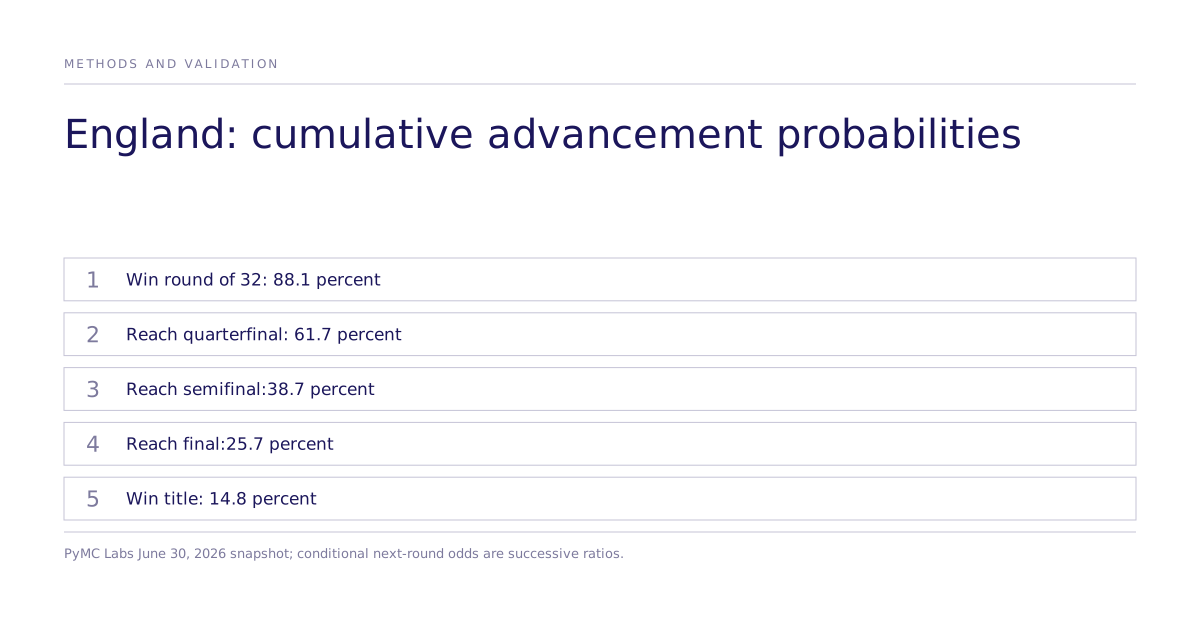
A favorite is not a forecast of the title
The Round of 32 produced some lopsided matchups: England at 88.1% against DR Congo, and Argentina at 88.0% against Cape Verde. Those are real edges in a single match. They are not title predictions.
England's cumulative probabilities in the source are 88.1 percent to survive the round of 32, 61.7 percent to reach the quarterfinal,38.7 percent the semifinal,25.7 percent the final and 14.8 percent to win the title. The conditional probability of reaching the quarterfinal after winning the first match is approximately 61.7/88.1, or 70 percent. Multiplying successive conditional probabilities produces the cumulative probability; the displayed values are not themselves conditional round odds.
The source reports Canada's pre-match win probability against South Africa as 66.1 percent and then describes Canada's win as a subsequent outcome. Its original title probability was 0.2 percent. A realized first-round win should not be confused with the probability assigned before that match.
Morocco had a 41.8 percent modeled chance against the Netherlands, making it the underdog. The source gives cumulative quarterfinal, semifinal, final and title probabilities of 30.4, 15.0, 7.1 and 3.0 percent. Its path depends on subsequent opponents as well as the opening matchup.
Where the uncertainty comes from
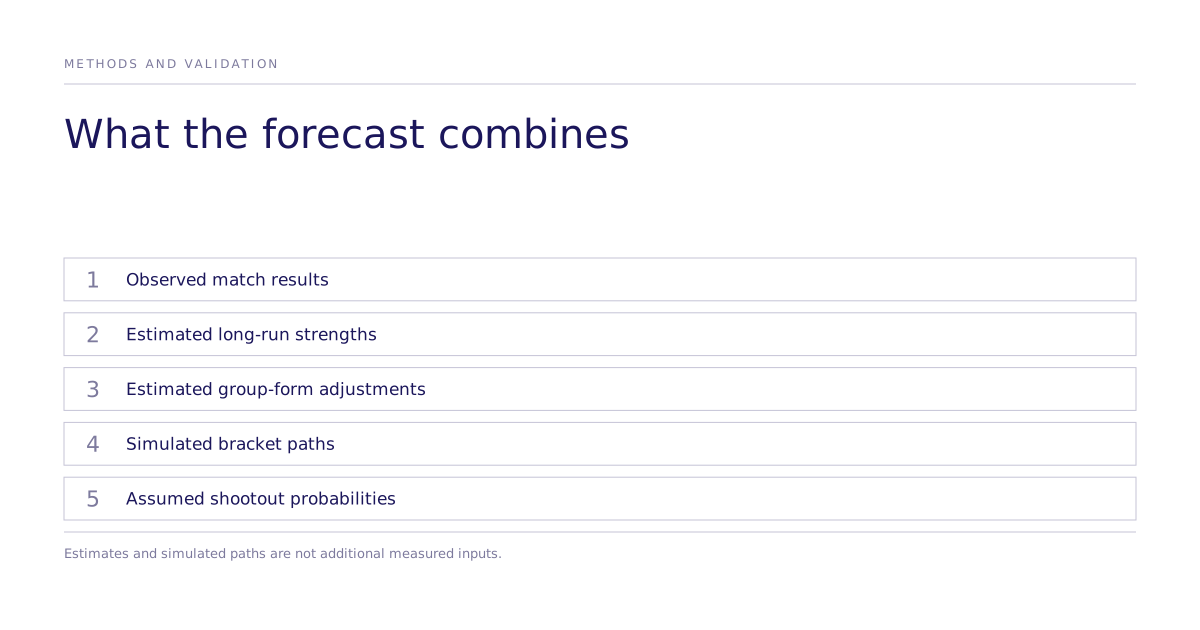
The forecast is not just a ranking of teams. It carries uncertainty forward from three distinct places:
- Long-run team strength. A slow-moving estimate built from years of international results, not a single tournament.
- Group-stage form. A state-space adjustment layered on top of that long-run baseline, drawn from each team's actual group matches and modeled with a Kalman filter through the
pymc-extrasstatespace module. This adjustment is deliberately small and centered across the field, so a hot three-match stretch does not get mistaken for a new baseline. - Bracket path. Every simulated match produces a scoreline, which can go to extra time and then a penalty shootout. The winner of that draw becomes someone else's next opponent, and the simulation runs forward through the whole tree rather than treating each round as independent.
Penalty shootouts are treated as a coin flip in this model, because the underlying data has no per-player shootout history. That is a real limitation, not a hidden precision claim: it is honest about what the model does not know, rather than inventing a penalty-taking skill rating it cannot support.
The decision this maps to
Business forecasts also need to carry uncertainty through sequences of dependent outcomes. That reasoning does not turn a bracket simulation into a causal business experiment: intervention effects require their own identification assumptions and evidence.
That is the same discipline Subconscious applies to a business decision: run a controlled causal experiment on a simulated population, and report the causal effect with a confidence interval, scoped to that simulated population, rather than a single favorite number. For a consequential modeled choice result, define the matched human audience, treatment, endpoint and agreement criterion, and confirm recruitment and delivery ownership in the brief. The study workflow provides context. The bracket forecast illustrates predictive uncertainty; a causal business study needs its own identification and transport evidence.
What to demand before a decision
Before committing budget to a launch, a pricing change, or a messaging test, the same three questions this bracket forecast answers are worth asking of any model producing a recommendation:
- What is the full path of probabilities, not just the first-round number?
- Where does the uncertainty come from, and is it being carried forward honestly?
- What does the model admit it does not know, rather than papering over with a false precision?
The public research record reports aggregate choice-parameter-rank replication evidence. It does not publish customer effects or round-by-round business forecasts; request the protocol and outcome checks relevant to the decision.