How Research Teams Check AI-Assisted Findings
A research leader using AI to draft a survey or summarize responses still has to decide what the business question needs as evidence. Generated themes, expert quality review, a representative survey estimate and an observed intervention effect support different claims. The workflow should make those differences clear before the result reaches a decision maker.
Why is the pressure showing up now?
The BLS occupational outlook projects 7 percent employment growth for market research analysts from 2025 to 2035. That occupational forecast does not establish how any specific AI tool affects research jobs or study quality.
When tools make drafting and summaries easier to access, research expertise remains necessary for defining outcomes, checking coverage and selecting evidence. Evaluate the actual workflow and cost, rather than assuming that synthetic fielding is equivalent to collecting human responses.
What actually changes for researchers?
Research expertise used to rest partly on access - the know-how to source data, run the study, tidy up responses, read a chart correctly, and package a finding. AI is eroding that edge. More people can draft a survey, summarize a transcript, generate a persona, or ask an AI panel for a first reaction.
None of that makes expertise beside the point - it puts expertise under a spotlight. When anyone can generate an answer, the person worth paying for is the one who can tell which answer holds up, and who notices when a story is generic, thinly sourced, or beside the point for the decision the business faces.
Build an evidence system, not an AI habit
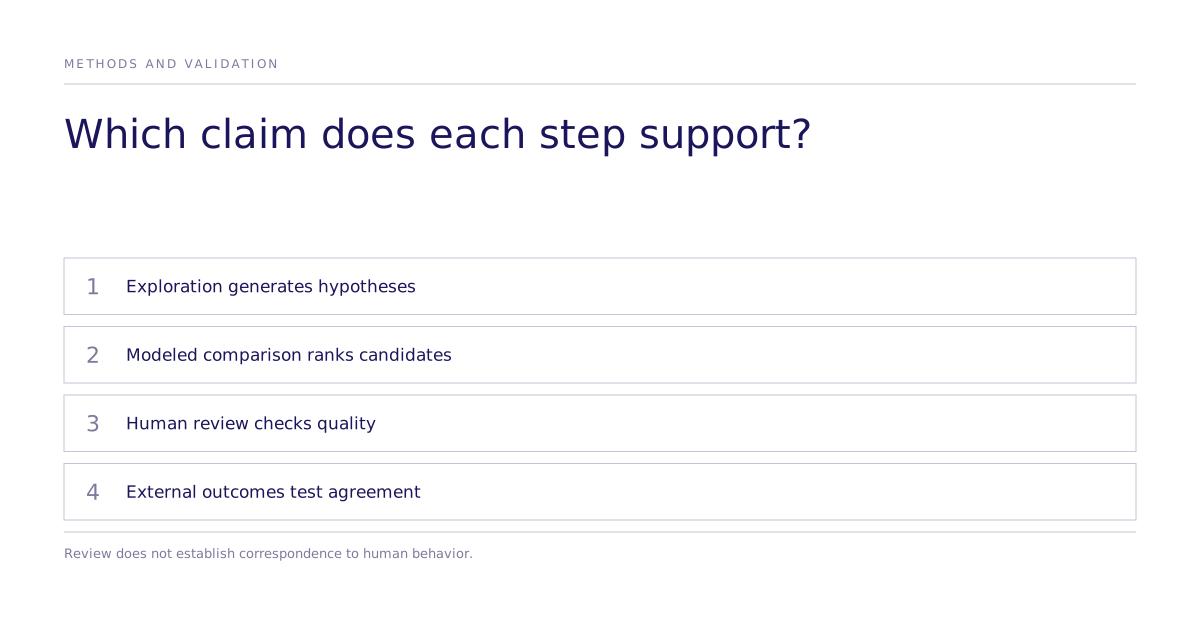
A research team can assign a distinct purpose to each step:
- Exploration. Turn to AI for hypotheses, objections, alternate routes, and other possible explanations.
- Modeled comparison. Compare candidate hypotheses or stimuli under a documented response protocol; inspect relevance and sensitivity.
- Human review. A person looks over the work: is the audience defined correctly, was the prompt free of leading bias, does the sourcing hold up, and does it fit the business context.
- Outcome validation. Compare the prediction with independent human or behavioral data for the claim and audience. Expert review assesses plausibility and quality; it is not a substitute for outcome data.
The value comes from knowing which conclusion each source of evidence supports and what uncertainty remains.
A Subconscious choice study can compare specified concepts, messages or prices under a documented experimental protocol. Its result needs an audience, alternatives, endpoint and uncertainty procedure. For a decision that requires agreement with human responses or behavior, scope an independent comparison and document any changes to stimuli, incentives or measurement. Confirm participant recruitment, fieldwork and reporting responsibility before treating that comparison as an available deliverable. The research record describes aggregate choice-parameter evidence; it does not validate every new study.
A practical workflow for using AI panels
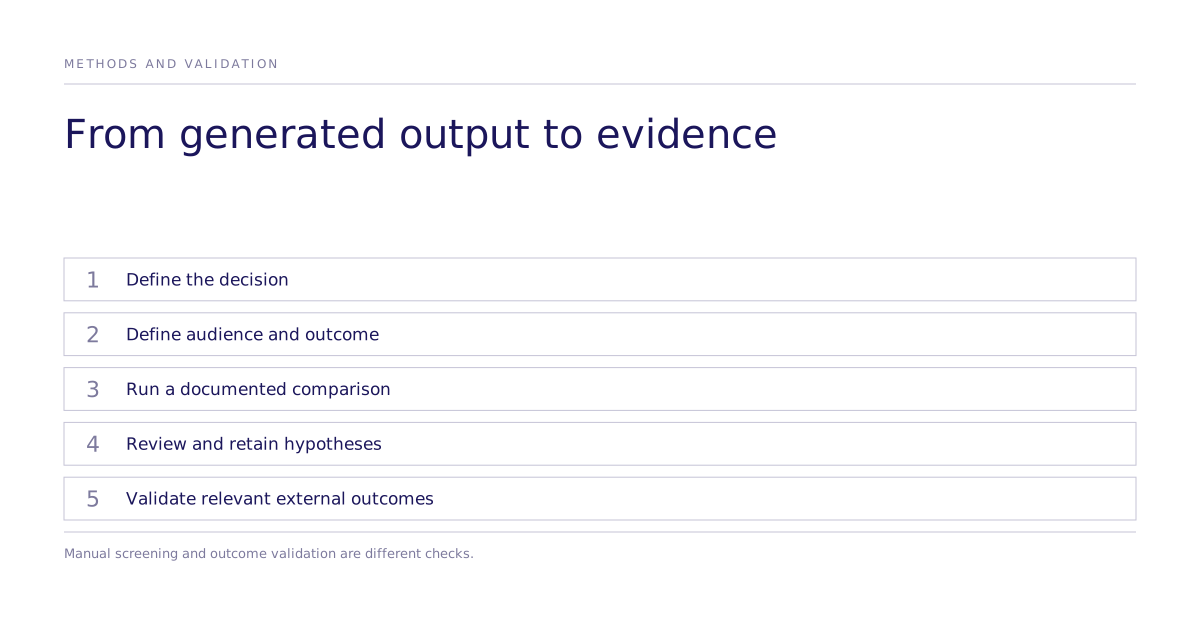
Begin from the decision itself: note what would change depending on which way the research points. From there, define the audience - segment, context, current behavior, alternatives, and the outcome that person is chasing. A panel is only ever as good as the brief it's built on.
Aim the panel at exactly one thing under test - it might be a creative concept, a piece of messaging, a pricing narrative, a campaign direction, a feature concept, a moment in the customer journey, or a strategic bet the team is making. Surface confusion, pushback, side-by-side comparisons, gut reactions, and clues about what would build more trust in the idea. Never treat the first response as final: follow up, weigh different segments against each other, and watch for places where answers don't agree.
Review the responses for generic themes, unsupported specifics and inconsistent segments. Keep promising items as screened hypotheses. Establish human or behavioral agreement with a separate comparator before calling those hypotheses validated findings.
Label the output honestly at the end. Tags such as "directional read, panel-sourced," "AI-assisted hypothesis, not yet confirmed," and "needs validation before any external use" strengthen the method's credibility instead of undercutting it.
Is more volume the same as validity?
Piling up more responses feels like a better decision, even when it isn't - the trap. The confusion tends to show up under pressure: deadlines push the team toward speed, the tool hands back something that sounds fluent, and the deck still needs a tidy conclusion. What separates credible research is a clear line between an output and actual evidence. AI can produce something useful, but whether that output fits the decision at hand isn't something it can judge by itself.
Document the data sources, method, limitations and use of AI or synthetic personas. Articles 7 and 9 of the 2025 ICC/ESOMAR Code address client information and publishing findings, including disclosure of significant AI involvement and human oversight.
What to do this week
Skip the full job rewrite. Instead, pick one visible workflow to start with:
- Pick a real project with a live decision.
- Write the business decision in one sentence.
- Define the audience and the risk level.
- Use AI or an AI panel only for the exploratory stage.
- Go through the output by hand, flagging each piece as useful, weak, or unsafe.
- Deliver the answer alongside an explicit caveat and a suggested next step for validation.
Before drafting a single question for an upcoming survey, put in writing the three decisions that survey has to support. Keep doing that weekly across a full month. By the end, the result is a working research system, not a longer list of AI tools. For a consequential decision, request a case study with its actual audience, protocol, comparator and outcome, then assess which parts apply to the proposed study.
Choosing the next evidence check
Pick a current project and write down the conclusion the team intends to use. Identify which claims are supported by human responses or behavior and which remain modeled hypotheses. Then choose the smallest relevant external check before committing the decision. Discuss a study design.