AI Can Summarize Consumers. It Still Needs Human Judgment.
AI can summarize consumers fast, but it still needs a human to review sources and judgment for high-stakes launch, pricing, or messaging decisions. A Head of Consumer Insights gets a stakeholder request: let an AI-generated consumer summary stand in as decision-grade evidence for a launch, pricing, or messaging call. The question underneath it does not change: is this directional exploration, or is it proof strong enough to commit a budget against?
Get that call wrong and a team ships a launch, pricing, or positioning decision off a narrative that never held up with real customers: after the budget is spent and the research function's credibility with stakeholders is already burned.
Why the pressure is showing up now
AI supports analysis, reporting, and research preparation, but these tasks still require judgment about measurement and interpretation. The Bureau of Labor Statistics projects employment growth for market research analysts and marketing specialists over 2025–2035; that projection does not measure which research tasks AI can perform reliably.
So the danger isn't "AI replaces researchers." It is a team accepting a confident-sounding AI or synthetic-panel narrative as fact before checking whether it is grounded in evidence.
The decision that actually needs a system
The old bargain in consumer research put expertise partly in access: knowing how to field a study, clean the responses, interpret the chart. AI weakens that advantage, but not the harder judgment call: which answer deserves trust, and what the decision in front of you requires.
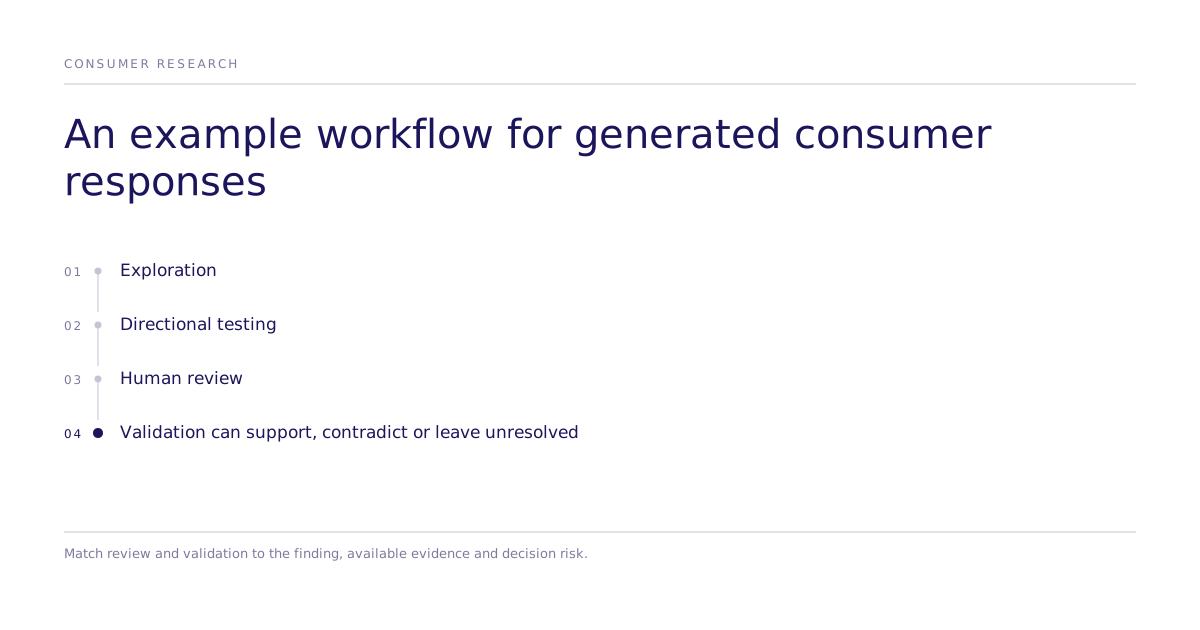
That call needs a structure, not a habit of reaching for whichever tool is fastest. A workable version has four layers:
- Exploration: use AI to generate hypotheses, objections, and alternative explanations.
- Directional testing: use a synthetic panel or AI-assisted read to compare options quickly.
- Human review: check the audience definition, prompt neutrality, source grounding, and business context; look for contradictions across segments.
- Validation: check relevant findings against suitable human responses, observed behavior, expert evidence, or a fielded study; contradiction and inconclusive results remain evidence.
The output of step 2 is not the answer. It is an input to steps 3 and 4.
Where does a structured evidence path hold up?
Subconscious distinguishes simulated comparisons from human validation. Keep the decision question fixed, and specify the estimator and uncertainty method for each study. A modeled interval cannot account for all error in transferring the result to real buyers.
Check audience coverage and calibration for the actual question. A modeled audience is not a recruited panel and does not substitute for human review or relevant validation.
Calling out which layer a tool sits in is what a buyer needs before relying on it. This is the evidence layer, not the judgment layer. A human still has to define the decision, write the audience brief, spot contradictions, and decide what needs real-human validation before a claim goes external, regardless of which tool produced the directional read.
What does honest labeling look like?
The step that keeps a directional read from becoming a false decision-grade claim is naming it accurately before it leaves the research team: label a synthetic read as "directional synthetic panel read" or "AI-assisted hypothesis, still needs confirmation before it goes external." Stakeholders can then see exactly how much weight the finding can carry.
The failure mode: a polished narrative ships before anyone confirms it rests on real evidence, usually because a deliverable is due and a fluent AI answer arrived before the source got checked. The fix: spell out the boundary in the deliverable itself, what the AI-assisted work covered, where it stopped, and what still needs validation.
A first workflow to run this week
- Pick a real project with a live decision attached to it.
- Write the business decision in one sentence.
- Define the audience and the risk level of getting it wrong.
- Match AI use to validated task scope. Exploratory work needs clear limitations; consequential decisions need independent evidence and a human review of what remains uncertain.
- Go through the output by hand and flag what holds up, what's shaky, and what's unsafe to use.
- Present the answer with a clear caveat and a named next validation step.
Repeat that loop across a handful of real decisions and the output is not a list of AI tools. It is a working evidence system that shows speed, judgment, and quality control together.
The limit that does not go away
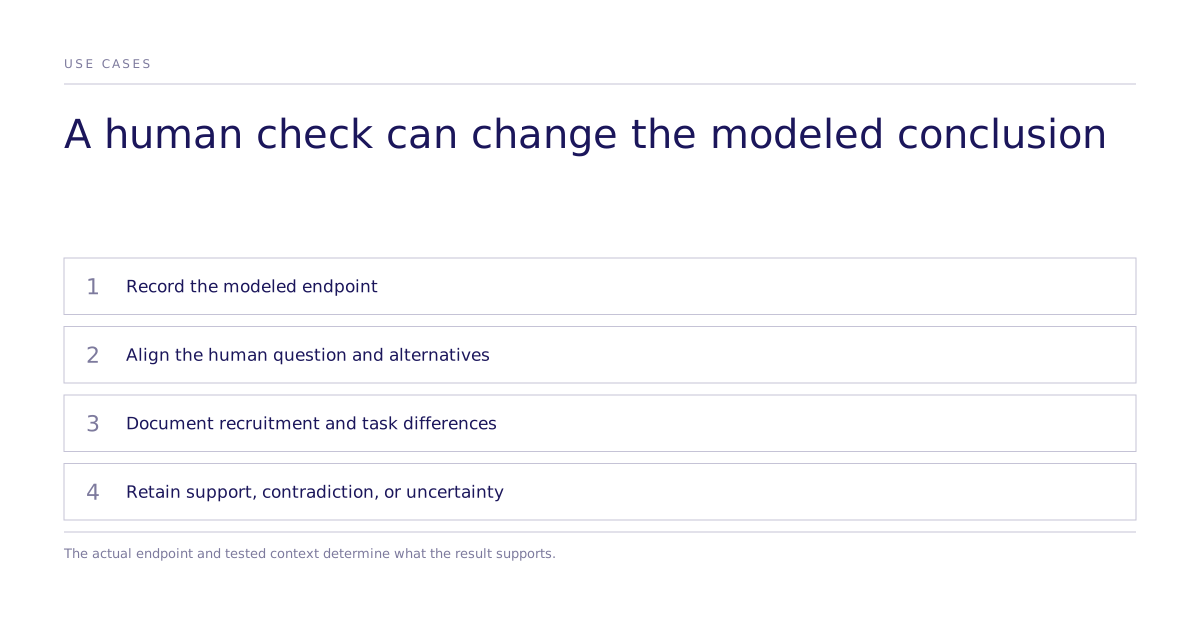
A human check can support, contradict, or leave a directional finding unresolved. It does not turn a choice comparison into observed usability or proof of market performance. Record the endpoint and context actually tested before reusing the result.
Saying plainly what AI does not do is what keeps the claim honest for the person deciding whether to trust it. AI changes what a first-pass consumer synthesis looks like. It does not remove the need for a human to decide what is true, useful, and too risky to act on. That decision, and the evidence path behind it, is what makes a consumer insight safe to put in front of a stakeholder.
Review the research approach and published case studies, then scope the decision and any separately arranged human evidence.