How to Assess a Fish-Preference Replication
A simulated fish-choice study earns trust through a matched comparison with human evidence, not a benchmark borrowed from another experiment. Start with the original choice task, recover comparable estimates and inspect where the simulation agrees or misses. A food-brand insights leader needs those details before using a ranking to choose a product, price or research budget.
What does the human reference establish?
The human reference is Claret and colleagues' 2012 exploratory conjoint study. It investigates four factors in sea-fish preferences: country of origin, obtaining method, storage conditions and purchasing price. That combination matters for a fish-category team because a preference for origin may depend on how a product is obtained, stored and priced.
Recover the original attribute levels and sample definition before building simulated alternatives. A fresh-versus-frozen comparison with different origins and prices would answer a different question from the published task. The human study provides a reference for its own context; it does not validate a later simulated run or establish demand in a new market.
A study-specific replication score requires a dated run record that makes the simulated and human estimates comparable. This page reports no fish-specific replication score because no dated public run record exists. The aggregate working paper does not supply one.
Which mismatches would change a fish-category decision?
| Check | Evidence to inspect | Why it changes the decision |
|---|---|---|
| Origin | Identical country labels and reference category | Changing the available origins can change the comparison |
| Obtaining method | Original wording and product context | Familiarity with a production method may differ between populations |
| Storage | Matched conditions and presentation | A storage preference cannot be separated from altered descriptions |
| Price | Same currency, levels and parameter scale | A rank match does not establish willingness to pay at a new price |
| Sample and analysis | Human population, simulated coverage, exclusions and matched estimates | A useful historical comparison can still miss the intended customers |
Keep the run date, model configuration, repeated runs and possible exposure to the published paper in the comparison record. Report ties, missing estimates and scoring choices. A p-value on a small set of parameters does not establish that the simulated population represents new customers.
What does the public aggregate benchmark show?
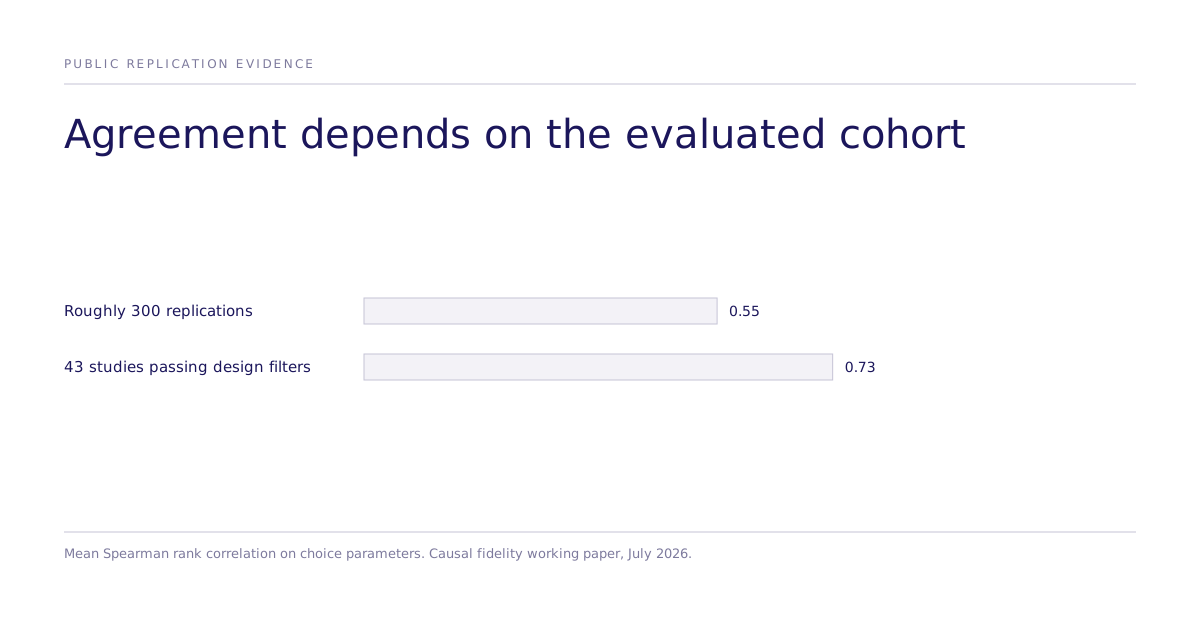
Subconscious's July 2026 causal-fidelity working paper, not peer reviewed, reports mean Spearman rank correlation on estimated choice parameters of 0.55 across roughly 300 replications and 0.73 across the 43 studies passing design filters. Those are aggregate results for a different reporting scope. They do not supply a missing fish-study score, an accuracy percentage or evidence of realized purchasing lift.
How should a food-brand team use the comparison?
Consider a retailer deciding whether to test a new origin-and-storage combination. The historical study can help frame the attributes to investigate. A new simulation can explore candidate combinations, but the retailer still needs evidence for the relevant customers, prices and distribution context before treating a ranking as a launch recommendation.
The next study should define the commercial alternatives and the cost of a wrong choice. Inspect effect directions and uncertainty as well as ranks, then choose a human choice study or market test that measures the outcome at stake. Missing run provenance or a weak comparison is a reason to collect more evidence, not a reason to report a score the record does not support.
Review the public methodology for the aggregate measurement task. Book a decision review to scope the alternatives, target population and validation needed for a fish-category decision.